Practice Perfusion NCLEX Questions and Answers 100% pass
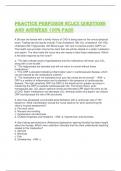
Practice Perfusion NCLEX Questions and Answers 100% pass A 58-year-old female with a family history of CAD is being seen for her annual physical exam. Fasting lab test results include: Total cholesterol 198; LDL cholesterol 120; HDL cholesterol 58; Triglycerides 148; Blood sugar 102; and C-reactive protein (CRP) 4.2. The health care provider informs the client that she will be started on a statin medication and aspirin. The client asks the nurse why she needs to take these medications. Which is the best response by the nurse? a. "The labs indicate severe hyperlipidemia and the medications will lower your LDL, along with a low-fat diet." b. "The triglycerides are elevated and will not return to normal without these medications." c. "The CRP is elevated indicating inflammation seen in cardiovascular disease, which can be lowered by the medications ordered." d. "The medications are not indicated since your lab values are all normal." - ANS -c. CRP is a marker of inflammation and is elevated in the presence of cardiovascular disease. The high sensitivity CRP (hs-CRP) is the blood test for greater accuracy in measuring the CRP to evaluate cardiovascular risk. The family history, post-menopausal age, LDL above optimum levels and elevated CRP place the client at risk of CAD. Statin medications can decrease LDL, whereas statins and aspirin can reduce CRP and decrease the risk of MI and stroke. A client has developed uncontrolled atrial fibrillation with a ventricular rate of 150 beats/min. What manifestation should the nurse observe for when performing the client's focused assessment? a. Flat neck veins b. Nausea and vomiting c. Hypotension and dizziness d. Clubbed fingertips and headache - ANS -d. Hypotension and dizziness A client taking spironolactone (Aldactone) [potassium-sparing diuretic] has been taught about the therapy. Which menu selection indicates that the client understands teaching related to this medication? a. Apricots b. Bananas c. Fish d. Strawberries - ANS -c. Spironolactone is a potassium-sparing diuretic that could potentially cause hyperkalemia. Fish is an appropriate dietary choice, because it is low in potassium. The other foods are high in potassium. A client with a diagnosis of cardiac dysrhythmias and a history of type I diabetes mellitus is placed on propranolol therapy. The client asks the nurse if the drug will affect insulin needs. The best response by the nurse would be that: a. The drug will have no effect on insulin needs. b. The drug might cause hypoglycemia. c. The drug could cause hyperglycemia. d. The client should ask the physician this question. - ANS -b. The drug might cause hypoglycemia. There is increased incidence of hypoglycemia with type I diabetes mellitus, because propranolol can inhibit glycogenolysis. A client with a first-degree heart block has an electrocardiogram (ECG) taken during an episode of chest pain. The nurse knows that which ECG finding would be an indication of first-degree heart block? a. Presence of Q waves b. Tall, peaked T waves c. Prolonged PR interval d. Widened QRS complex - ANS -c. Prolonged PR interval A client's blood pressure (BP) is 145/90. According to the guidelines for determining hypertension, the nurse realizes that the client's BP is at which stage? a. Normal b. Prehypertension c. Stage 1 hypertension d. Stage 2 hypertension - ANS -c A client's serum lipids are cholesterol 197 mg/dl, low-density lipoprotein (LDL) 110 mg/dl, and high-density lipoprotein (HDL) 35 mg/dl. The nurse knows what about these values? a. Serum lipids are within desirable values. b. Cholesterol is within desirable value, but LDL and HDL are not. c. Cholesterol is not within desirable value, though LDL and HDL are. d. Cholesterol, LDL, and HDL are not within desirable values. - ANS -b A nurse is caring for a client who is taking an angiotensin-converting enzyme inhibitor and develops a dry, nonproductive cough. What is the nurse's priority action? a. Call the health care provider to switch the medication. b. Assess the client for other symptoms of upper respiratory infection. c. Instruct the client to take antitussive medication until the symptoms subside. d. Tell the client that the cough will subside in a few days. - ANS -a. Angiotensin-converting enzyme inhibitors prevent the breakdown of bradykinin, frequently causing a nonproductive cough. Angiotensin receptor blocking agents do not block this breakdown, thus minimizing this annoying side effect. The client should be switched to a different medication if the side effect cannot be tolerated. A nurse is watching the cardiac monitor and notices that the rhythm suddenly changes. There are no P waves, the QRS complexes are wide, and the ventricular rate is regular but over 100. The nurse determines that the client is experiencing: a. premature ventricular contractions b. ventricular tachycardia c. ventricular fibrillation d. sinus tachycardia - ANS -b. ventricular tachycardia is characterized by the absence of P waves, wide QRS complexes (greater than 0.14) and a rate between 100 and 250 impulses per minute. The rhythm is usually regular. A nurse who is auscultating a 56-year-old client's apical heart rate before administering digoxin (Lanoxin) notes that the heart rate is 52 beats/min. The nurse should make which interpretation about this information? a. Normal, because of the client's age b. Abnormal, requiring further assessment c. Normal, as a result of the effects of digoxin d. Normal, because this is the reason the client is receiving digoxin - ANS -b. Abnormal, requiring further assessment A nurse who is giving a statin(Lipitor) realizes the importance of monitoring for which serious adverse reaction? a. Pharyngitis b. Rash/pruritus c. Rhabdomyolysis d. Agranulocytosis - ANS -c An older, sedentary adult may not respond to emotional or physical stress as well as a younger individual because of: a. Left ventricular atrophy b. Irregular heartbeats c. Peripheral vascular occlusion d. Pacemaker placement - ANS -a. In older adults who are less active and do not exercise the heart muscle, atrophy can result. Disuse or deconditioning can lead to abnormal changes in the myocardium of the older adult. As a result, under sudden emotional or physical stress, the left ventricle is less able to respond to the increased demands on the myocardial muscle. Decreased cardiac output, cardiac hypertrophy, and heart failure are examples of the chronic conditions that may develop in response to inactivity, rather than in response to the aging process. Irregular heartbeats are generally not associated with an older sedentary adult's lifestyle. Peripheral vascular occlusion or pacemaker placement should not affect response to stress. Captopril (Capoten) has been ordered for a client. The nurse teaches the client that ACE inhibitors have which common side effects? a. Nausea and vomiting b. Dizziness and headaches c. Upset stomach d. Constant, irritating cough - ANS -d For which of the following dysrhythmias is defibrillation primarily indicated? a. Ventricular fibrillation b. Third-degree AV block c. Uncontrolled atrial fibrillation d. Ventricular tachycardia with a pulse - ANS -a. Ventricular fibrillation Rationale: Defibrillation is always indicated in the treatment of ventricular fibrillation. Drug treatments are normally used in the treatment of uncontrolled atrial fibrillation and for ventricular tachycardia with a pulse (if the patient is stable). Otherwise, synchronized cardioversion is used (as long as the patient has a pulse). Pacemakers are the treatment of choice for third-degree heart block. Prior to discharge from the Emergency Department, the nurse prints a rhythm strip on a patient and notices that the P wave cannot be detected and the QRS complex is 0.24 seconds. This is a change in the patient's condition. What is the best action for the nurse to take? a. Measure the PR interval. b. Prepare the patient for discharge. c. Notify the physician of this abnormal strip. d. Continue to monitor for abnormalities. - ANS -c. Notify the physician of this abnormal strip. Rationale: c. is correct because notifying the physician of the abnormal rhythm would be the most appropriate response. The patient has experienced a rhythm change and requires further treatment.
Written for
- Institution
- Practice Perfusion NCLEX
- Course
- Practice Perfusion NCLEX
Document information
- Uploaded on
- July 11, 2024
- Number of pages
- 8
- Written in
- 2023/2024
- Type
- Exam (elaborations)
- Contains
- Questions & answers
Subjects
-
practice perfusion nclex questions and answers 100

Also available in package deal