
Supply Chain Networks Summary
Value chain = every firm is a collection of activities that are performed to design, produce,
market, deliver, and support its product. All these activities can be represented using a value
chain.
Supply chain = the network or organizations that are involved, through upstream and
downstream linkages, in the different processes and activities that produce value in the form
of product and services in the hands of the ultimate consumer.
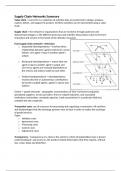
Food supply chain networks - Netchains
o Sequential interdependence = involves direct
relationships between agents ordered in a serial
fashion: one agent’s input is another agent’s
output.
o Reciprocal interdependence = means that one
agent’s input is another agent’s output and
vice-versa; agents are mutually dependent on
the choices and actions made by each other.
o Pooled interdependence = interdependence
involves discrete or autonomous contributions
by loosely coupled agents; agents in sparse and
indirect.
Cluster = spatial networks – geographic concentrations of inter-connected companies,
specialized suppliers, service providers, firms in related industries, and associated
institutions (universities, standards agencies, trade associations) in a particular field that
compete but also cooperate.
Transaction costs: use of resources for processing and organizing a transaction. All sacrifices
and disadvantages that the exchange partners have to bear in order to realize the exchange
of goods/services.
Types:
o Initiation costs
o Agreement costs
o Processing costs
o Control costs
o Adjustment costs
Transparency- ‘transparency of a chain is the extent to which all stakeholders have a shared
understanding of, and access to, the product related information that they request, without
loss, noise, delay and distortion’.
,Stakeholder= a netchain actor, of an institutional actor with some stake in the netchain, or a
customer.
o A stakeholder in an organization is any group or individual who can affect or is
affected by achievement of the organization’s objectives.
Loss= an actor does not transmit information. It affects completeness.
Noise= an actor adds non-relevant data to the information. It affects relevancy. This is a
subjective notion. Noise can point to lack of agreement among actors as to what information
is relevant.
Delay= an actor delays information. It affects timeliness.
Distortion= an actor changes the information either by accident or on purpose, or fails to
update the product changes, so that the information no longer actually describes the
product. It affects validity.
Types of transparency
1. History transparency = knowing what has happened in the netchain.
2. Operations transparency = knowing what will happen across the netchain. Across the
netchain -> keeping netchain actors informed on one’s logistics and other operational
parameters.
, 3. Strategy transparency = deciding what may happen in the netchain. Involves creative
investigation of the netchain’s context to find opportunities and threats and to
design adaptive responses. Joint innovation is a case in point. Strategic R&D alliances
are vehicles for strategy transparency.
Stakeholder-management steps:
1. Identifying relevant stakeholders and their interests.
a. Primary stakeholder = are directly engaged in economic transactions
b. Secondary stakeholder = not directly engaged in economic transactions but
affect/ are affected by the firm.
2. Evaluating stakeholders and their importance.
a. Stakeholder typology
Implementing measures towards specific stakeholder groups and single stakeholders
Stakeholder typology
1) Supportive stakeholder
o The ideal stakeholder supports an organization’s goals and actions.
o High potential for cooperation + low potential for threat.
o General examples: managers, employees, suppliers, service providers.
2) Marginal stakeholder
o Have a stake but are generally not concerned about most issues.
o Neither highly threatening nor especially cooperative
o General examples: consumer interest groups, stockholders, employee
associations.
o But stakeholders could be activated once.
3) Non-supportive stakeholder
o Are the most distressing stakeholders for an organization
o High potential for threat + low potential for cooperation
o General examples: competing organizations, employee unions, federal
government, sometimes the media.
4) Mixed blessing stakeholder
o Play a key role, because it could either shift to type 1 or type 3
o High potential for threat + high potential for cooperation
o General examples: employees on short supply, clients or customers, organizations
with complementary product or services.
Stakeholder engagement:
o The creation and diffusion of trust, knowledge, and values, to build a foundation of
social capital.
o The interaction among a firm and its stakeholders that addresses knowledge
problems to improve correspondence in understanding between managers and
stakeholders, thereby to assist in resolving ethical challenges faced by managers.
o Practices that the organization undertakes to involve stakeholders in a positive
manner.
Capacity = the number of units, per unit of time, that can be processed.
F.e. a cashier can serve 20 customers per hour.
Value chain = every firm is a collection of activities that are performed to design, produce,
market, deliver, and support its product. All these activities can be represented using a value
chain.
Supply chain = the network or organizations that are involved, through upstream and
downstream linkages, in the different processes and activities that produce value in the form
of product and services in the hands of the ultimate consumer.
Food supply chain networks - Netchains
o Sequential interdependence = involves direct
relationships between agents ordered in a serial
fashion: one agent’s input is another agent’s
output.
o Reciprocal interdependence = means that one
agent’s input is another agent’s output and
vice-versa; agents are mutually dependent on
the choices and actions made by each other.
o Pooled interdependence = interdependence
involves discrete or autonomous contributions
by loosely coupled agents; agents in sparse and
indirect.
Cluster = spatial networks – geographic concentrations of inter-connected companies,
specialized suppliers, service providers, firms in related industries, and associated
institutions (universities, standards agencies, trade associations) in a particular field that
compete but also cooperate.
Transaction costs: use of resources for processing and organizing a transaction. All sacrifices
and disadvantages that the exchange partners have to bear in order to realize the exchange
of goods/services.
Types:
o Initiation costs
o Agreement costs
o Processing costs
o Control costs
o Adjustment costs
Transparency- ‘transparency of a chain is the extent to which all stakeholders have a shared
understanding of, and access to, the product related information that they request, without
loss, noise, delay and distortion’.
,Stakeholder= a netchain actor, of an institutional actor with some stake in the netchain, or a
customer.
o A stakeholder in an organization is any group or individual who can affect or is
affected by achievement of the organization’s objectives.
Loss= an actor does not transmit information. It affects completeness.
Noise= an actor adds non-relevant data to the information. It affects relevancy. This is a
subjective notion. Noise can point to lack of agreement among actors as to what information
is relevant.
Delay= an actor delays information. It affects timeliness.
Distortion= an actor changes the information either by accident or on purpose, or fails to
update the product changes, so that the information no longer actually describes the
product. It affects validity.
Types of transparency
1. History transparency = knowing what has happened in the netchain.
2. Operations transparency = knowing what will happen across the netchain. Across the
netchain -> keeping netchain actors informed on one’s logistics and other operational
parameters.
, 3. Strategy transparency = deciding what may happen in the netchain. Involves creative
investigation of the netchain’s context to find opportunities and threats and to
design adaptive responses. Joint innovation is a case in point. Strategic R&D alliances
are vehicles for strategy transparency.
Stakeholder-management steps:
1. Identifying relevant stakeholders and their interests.
a. Primary stakeholder = are directly engaged in economic transactions
b. Secondary stakeholder = not directly engaged in economic transactions but
affect/ are affected by the firm.
2. Evaluating stakeholders and their importance.
a. Stakeholder typology
Implementing measures towards specific stakeholder groups and single stakeholders
Stakeholder typology
1) Supportive stakeholder
o The ideal stakeholder supports an organization’s goals and actions.
o High potential for cooperation + low potential for threat.
o General examples: managers, employees, suppliers, service providers.
2) Marginal stakeholder
o Have a stake but are generally not concerned about most issues.
o Neither highly threatening nor especially cooperative
o General examples: consumer interest groups, stockholders, employee
associations.
o But stakeholders could be activated once.
3) Non-supportive stakeholder
o Are the most distressing stakeholders for an organization
o High potential for threat + low potential for cooperation
o General examples: competing organizations, employee unions, federal
government, sometimes the media.
4) Mixed blessing stakeholder
o Play a key role, because it could either shift to type 1 or type 3
o High potential for threat + high potential for cooperation
o General examples: employees on short supply, clients or customers, organizations
with complementary product or services.
Stakeholder engagement:
o The creation and diffusion of trust, knowledge, and values, to build a foundation of
social capital.
o The interaction among a firm and its stakeholders that addresses knowledge
problems to improve correspondence in understanding between managers and
stakeholders, thereby to assist in resolving ethical challenges faced by managers.
o Practices that the organization undertakes to involve stakeholders in a positive
manner.
Capacity = the number of units, per unit of time, that can be processed.
F.e. a cashier can serve 20 customers per hour.


