ch 15 NCLEX questions and answers Graded A
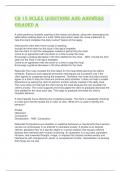
ch 15 NCLEX questions and answers Graded A A client performs ritualistic washing of the hands and dishes, along with rearranging the table before settling down to a meal. What intervention does the nurse implement to help this client complete this daily routine? Select all that apply. Interrupt the client after three rounds of washing. Include the time taken for the ritual in the day's timetable. Ask the client to read the newspaper instead of performing the ritual. Come to an agreement with the client on a time to stop the ritual. Encourage a gradual decrease in the time allotted for the ritual. - ANS -Include the time taken for the ritual in the day's timetable. Come to an agreement with the client on a time to stop the ritual. Encourage a gradual decrease in the time allotted for the ritual. Rationale:The nurse includes the time taken for the ritual while planning the client's schedule. Exposure and response prevention techniques are successful only if the client agrees to cooperate during the treatment. Therefore, the nurse and client should agree on a time to stop the ritual and continue daily activities. It does not help to create distractions by asking the client to perform another activity instead of the daily ritual. The nurse does not interrupt the client during the ritual because this can escalate the client's anxiety. The nurse supports and encourages the client to gradually decrease the time allotted for the ritual each day. This helps to gradually eliminate the client's ritualistic behavior. A client spends hours stacking and unstacking towels. The client is repeatedly checking to make sure that the towels are in order of color. What term is used to identify this behavior? Phobia Obsession Compulsion Derealization - ANS -Compulsion Rationale:Compulsions are ritualistic or repetitive behaviors or mental acts that a person carries out continuously in an attempt to neutralize anxiety. A phobia is an illogical, intense, persistent fear of a specific object or a social situation that causes extreme distress and interferes with normal functioning. An obsession is a recurrent, persistent, intrusive, and unwanted thought, image, or impulse that causes marked anxiety and interference with interpersonal, social, or occupational function. Derealization is sensing that things are not real. A client with obsessive-compulsive disorder (OCD) states making a concerted effort to reduce the frequency and duration of rituals. What intervention should the nurse include to assist in these efforts? Administer mood stabilizers as prescribed Educate the client about the negative effects of obsessions and compulsions Teach the client how to complete the client's rituals in less time Teach the client nonpharmacologic relaxation techniques - ANS -Teach the client nonpharmacologic relaxation techniques Rationale:Reducing the frequency of rituals for a person with OCD causes anxiety. Clients consequently benefit from learning techniques that can reduce their stress in a healthy way. Mood stabilizers are not typically used in the treatment of OCD, and nurses do not normally facilitate the performance of rituals. The client is likely aware of the negative consequences of obsessions and rituals, as evidence by efforts to eliminate them. A client's older parent has been diagnosed with hoarding disorder. What does the nurse instruct the client about the parent's hoarding disorder? Short-term treatment can provide a successful outcome. It is a degenerative disorder. Treatment may involve community agencies. It is caused by an injury to the basal ganglia. - ANS -Treatment may involve community agencies. Rationale:The treatment for hoarding disorder in the older adult may involve multiple community agencies besides medications and behavior therapy. Hoarding disorder is an obsessive-compulsive disorder (OCD) with a late-age onset; any other recently acquired OCD in the older client may be a degenerative disorder or the result of an injury to the basal ganglia. Long-term, not short-term, treatment can result in a successful outcome. A teenager and the teenager's parents visit the clinic to discuss the teen's skin picking. There are many bleeding wounds and various stages of scabs located up and down both arms. The parents are very upset about this behavior and want it to stop. Which would the health care provider document? Disrupted family dynamics Control dysfunction Body dysmorphic disorder Excoriation disorder - ANS -Excoriation disorder Rationale:Excoriation disorder (skin picking) is the inability to stop recurrent picking at skin for emotional release or anxiety release. Body dysmorphic disorder is a preoccupation with slight or imagined physical defects that are not apparent to others. There is not enough information to diagnose disrupted family dynamics or control issues within the family unit. The nurse is assessing a client recently diagnosed with obsessive-compulsive disorder (OCD). What does the nurse tell the client about the onset of the disorder? It starts in childhood in female clients. Early onset may indicate family history of OCD. It is diagnosed very early in most clients. It starts in the 20s in male clients. - ANS -Early onset may indicate family history of OCD. Rationale:Early onset of OCD indicates the likelihood of a family history of OCD. OCD starts in childhood especially in males. In females the onset is in the 20s. OCD is diagnosed only when the client's compulsive behavior interferes with the client's personal, social, and occupational function. The nurse is assessing a client who spends several hours arranging and rearranging items around the house. What does the nurse anticipate is the cause of this compulsive behavior? The client is obsessed with cleanliness. The client is obsessed with blasphemous thoughts. The client has a fear of contamination. The client is preoccupied with perfection. - ANS -The client is preoccupied with perfection. Rationale:The client who is obsessed with perfection performs compulsive rituals such as arranging and rearranging items around the house. The client who has a fear of contamination is obsessed with cleanliness. This client repeatedly washes hands and cleans and scrubs the surroundings. The client who is obsessed with blasphemous thoughts engages in repeated prayers or confession. The nurse is assessing a teenage client with onychophagia. What does the nurse teach the parent about the disorder? Treatment with selective serotonin reuptake inhibitor (SSRI) antidepressants is effective. The behavior typically decreases by age 50. It is a generalized anxiety disorder. It is an attention-seeking behavior. - ANS -Treatment with selective serotonin reuptake inhibitor (SSRI) Rationale:SSRI depressants are found to be effective in the treatment of onychophagia or nail biting disorder. The typical onset of the disorder is in childhood with a decrease in behavior by age 18. It is a self-soothing behavior. It cannot be classified as a
Written for
- Institution
- Ch 15 NCLEX
- Course
- Ch 15 NCLEX
Document information
- Uploaded on
- July 10, 2024
- Number of pages
- 11
- Written in
- 2023/2024
- Type
- Exam (elaborations)
- Contains
- Questions & answers
Subjects
-
ch 15 nclex questions and answers graded a

Also available in package deal