
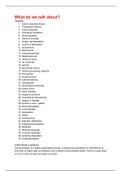
What do we talk about?
Terms.
1. Action assembly theory
2. Procedural memory
3. Action-outcome
4. Activating conditions
5. Goal activation
6. Element strength
7. Output representation
8. Levels of abstraction
9. propositions
10. hierarchical
11. interactional level
12. ideational level
13. utterance level
14. an assembly
15. axioms
16. procedural record
17. central processing capacity
18. why gossip
19. social function
20. cultural learning
21. socialization
22. observational learning
23. social norms
24. norm violation
25. negative emotions
26. motivational interviewing
27. stages of change
28. practice nurse - patient
29. precontemplation
30. contemplation
31. preparation
32. action
33. maintenance
34. linguistic abstraction
35. interpersonal distance
36. feedback
37. abstract language
38. concrete language
39. enduring disposition
40. incidental feature
Literature Lecture.
Communication is a highly automated process. A person has something in mind that he or
she want to make clear to someone, this is where communication starts. We try to code what
is in our mind, we have our body to do that.
,There must be somebody that understands what we are trying to communicate. Only by
communicating we can do something together. We need to be able to communicate in order
to survive. Communication is the clue of everything, communication links people: in
organisations, cultures, groups and relations.
Very important in communication are the goals. What do you want to establish with your
message. People can have multiple goals with their message (secondary goals).
Speech events are the building blocks of communication. These blocks are based on goals.
Jointly they enact communication episodes. These define the relationship. Vocabulary to
describe relationships.
Gossip can be seen as a way to bond, a way to learn about the target person or a way to
harm another. But we can also view gossip as a way of observational learning, through
gossip we learn about cultural norms and rules. Research has confirmed this. Negative
gossip has more effect, because if focuses on violations.
Therapist communication is goal directed, skilled, structured and adaptive.
Expert Lecture: Facial expression - a guideline to personal
characteristics.
What do we show in our face? What do our facial expressions mean? There is a direct
connection to what we show and our character.
First step of analyzing facial expression:
1. Acknowledging your own first impressions
2. Observe and describe actual movements
→ Look at the eyes, the mouth and then the rest.
By observing patterns in facial expression you can predict behaviour. What we see in others
people facial expressions happens unconsciously for them: we recognize an unconscious
, dimension in communication and conflict. If you know your own pattern, you can have a
better understanding of what your facial expressions say to other people and you have the
ability to act on your ‘’personal manual’’.
So if we focus on the micro-movements in the face. The results are a more tailor made
process-management, more accurate interventions and more effective teamwork.
The theoretical basis of facial expressions.
Different researches have created different meaning and functionality theories:
- Ekman: Facial muscle movements create displays conveying emotions (particles of
emotions: different meaning). Facial expressions are universal. Ekman made a
coding system for all facial expressions.
- Goodfield: Humans make repetitive movements, what you actually see is that we
are leaking our unconscious feelings, goodfield called this the non verbal leak.
- Fridlund: Fridlund focuses on the interactional function of facial expressions. We use
all facial movements to have good communication.
- Frijda: Facial displays are part of a dynamic interaction process. The state of action
readiness: displays influence by showing behavioural tendency.
People show an individually highly consistent repertoire of nonverbal displays, we call this
the Personal Non Verbal Repertoire (PNR). Our PNR is consistent through a variety of
situations and becomes more visible when there is a level of tension. There are two types of
movements: impulse movements and regulation movements. Impulse movements intensify
the interaction, while regulation movement de-intensify the interaction.
Impulse movements Regulation movements.
Eyebrow elevated Eyes blink
Frown White under iris
Tense jaw muscles Drooping eyelids
Corners of mouth elevated Slack, open mouth
Lower eyelids squint Social smile
Upper lip elevated Lip tense
Tongue out One eye aside
If you make a combination of these movements, it is very useful to look at the instinct
triangle. In reality people do not stick to one type, but are a combination of the three.
General Type Sensitive/Freeze Responsive/Fight Analytical/flight
Qualities Loyal, supportive. Doer, active, takes Analytically strong
Sticks to plan, decisions Systematic and
agreement. Inspirator, takes structured
Strong on content and
Leaves space for initiative
procedure
others Flexible in the face of Keeps overview
Listens well adversity
Result oriented
Terms.
1. Action assembly theory
2. Procedural memory
3. Action-outcome
4. Activating conditions
5. Goal activation
6. Element strength
7. Output representation
8. Levels of abstraction
9. propositions
10. hierarchical
11. interactional level
12. ideational level
13. utterance level
14. an assembly
15. axioms
16. procedural record
17. central processing capacity
18. why gossip
19. social function
20. cultural learning
21. socialization
22. observational learning
23. social norms
24. norm violation
25. negative emotions
26. motivational interviewing
27. stages of change
28. practice nurse - patient
29. precontemplation
30. contemplation
31. preparation
32. action
33. maintenance
34. linguistic abstraction
35. interpersonal distance
36. feedback
37. abstract language
38. concrete language
39. enduring disposition
40. incidental feature
Literature Lecture.
Communication is a highly automated process. A person has something in mind that he or
she want to make clear to someone, this is where communication starts. We try to code what
is in our mind, we have our body to do that.
,There must be somebody that understands what we are trying to communicate. Only by
communicating we can do something together. We need to be able to communicate in order
to survive. Communication is the clue of everything, communication links people: in
organisations, cultures, groups and relations.
Very important in communication are the goals. What do you want to establish with your
message. People can have multiple goals with their message (secondary goals).
Speech events are the building blocks of communication. These blocks are based on goals.
Jointly they enact communication episodes. These define the relationship. Vocabulary to
describe relationships.
Gossip can be seen as a way to bond, a way to learn about the target person or a way to
harm another. But we can also view gossip as a way of observational learning, through
gossip we learn about cultural norms and rules. Research has confirmed this. Negative
gossip has more effect, because if focuses on violations.
Therapist communication is goal directed, skilled, structured and adaptive.
Expert Lecture: Facial expression - a guideline to personal
characteristics.
What do we show in our face? What do our facial expressions mean? There is a direct
connection to what we show and our character.
First step of analyzing facial expression:
1. Acknowledging your own first impressions
2. Observe and describe actual movements
→ Look at the eyes, the mouth and then the rest.
By observing patterns in facial expression you can predict behaviour. What we see in others
people facial expressions happens unconsciously for them: we recognize an unconscious
, dimension in communication and conflict. If you know your own pattern, you can have a
better understanding of what your facial expressions say to other people and you have the
ability to act on your ‘’personal manual’’.
So if we focus on the micro-movements in the face. The results are a more tailor made
process-management, more accurate interventions and more effective teamwork.
The theoretical basis of facial expressions.
Different researches have created different meaning and functionality theories:
- Ekman: Facial muscle movements create displays conveying emotions (particles of
emotions: different meaning). Facial expressions are universal. Ekman made a
coding system for all facial expressions.
- Goodfield: Humans make repetitive movements, what you actually see is that we
are leaking our unconscious feelings, goodfield called this the non verbal leak.
- Fridlund: Fridlund focuses on the interactional function of facial expressions. We use
all facial movements to have good communication.
- Frijda: Facial displays are part of a dynamic interaction process. The state of action
readiness: displays influence by showing behavioural tendency.
People show an individually highly consistent repertoire of nonverbal displays, we call this
the Personal Non Verbal Repertoire (PNR). Our PNR is consistent through a variety of
situations and becomes more visible when there is a level of tension. There are two types of
movements: impulse movements and regulation movements. Impulse movements intensify
the interaction, while regulation movement de-intensify the interaction.
Impulse movements Regulation movements.
Eyebrow elevated Eyes blink
Frown White under iris
Tense jaw muscles Drooping eyelids
Corners of mouth elevated Slack, open mouth
Lower eyelids squint Social smile
Upper lip elevated Lip tense
Tongue out One eye aside
If you make a combination of these movements, it is very useful to look at the instinct
triangle. In reality people do not stick to one type, but are a combination of the three.
General Type Sensitive/Freeze Responsive/Fight Analytical/flight
Qualities Loyal, supportive. Doer, active, takes Analytically strong
Sticks to plan, decisions Systematic and
agreement. Inspirator, takes structured
Strong on content and
Leaves space for initiative
procedure
others Flexible in the face of Keeps overview
Listens well adversity
Result oriented


