

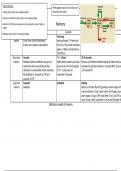
Study evaluations-
MSM suggests each store is unitary and
Sperling: high control, low ecological validity separate to the others
Peterson and Peterson: high control, low ecological validity
Bahrick et al: EV that some people may have stayed in contact, high eco Memory
validity
Baddeley: high control, low ecological validity
Coding Capacity Duration
Sensory Unprocessed Very large Limited
register Iconic store (visual information) Sperling flashed 3*4 letter grid Sperling
Echoic store (auditory information) for 50 ms. They could remember
approx. 4 letters and duration is
250-500 ms
Short term Acoustic 7 +/- 2 items 18-30 seconds
memory Baddeley divided conditions and gave 10 Miller listed numbers and asked Peterson and Peterson flashed trigram of letters and cou
words that where acoustically similar/ pps to recall. He found capacity backwards to prevent rehearsal. 3 seconds 80%, 18 secon
dissimilar or semantically similar/ dissimilar. of 7+/- 2 and easier to , 30 seconds 0%
Recall better for semantic in LTM and remember if chunked
acoustic in STM
Long term Semantic Unlimited Lifelong
memory Baddeley Bahrick et al found that 392 graduates shown images of h
school yearbook. Group 1 given names and images, group
given images. Group 1 90% recall after 15 yrs. and 70% aft
years. Group 2 60% recall after 15 years and 30% after 48
Multistore model of memory
, Memory
The working memory model
Central executive
Limited capacity
Codes all info
WMM evaluation:
Visuo-spatial sketchpad Phonological loop
(+) Baddeley found that splitting a group into conditions
Limited capacity Limited capacity
1. Hold pointer with moving light and imagery task
Visual coding Acoustic coding 2. Tracking fast and verbal task
Condition 1 easier because of limited space in visuo-
spatial sketchpad in task 2
Episodic buffer (+) KF case study- damage in motorcycle incident, poor
Limited capacity STM for auditory but could process visual information
Processes visual and (-) case study low generalisability
auditory info (-) little known about central executive
Visuo-spatial sketchpad split into:
- Visual cache – stores visual data
- Inner scribe – records arrangement of objects
Phonological loop split into:
- Phonological store- stores words you hear
- Articulatory loop- allows maintenance rehearsal
MSM suggests each store is unitary and
Sperling: high control, low ecological validity separate to the others
Peterson and Peterson: high control, low ecological validity
Bahrick et al: EV that some people may have stayed in contact, high eco Memory
validity
Baddeley: high control, low ecological validity
Coding Capacity Duration
Sensory Unprocessed Very large Limited
register Iconic store (visual information) Sperling flashed 3*4 letter grid Sperling
Echoic store (auditory information) for 50 ms. They could remember
approx. 4 letters and duration is
250-500 ms
Short term Acoustic 7 +/- 2 items 18-30 seconds
memory Baddeley divided conditions and gave 10 Miller listed numbers and asked Peterson and Peterson flashed trigram of letters and cou
words that where acoustically similar/ pps to recall. He found capacity backwards to prevent rehearsal. 3 seconds 80%, 18 secon
dissimilar or semantically similar/ dissimilar. of 7+/- 2 and easier to , 30 seconds 0%
Recall better for semantic in LTM and remember if chunked
acoustic in STM
Long term Semantic Unlimited Lifelong
memory Baddeley Bahrick et al found that 392 graduates shown images of h
school yearbook. Group 1 given names and images, group
given images. Group 1 90% recall after 15 yrs. and 70% aft
years. Group 2 60% recall after 15 years and 30% after 48
Multistore model of memory
, Memory
The working memory model
Central executive
Limited capacity
Codes all info
WMM evaluation:
Visuo-spatial sketchpad Phonological loop
(+) Baddeley found that splitting a group into conditions
Limited capacity Limited capacity
1. Hold pointer with moving light and imagery task
Visual coding Acoustic coding 2. Tracking fast and verbal task
Condition 1 easier because of limited space in visuo-
spatial sketchpad in task 2
Episodic buffer (+) KF case study- damage in motorcycle incident, poor
Limited capacity STM for auditory but could process visual information
Processes visual and (-) case study low generalisability
auditory info (-) little known about central executive
Visuo-spatial sketchpad split into:
- Visual cache – stores visual data
- Inner scribe – records arrangement of objects
Phonological loop split into:
- Phonological store- stores words you hear
- Articulatory loop- allows maintenance rehearsal


