
• Mauvais document ? Échangez-le gratuitement
  • Rédigé par des étudiants ayant réussi
  • Disponible immédiatement après paiement
  • Lire en ligne ou en PDF
Vendre
Où étudie-tu ?
La langue
Document preview thumbnail
Aperçu 2 sur 7 pages
Resume

Summary Numeric Data Types in JAVA

Document preview thumbnail
Aperçu 2 sur 7 pages

Numeric data types in Java are used to represent numbers. They include both integer types for whole numbers and floating-point types for numbers with decimal points. Understanding these types is crucial for performing arithmetic operations, handling financial calculations, and processing numerical data.

Aperçu du contenu

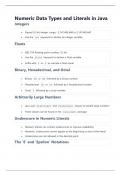
Numeric Data Types and Literals in Java
Integers

• Signed 32-bit integer, range: -2,147,483,648 to 2,147,483,647

• Use the int keyword to declare an integer variable


Floats

• IEEE 754 floating-point number, 32-bit

• Use the float keyword to declare a float variable

• Suffix with f or F to indicate a float literal


Binary, Hexadecimal, and Octal

• Binary: 0b or 0B followed by a binary number

• Hexadecimal: 0x or 0X followed by a hexadecimal number

• Octal: 0 followed by a octal number


Arbitrarily Large Numbers

• Java uses BigInteger and BigDecimal classes to handle large numbers

• These classes can be found in the java.math package


Underscore in Numeric Literals

• Numeric literals can contain underscores to improve readability
• However, underscores cannot appear at the beginning or end of the literal
• Underscores are not allowed in the decimal point

The 'E' and 'Epsilon' Notations

, • Floating-point numbers can use scientific notation with the 'E' notation
• The 'E' stands for exponent and is followed by the exponent value
• The 'epsilon' notation is used as a tolerance value in floating -point
calculations

Boolean Data Type

• Represents true or false values

• Use the boolean keyword to declare a boolean variable

• The boolean values are: true and false


Character and String Literals in Java
Character Literals

• Enclosed in single quotes ( ' )

• Represent a single character

• Can include escape sequences (e.g. \n for newline)


String Literals

• Enclosed in double quotes ( " )

• Represent a sequence of characters

• Can include escape sequences (e.g. \t for tab)


Arbitrarily Large Numbers and Java's
Implementation

• Java uses a system called automatic garbage collection

Infos sur le Document

Cours
Publié le
7 juillet 2024
Nombre de pages
7
Écrit en
2023/2024
Type
Resume
$3.99

Mauvais document ? Échangez-le gratuitement Dans les 14 jours suivant votre achat et avant le téléchargement, vous pouvez choisir un autre document. Vous pouvez simplement dépenser le montant à nouveau.
Rédigé par des étudiants ayant réussi
Disponible immédiatement après paiement
Lire en ligne ou en PDF

Vendu
0
Abonnés
0
Éléments
10
Dernière vente
-


Pourquoi les étudiants choisissent Stuvia

Créé par d'autres étudiants, vérifié par les avis

Une qualité sur laquelle compter : rédigé par des étudiants qui ont réussi et évalué par d'autres qui ont utilisé ce document.

Le document ne convient pas ? Choisis un autre document

Aucun souci ! Tu peux sélectionner directement un autre document qui correspond mieux à ce que tu cherches.

Paye comme tu veux, apprends aussitôt

Aucun abonnement, aucun engagement. Paye selon tes habitudes par carte de crédit et télécharge ton document PDF instantanément.

Student with book image

“Acheté, téléchargé et réussi. C'est aussi simple que ça.”

Alisha Student

Vous travaillez sur vos références ?

Créez des citations précises en APA, MLA et Harvard avec notre générateur de sources gratuit.

Vous travaillez sur vos références ?

Foire aux questions

