Respiratory System (Seeley's) Questions and Answers 100% pass
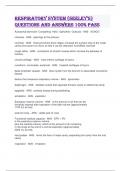
Respiratory System (Seeley's) Questions and Answers 100% pass Autosomal-dominant- Compelling- Helio- Opthalmic- Outburst - ANS- ACHOO choanae - ANS- openings to the pharynx conchae - ANS- three prominent bone ridges; increase the surface area of the nasal cavity and cause it to churn so that it can be cleansed, humidified, warmed cough relfex - ANS- contraction of smooth muscle which narrows the diameter of trachea cricoid cartilage - ANS- most inferior cartilage of larynx cuneiform, corniculate, arytenoid - ANS- 3 paired cartilages of larynx deep lymphatic vessels - ANS- drain lymph from the bronchi to associated connective tissues device that measures respiratory volume - ANS- spirometer diaphragm - ANS- skeletal muscle that separate thoracic cavity to abdominal cavity epiglottis - ANS- protects airway during swallowing exhalation - ANS- expiration Expiratory reserve volume - ANS- is the amount of air that can be forcefully expired after expiration of the tidal volume (approximately 1100 mL at rest). external nose - ANS- visible part of nose Functional residual capacity - ANS- ERV + RV is the expiratory reserve volume plus the residual volume, which is the amount of air remaining in the lungs at the end of a normal expiration (approximately 2300 mL at rest). hard palate - ANS- forms the floor of nasal cavity; separating the cavity from the oral cavity inspiration - ANS- inhalation inspiratory capacity - ANS- TV + IRV the tidal volume plus the inspiratory reserve volume, which is the amount of air a person can inspire maximally after a normal expiration (approximately 3500 mL at rest). Inspiratory reserve volume - ANS- is the amount of air that can be inspired forcefully after inspiration of the tidal volumeb(approximately 3000 mL at rest). lingual tonsil palatine tonsil - ANS- 2 tonsils present in oropharynx lobar bronchi - ANS- secondary bronchi lungs - ANS- principal organ for respiration nares - ANS- nostrils nasal septum - ANS- divides nasal cavity to left and right nasopharynx oropharynx laryngopharynx - ANS- pharynx is divide into 3: normal, quiet, labored breathing - ANS- 3 types of breathing nose pharynx larynx - ANS- parts of upper respiratory tract paranasal sinuses - ANS- air filled spaces within the bone parietal pleura - ANS- lines the wall of thorax, diaphragm, and mediastinum pharynx - ANS- common passageway for both respiratory and digestive pleural cavity - ANS- cavity that surrounds each lung Regulation of blood pH Olfaction Voice production innate immunity - ANS- Functions of Respiratory Residual volume - ANS- is the volume of air still remaining in the respiratory passages and lungs after the most forceful expiration (approximately 1200 mL). respiratory capacities - ANS- sum of two or more respiratory volumes respiratory volumes - ANS- measures of the amount of air movement during different portions of ventilation segmental bronhchi - ANS- tertiary bronchi sinusitis - ANS- inflammation of mucous membrane of sinus sneeze reflex - ANS- dislodges foreign substances from the nasal cavity spirometry - ANS- process of measuring volumes of air that movies into and out of the respiratory system Superficial lymphatic vessels - ANS- drain lymph from superficial lung tissue and the visceral pleura
Written for
- Institution
- Respiratory System Seeley\'s
- Course
- Respiratory System Seeley\'s
Document information
- Uploaded on
- July 4, 2024
- Number of pages
- 4
- Written in
- 2023/2024
- Type
- Exam (elaborations)
- Contains
- Questions & answers
Subjects
-
respiratory system seeleys questions and answer

Document also available in package deal