AMAT VICTORIA CURAM
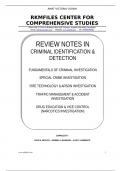
RKMFILES CENTER FOR
COMPREHENSIVE STUDIES
Room 309, 3rd Floor A-Building, Main AUF Campus, Angeles University Foundation
Email: Website: www.rkmfiles.net CP: 09088849680
REVIEW NOTES IN
CRIMINAL IDENTIFICATION &
DETECTION
FUNDAMENTALS OF CRIMINAL INVESTIGATION
SPECIAL CRIME INVESTIGATION
FIRE TECHNOLOGY & ARSON INVESTIGATION
TRAFFIC MANAGEMENT & ACCIDENT
INVESTIGATION
DRUG EDUCATION & VICE CONTROL
(NARCOTICS INVESTIGATION)
COMPILED BY:
LUCIA M. HIPOLITO -- ROMMEL K. MANWONG -- ALFIE P. SARMIENTO
www.rkmfiles.net 1
, AMAT VICTORIA CURAM
FUNDAMENTALS OF CRIMINAL INVESTIGATION
BASIC CONCEPTS
Criminal Investigation- is an art that deals with the identity and location of the offender and prove his guilt in a
criminal proceeding.
Criminal Investigation- it is the systematic method of inquiry that is more a science than an art. The logic of scientific
method must however, be supplemented by the investigator's initiative and resourcefulness. The sequences of the
investigation should be regarded by scientific, operating framework that requires improvising on the part of the
investigator.
Criminal Investigation is an Art based on intuition, felicity of inspiration or by chance; and a Science based on
adequate professional preparation and abundance of certain qualities
Investigator- is the person who is charged with the duty of carrying out the objectives of criminal investigation. He is
an individual who gathers documents and evaluates facts about crime
Special Crime Investigation- deals with the study of major crimes based on the application of special investigative
techniques. It is also the study concentrates more on physical evidence; it s collection, handling, identification and
preservation in coordination with the various criminalists in the crime laboratory. Special crime investigation involves
close relationship between the investigator in the field and the investigator in the laboratory- the Criminalist.
Duty of Criminal Investigator
1. Establish that, in fact, a crime was committed under the law.
2. Identify and apprehend the suspect.
3. To recover stolen property.
4. To assist the state in prosecuting the party charged with the offense.
Job of the Criminal Investigator
1. Discover whether or not an offense has been committed under the law.
2. After determining what specific offense has been committed, he must discover how, when, where, why, what
offense was committed.
Methods of Identifications of Criminals
Criminal are identified thru the following:
1. Confession and Admission
2. Statement of witnesses
3. Circumstantial Evidence
4. Associative Evidence
A. Confession- this is an expressed acknowledgement by the accused in criminal cases of the truth of his guilt as to
the crime charged or of some of the essential part there of. There is no implied confession for it is positive and direct
acknowledgement of guilt. It is the best means of identifying criminal.
Rules in Confession
a. Confession need not to be in writing
b. Confession may be written in a language which the accused does not speak
c. Confession must be freely and voluntarily made
www.rkmfiles.net 2
, AMAT VICTORIA CURAM
Voluntarily means that the accused speak of his free will and accord, without inducement of any kind and with the
full and complete knowledge of the nature and consequences of the confession.
Freely- when the speaking is so free from the influence affecting the will of the accused at the same time the
confession was made.
Requirement for confession as proof of guilt
1. Other corroborative evidence must support it.
2. Corpus delicti- must be established separately (the actual commission of the crime charged. It refers to a
particular crime and signifies that specific offense had been actually committed by someone being composed of
two elements: that certain results were produced, that someone is criminally responsible
3. Confession must be made voluntarily.
B. By EYE-WITNESS TESTIMONY- description made by eyewitness
Value of identification by eyewitness testimony depends on the following: (credibility-bringing honor)
1. the ability of the eyewitness testimony to observe and remember the relative distinctiveness of the accused
appearance
2. The prevailing conditions, visibility and observation
3. The lapse of time between the criminal event and identification
Methods of Identification made by eyewitness
1. Verbal Description- portrait parley vividly describing in words the appearance of a person by comparing and thru
personal appearance.
2. Photographic files (rogues gallery)
3. General photograph- files of photograph in any given establishment.
4. Artist Assistance or composite sketches- drawing or sketching the description of a person s face by the
cartographer
5. Police line-up- selecting the suspect from a group of innocent persons to eliminate the power of suggestions as
factor of identification
Cartography- the art of sketching the image of a person or the art of making map
Bases of the eyewitness in the identification of criminal
1. Face-forehead, eyebrow, mustache, eyes, ears, cheeks, mouth, lips, teeth, chin, jaw, etc.
2. Neck- shape, length, Adams apple
3. Shoulder- width and shape
4. Waist- size, shape of the abdomen
5. Hands- length, size, hair, condition of the palms
6. Fingers- length, thickness, stains, shape of nails and condition
7. Any deformities (cross eyed, limping and etc.)
8. Teeth-
9. Gait
Bases of Physical Description of Physical Appearance
1. Mug Shot
2. Artist Drawing
3. Composite Sketches
4. Verbal description or Portrait Parley
www.rkmfiles.net 3
, AMAT VICTORIA CURAM
HISTORICAL FEATURES IN CRIMINAL INVESTIGATION
The art and science of Criminal Investigation that exist today is the result of countless development since
policing was conceived and then institutionalized. The following is just a brief account of some of the major milestone in
the history of Criminal Investigation.
WORLDWIDE DEVELOPMENT
1720s, ENGLAND: - JONATHAN WILD He was a buckle maker then a brothel operator; a master criminal who
became Londons most effective criminal investigator. He was the most famous THIEF-CATCHER in 1720s. His
methods or techniques made popular the logic of EMPLOYING A THIEF TO CATCH A THIEF. He conceived the idea
of charging a fee for locating and returning stolen property to its rightful owners.
1750s, ENGLAND: - HENRY FIELDING An Englishman who wrote a novel entitled Tom Jones and was appointed
as magistrate (sheriff) for the areas of Westminster and Middle Age, London. He was the creator of the BOW STREET
RUNNERS while he was the magistrate; he formed a group of police officers attached to the Bow Street Court, and not
in uniform, performing criminal investigative functions.
1753, ENGLAND: - SIR JOHN FIELDING The younger brother of Henry Fielding who took over the control of Bow
Street Court in 1753. His investigators were then called Bow Street Runners and became quite effective because of his
personal guidance despite the fact that he was blind. He introduced the practice of developing paid informants, printing
wanted notices, employing criminal raids, and bearing firearms and handcuffs.
1759, USA: The US CONGRESS created the office of the GENERAL AND REVENUE CUTTER SERVICE. This is the
first organized federal law enforcement and investigative effort made by the US government.
1800, LONDON: - PATRICK COLQUHOUN A prominent London president who proposed the unique idea of creating
sizeable uniformed force to police the city of London in order to remedy the public outcry concerning the alarming
increase of criminality during the early 1800s. His proposal was considered too radical and was dismissed by the Royal
Court.
1811, FRANCE: - EUGENE Francois VIDOCQ He was a criminal who turned Paris Investigator. He is a former
convict who became a notorious thief-catcher in France. He is credited as the founder of LA SURETE, France s
national detective organization. He made popular the concept of SET A THIEF TO CATCH A THIEF . He introduced
the concept of TRADE PROTECTION SOCIETY, which is a forerunner of our present-day credit card system. For
a fee, any owner of a shop or business establishment could obtain particulars concerning the financial solvency of new
customers. He created a squad of ex-convicts to aid the Paris police in crime investigation.
1829, LONDON: - SIR ROBERT PEELS The founder and chief organizer of the London Metropolitan Police the
SCOTLAND YARD. He reiterated the idea of creating sizeable police force in his recommendations, which lead to the
passage of the Metropolitan Police Act. This act had a tremendous impact on the history of criminal justice in general,
and on the development of criminal investigation specifically. He introduced the techniques of detecting crimes such
as: detectives concealing themselves, and secretly photographing and recording conversations.
1833, ENGLAND: The Scotland Yard employed the first undercover officer while in
USA: First daytime paid police department was established in Philadelphia, USA.
1835, USA: TEXAS RANGERS was organized as the first law enforcement agency with statewide investigative
authority, the forerunner of the Federal Bureau of Investigation.
1839: - The birth year of Photography. WILLIAM HENRY FOX TALBOT explained a photographic process he had
invented to the Royal Society of London.
JACQUES MANDE DAGUERRE gave a public demonstration in Paris of his discovery - a photographic
process he developed in collaboration with NICEPHORE NIEPCE.
www.rkmfiles.net 4
RKMFILES CENTER FOR
COMPREHENSIVE STUDIES
Room 309, 3rd Floor A-Building, Main AUF Campus, Angeles University Foundation
Email: Website: www.rkmfiles.net CP: 09088849680
REVIEW NOTES IN
CRIMINAL IDENTIFICATION &
DETECTION
FUNDAMENTALS OF CRIMINAL INVESTIGATION
SPECIAL CRIME INVESTIGATION
FIRE TECHNOLOGY & ARSON INVESTIGATION
TRAFFIC MANAGEMENT & ACCIDENT
INVESTIGATION
DRUG EDUCATION & VICE CONTROL
(NARCOTICS INVESTIGATION)
COMPILED BY:
LUCIA M. HIPOLITO -- ROMMEL K. MANWONG -- ALFIE P. SARMIENTO
www.rkmfiles.net 1
, AMAT VICTORIA CURAM
FUNDAMENTALS OF CRIMINAL INVESTIGATION
BASIC CONCEPTS
Criminal Investigation- is an art that deals with the identity and location of the offender and prove his guilt in a
criminal proceeding.
Criminal Investigation- it is the systematic method of inquiry that is more a science than an art. The logic of scientific
method must however, be supplemented by the investigator's initiative and resourcefulness. The sequences of the
investigation should be regarded by scientific, operating framework that requires improvising on the part of the
investigator.
Criminal Investigation is an Art based on intuition, felicity of inspiration or by chance; and a Science based on
adequate professional preparation and abundance of certain qualities
Investigator- is the person who is charged with the duty of carrying out the objectives of criminal investigation. He is
an individual who gathers documents and evaluates facts about crime
Special Crime Investigation- deals with the study of major crimes based on the application of special investigative
techniques. It is also the study concentrates more on physical evidence; it s collection, handling, identification and
preservation in coordination with the various criminalists in the crime laboratory. Special crime investigation involves
close relationship between the investigator in the field and the investigator in the laboratory- the Criminalist.
Duty of Criminal Investigator
1. Establish that, in fact, a crime was committed under the law.
2. Identify and apprehend the suspect.
3. To recover stolen property.
4. To assist the state in prosecuting the party charged with the offense.
Job of the Criminal Investigator
1. Discover whether or not an offense has been committed under the law.
2. After determining what specific offense has been committed, he must discover how, when, where, why, what
offense was committed.
Methods of Identifications of Criminals
Criminal are identified thru the following:
1. Confession and Admission
2. Statement of witnesses
3. Circumstantial Evidence
4. Associative Evidence
A. Confession- this is an expressed acknowledgement by the accused in criminal cases of the truth of his guilt as to
the crime charged or of some of the essential part there of. There is no implied confession for it is positive and direct
acknowledgement of guilt. It is the best means of identifying criminal.
Rules in Confession
a. Confession need not to be in writing
b. Confession may be written in a language which the accused does not speak
c. Confession must be freely and voluntarily made
www.rkmfiles.net 2
, AMAT VICTORIA CURAM
Voluntarily means that the accused speak of his free will and accord, without inducement of any kind and with the
full and complete knowledge of the nature and consequences of the confession.
Freely- when the speaking is so free from the influence affecting the will of the accused at the same time the
confession was made.
Requirement for confession as proof of guilt
1. Other corroborative evidence must support it.
2. Corpus delicti- must be established separately (the actual commission of the crime charged. It refers to a
particular crime and signifies that specific offense had been actually committed by someone being composed of
two elements: that certain results were produced, that someone is criminally responsible
3. Confession must be made voluntarily.
B. By EYE-WITNESS TESTIMONY- description made by eyewitness
Value of identification by eyewitness testimony depends on the following: (credibility-bringing honor)
1. the ability of the eyewitness testimony to observe and remember the relative distinctiveness of the accused
appearance
2. The prevailing conditions, visibility and observation
3. The lapse of time between the criminal event and identification
Methods of Identification made by eyewitness
1. Verbal Description- portrait parley vividly describing in words the appearance of a person by comparing and thru
personal appearance.
2. Photographic files (rogues gallery)
3. General photograph- files of photograph in any given establishment.
4. Artist Assistance or composite sketches- drawing or sketching the description of a person s face by the
cartographer
5. Police line-up- selecting the suspect from a group of innocent persons to eliminate the power of suggestions as
factor of identification
Cartography- the art of sketching the image of a person or the art of making map
Bases of the eyewitness in the identification of criminal
1. Face-forehead, eyebrow, mustache, eyes, ears, cheeks, mouth, lips, teeth, chin, jaw, etc.
2. Neck- shape, length, Adams apple
3. Shoulder- width and shape
4. Waist- size, shape of the abdomen
5. Hands- length, size, hair, condition of the palms
6. Fingers- length, thickness, stains, shape of nails and condition
7. Any deformities (cross eyed, limping and etc.)
8. Teeth-
9. Gait
Bases of Physical Description of Physical Appearance
1. Mug Shot
2. Artist Drawing
3. Composite Sketches
4. Verbal description or Portrait Parley
www.rkmfiles.net 3
, AMAT VICTORIA CURAM
HISTORICAL FEATURES IN CRIMINAL INVESTIGATION
The art and science of Criminal Investigation that exist today is the result of countless development since
policing was conceived and then institutionalized. The following is just a brief account of some of the major milestone in
the history of Criminal Investigation.
WORLDWIDE DEVELOPMENT
1720s, ENGLAND: - JONATHAN WILD He was a buckle maker then a brothel operator; a master criminal who
became Londons most effective criminal investigator. He was the most famous THIEF-CATCHER in 1720s. His
methods or techniques made popular the logic of EMPLOYING A THIEF TO CATCH A THIEF. He conceived the idea
of charging a fee for locating and returning stolen property to its rightful owners.
1750s, ENGLAND: - HENRY FIELDING An Englishman who wrote a novel entitled Tom Jones and was appointed
as magistrate (sheriff) for the areas of Westminster and Middle Age, London. He was the creator of the BOW STREET
RUNNERS while he was the magistrate; he formed a group of police officers attached to the Bow Street Court, and not
in uniform, performing criminal investigative functions.
1753, ENGLAND: - SIR JOHN FIELDING The younger brother of Henry Fielding who took over the control of Bow
Street Court in 1753. His investigators were then called Bow Street Runners and became quite effective because of his
personal guidance despite the fact that he was blind. He introduced the practice of developing paid informants, printing
wanted notices, employing criminal raids, and bearing firearms and handcuffs.
1759, USA: The US CONGRESS created the office of the GENERAL AND REVENUE CUTTER SERVICE. This is the
first organized federal law enforcement and investigative effort made by the US government.
1800, LONDON: - PATRICK COLQUHOUN A prominent London president who proposed the unique idea of creating
sizeable uniformed force to police the city of London in order to remedy the public outcry concerning the alarming
increase of criminality during the early 1800s. His proposal was considered too radical and was dismissed by the Royal
Court.
1811, FRANCE: - EUGENE Francois VIDOCQ He was a criminal who turned Paris Investigator. He is a former
convict who became a notorious thief-catcher in France. He is credited as the founder of LA SURETE, France s
national detective organization. He made popular the concept of SET A THIEF TO CATCH A THIEF . He introduced
the concept of TRADE PROTECTION SOCIETY, which is a forerunner of our present-day credit card system. For
a fee, any owner of a shop or business establishment could obtain particulars concerning the financial solvency of new
customers. He created a squad of ex-convicts to aid the Paris police in crime investigation.
1829, LONDON: - SIR ROBERT PEELS The founder and chief organizer of the London Metropolitan Police the
SCOTLAND YARD. He reiterated the idea of creating sizeable police force in his recommendations, which lead to the
passage of the Metropolitan Police Act. This act had a tremendous impact on the history of criminal justice in general,
and on the development of criminal investigation specifically. He introduced the techniques of detecting crimes such
as: detectives concealing themselves, and secretly photographing and recording conversations.
1833, ENGLAND: The Scotland Yard employed the first undercover officer while in
USA: First daytime paid police department was established in Philadelphia, USA.
1835, USA: TEXAS RANGERS was organized as the first law enforcement agency with statewide investigative
authority, the forerunner of the Federal Bureau of Investigation.
1839: - The birth year of Photography. WILLIAM HENRY FOX TALBOT explained a photographic process he had
invented to the Royal Society of London.
JACQUES MANDE DAGUERRE gave a public demonstration in Paris of his discovery - a photographic
process he developed in collaboration with NICEPHORE NIEPCE.
www.rkmfiles.net 4