

Brieanna yousupoff
Unit 17: Caring for individuals with dementia
P1- what is dementia caused by?
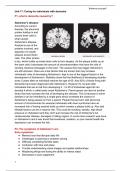
Alzheimer’s disease-
According to current
theories, the abnormal
protein buildup in and
around brain cells is
what causes
Alzheimer's disease.
Amyloid is one of the
proteins involved, and
deposits of it create
plaques around brain
cells. The other protein
is tau, which builds up inside brain cells to form tangles. As the plaque builds up on
the brain cells it decreases the amount of neurotransmitters that have the role of
sending chemical messages in the brain. The causes that may trigger Alzheimer's
are still unknown, there are a few factors that are known that may increase
individuals' risks of developing Alzheimer's. Age is one of the biggest factors in the
development of Alzheimer's. Statistics show that the likelihood of developing doubles
every 5 years after an individual reaches the age of 65. Also 62% of those living with
dementia have been diagnosed with Alzheimer's. However it's not just older
individuals that are at risk from developing it. 1 in 20 of individuals aged 40 can
develop it which is called early onset Alzheimer's. Parent genes can also be another
factor that may increase the risk of developing the disease. This is because in some
families it can be inherited by a single gene which increases the chance of
Alzheimer's being passed on from a parent. People that are born with abnormal
amount of chromosomes for example individuals with down syndrome have an
increased risk of having amyloid build up which creates a plaque build up. Also bad
lifestyle factors can be a massive risk. This could be smoking, obesity, high blood
pressure or cholesterol and they don't just increase the risk of Alzheimer's but
cardiovascular disease, damaged or failing organs. In covid more research was done
on Alzheimer's and it was found that loneliness, isolation, or poor mental health like
depression can increase the risk.
P2- The symptoms of Alzheimer’s are:
Early symptoms
● Memory loss that disrupts daily life
● Challenges in planning or problem solving
● Difficulty completing familiar tasks
● Confusion with time and place
● Trouble understanding visual images and spatial relationships
● Misplacing things and losing the ability to retrace steps
● Decreased or poor judgement
1
, Brieanna yousupoff
Unit 17: Caring for individuals with dementia
● Withdrawal from work or social activities
● Changes in mood and personality
Alzheimer's is a progressive disease and the symptoms are divided into 3 stages
which are early, middle and late stages. In the early stage of Alzheimer's disease an
individual should still be able to function properly, this can include tasks like driving
or working. In this stage symptoms are usually very mild and close family around
them may pick up on these signs. One of the most common signs in the early stage
is forgetting recently learned information. This could be forgetting dates and
important things like appointments and the individual was increasingly asking the
same question over and over again. Often this can result in individuals relying on
reminders which can be either on paper or electronically so they can still try to be as
independent as they can. It can also affect an individual's ability to develop and
follow a plan even if it is something they are familiar with. They could also have
trouble keeping uptodate on bills and having difficulty concentrating and take longer
to do things that what they would pre alzheier’s.
The middle symptoms:
● Being forgetful of events or personal history.
● Feeling moody or withdrawn, especially in socially or mentally challenging
situations.
● Being unable to recall information about themselves like their address or
telephone number, and the high school or college they attended.
● Experiencing confusion about where they are or what day it is.
● Requiring help choosing proper clothing for the season or the occasion.
● Having trouble controlling their bladder and bowels.
● Experiencing changes in sleep patterns, such as sleeping during the day and
becoming restless at night.
● Showing an increased tendency to wander and become lost.
● Demonstrating personality and behavioural changes, including
suspiciousness and delusions or compulsive, repetitive behaviour like hand-
wringing or tissue shredding.
Middle stage of Alzheimer’s is usually when people are diagnosed. The memory and
thinking problems become a lot more visible and may require more care over the
years. The person may become confused and angry so they may act out as they
may have trouble expressing their thoughts and communicating with others. They
may muddle up words or have trouble doing routine tasks without support. In this
stage mood swings are quite common and this could be down to short term memory
2
Unit 17: Caring for individuals with dementia
P1- what is dementia caused by?
Alzheimer’s disease-
According to current
theories, the abnormal
protein buildup in and
around brain cells is
what causes
Alzheimer's disease.
Amyloid is one of the
proteins involved, and
deposits of it create
plaques around brain
cells. The other protein
is tau, which builds up inside brain cells to form tangles. As the plaque builds up on
the brain cells it decreases the amount of neurotransmitters that have the role of
sending chemical messages in the brain. The causes that may trigger Alzheimer's
are still unknown, there are a few factors that are known that may increase
individuals' risks of developing Alzheimer's. Age is one of the biggest factors in the
development of Alzheimer's. Statistics show that the likelihood of developing doubles
every 5 years after an individual reaches the age of 65. Also 62% of those living with
dementia have been diagnosed with Alzheimer's. However it's not just older
individuals that are at risk from developing it. 1 in 20 of individuals aged 40 can
develop it which is called early onset Alzheimer's. Parent genes can also be another
factor that may increase the risk of developing the disease. This is because in some
families it can be inherited by a single gene which increases the chance of
Alzheimer's being passed on from a parent. People that are born with abnormal
amount of chromosomes for example individuals with down syndrome have an
increased risk of having amyloid build up which creates a plaque build up. Also bad
lifestyle factors can be a massive risk. This could be smoking, obesity, high blood
pressure or cholesterol and they don't just increase the risk of Alzheimer's but
cardiovascular disease, damaged or failing organs. In covid more research was done
on Alzheimer's and it was found that loneliness, isolation, or poor mental health like
depression can increase the risk.
P2- The symptoms of Alzheimer’s are:
Early symptoms
● Memory loss that disrupts daily life
● Challenges in planning or problem solving
● Difficulty completing familiar tasks
● Confusion with time and place
● Trouble understanding visual images and spatial relationships
● Misplacing things and losing the ability to retrace steps
● Decreased or poor judgement
1
, Brieanna yousupoff
Unit 17: Caring for individuals with dementia
● Withdrawal from work or social activities
● Changes in mood and personality
Alzheimer's is a progressive disease and the symptoms are divided into 3 stages
which are early, middle and late stages. In the early stage of Alzheimer's disease an
individual should still be able to function properly, this can include tasks like driving
or working. In this stage symptoms are usually very mild and close family around
them may pick up on these signs. One of the most common signs in the early stage
is forgetting recently learned information. This could be forgetting dates and
important things like appointments and the individual was increasingly asking the
same question over and over again. Often this can result in individuals relying on
reminders which can be either on paper or electronically so they can still try to be as
independent as they can. It can also affect an individual's ability to develop and
follow a plan even if it is something they are familiar with. They could also have
trouble keeping uptodate on bills and having difficulty concentrating and take longer
to do things that what they would pre alzheier’s.
The middle symptoms:
● Being forgetful of events or personal history.
● Feeling moody or withdrawn, especially in socially or mentally challenging
situations.
● Being unable to recall information about themselves like their address or
telephone number, and the high school or college they attended.
● Experiencing confusion about where they are or what day it is.
● Requiring help choosing proper clothing for the season or the occasion.
● Having trouble controlling their bladder and bowels.
● Experiencing changes in sleep patterns, such as sleeping during the day and
becoming restless at night.
● Showing an increased tendency to wander and become lost.
● Demonstrating personality and behavioural changes, including
suspiciousness and delusions or compulsive, repetitive behaviour like hand-
wringing or tissue shredding.
Middle stage of Alzheimer’s is usually when people are diagnosed. The memory and
thinking problems become a lot more visible and may require more care over the
years. The person may become confused and angry so they may act out as they
may have trouble expressing their thoughts and communicating with others. They
may muddle up words or have trouble doing routine tasks without support. In this
stage mood swings are quite common and this could be down to short term memory
2


