
Summary - Unit 3.1.8 - Thermodynamics (A-level only) (Chem)
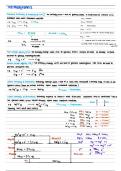
Thermodynamics in A-Level Chemistry involves the study of energy changes, particularly in chemical reactions. Here's a brief summary of the key concepts: 1. Enthalpy (H) Enthalpy Change (ΔH): The heat energy change measured under constant pressure. Exothermic Reactions: Release heat to the surroundings, ΔH is negative (e.g., combustion). Endothermic Reactions: Absorb heat from the surroundings, ΔH is positive (e.g., photosynthesis). 2. Standard Enthalpy Changes Standard Conditions: 298 K (25°C), 1 atm pressure, and 1 M concentration for solutions. Standard Enthalpy Change of Formation (ΔH⁰f): The enthalpy change when one mole of a compound is formed from its elements in their standard states. Standard Enthalpy Change of Combustion (ΔH⁰c): The enthalpy change when one mole of a substance is completely burned in oxygen. Standard Enthalpy Change of Reaction (ΔH⁰r): The enthalpy change when the number of moles of reactants as specified in the balanced equation react together under standard conditions. 3. Hess’s Law States that the total enthalpy change for a reaction is the same, no matter the route taken. Used to calculate enthalpy changes of reactions that are difficult to measure directly. 4. Bond Enthalpies Bond Enthalpy (D): The enthalpy change required to break one mole of bonds in gaseous molecules. Average bond enthalpies can be used to estimate ΔH for reactions involving gaseous reactants and products. 5. Entropy (S) Entropy Change (ΔS): A measure of the disorder or randomness of a system. Higher entropy indicates a more disordered system. Standard Entropy (S⁰): The entropy of one mole of a substance under standard conditions. 6. Gibbs Free Energy (G) Gibbs Free Energy Change (ΔG): Determines the spontaneity of a reaction. Calculated using the equation: Δ G = Δ H − T Δ S ΔG=ΔH−TΔS A negative ΔG indicates a spontaneous process; a positive ΔG indicates a non-spontaneous process. 7. Feasibility of Reactions For a reaction to be feasible, ΔG must be negative. The interplay of ΔH, ΔS, and temperature (T) affects reaction spontaneity. 8. Calculations and Applications Use of enthalpy cycles and Hess's law to determine unknown enthalpy changes. Calculation of ΔH, ΔS, and ΔG for given reactions. Understanding the impact of temperature changes on reaction spontaneity. These concepts help explain the energy dynamics in chemical processes, predict the direction of chemical reactions, and determine the conditions under which reactions occur.
Document information
- Study Level
- A/AS Level
- Subject
- A Level Chemistry
- Uploaded on
- July 3, 2024
- Number of pages
- 6
- Written in
- 2023/2024
- Type
- Summary


