

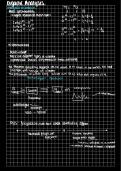
Summary - Unit 3.3.6 - Organic analysis (Chem)
Organic analysis in A-Level Chemistry under the AQA specification involves the identification and characterization of organic compounds using a variety of techniques. Here’s a brief summary of the key aspects: 1. Functional Group Analysis Test for Alkenes: Bromine water test. Alkenes decolorize bromine water (from orange to colorless). Test for Alcohols: Primary and Secondary Alcohols: Oxidation with acidified potassium dichromate (orange to green). Tertiary Alcohols: No reaction with acidified potassium dichromate. Test for Aldehydes and Ketones: Tollens’ Test: Aldehydes reduce Tollens' reagent to form a silver mirror. Fehling's Test: Aldehydes reduce Fehling's solution to a red precipitate of copper(I) oxide. Ketones do not react with these reagents. Test for Carboxylic Acids: Reaction with sodium carbonate/bicarbonate to produce carbon dioxide gas. 2. Infrared (IR) Spectroscopy Identification of functional groups based on characteristic absorption bands. O-H Stretch: Broad peak around cm⁻¹. C=O Stretch: Sharp peak around cm⁻¹. C-H Stretch: Peaks around cm⁻¹. 3. Mass Spectrometry (MS) Determination of molecular mass and fragmentation pattern. Interpretation of molecular ion peak (M⁺) to determine molecular weight. Analysis of fragmentation pattern to deduce structure of the compound. 4. Nuclear Magnetic Resonance (NMR) Spectroscopy Proton (¹H) NMR: Provides information about the hydrogen atoms in a molecule. Chemical shift (δ values) indicates the environment of the hydrogens. Integration gives the ratio of hydrogen atoms. Splitting patterns (multiplets) indicate the number of adjacent hydrogens (n+1 rule). Carbon-13 (¹³C) NMR: Provides information about the carbon atoms in a molecule. Chemical shift (δ values) indicates the environment of the carbons. No splitting due to proton decoupling in most ¹³C NMR spectra. 5. Combined Techniques Use of combined data from IR, MS, and NMR to elucidate the complete structure of organic compounds. Correlation between different spectroscopic data to confirm the presence of specific functional groups and overall molecular structure. These techniques together allow chemists to systematically analyze and identify unknown organic compounds.
Document information
- Study Level
- A/AS Level
- Subject
- A Level Chemistry
- Uploaded on
- July 3, 2024
- Number of pages
- 2
- Written in
- 2023/2024
- Type
- Summary


