

TEAS TEST (ALLIED HEALTH) Exam With Complete Questions And Complete Answers.
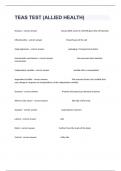
Nucleus - correct answer houses DNA, brain of cell DNA gives the cell function Mitochondria - correct answer Powerhouse of the cell Golgi apparatus - correct answer packaging / transport of proteins homeostatic mechanisms - correct answer the processes that maintain homeostasis independent variable - correct answer variable that is manipulated dependent variable - correct answer The outcome factor; the variable that may change in response to manipulations of the independent variable. Enzymes - correct answer Proteins that speed up chemical reactions Where is the aorta? - correct answer left side of the heart Synapse - correct answer Gap between neurons Lateral - correct answer side Distal - correct answer Farther from the trunk of the body Ventral - correct answer belly side Lysolomes - correct answer digestion of large molecules ribsomes - correct answer Makes proteins for the cell Centrioles - correct answer develop fibers for cell division Endoplasmic Reticulum (ER) - correct answer synthesis of lipids and proteins Where is eukaryotic DNA found? - correct answer humnas what is the difference between prokaryotic and eukaryotic - correct answer Prokaryotic has no nucleus and no organelles , and Eukaryotic has a nucleus and organelles. Plasma - correct answer Liquid part of blood red blood cells - correct answer Carry oxygen to all body cells Platelets - correct answer blood clotting white blood cells - correct answer fight infection and disease Aorta - correct answer Largest artery in the body arteriole - correct answer small artery capillary - correct answer connects arteries and veins lymph - correct answer liquid that fights diseases vena cava - correct answer where all veins get emptied sinoatrial (SA) node - correct answer pacemaker of the heart Venules - correct answer small veins frontal lobe of brain - correct answer thinking , emotions, personality parietal lobe - correct answer spelling , math , making sense temporal lobe - correct answer memory, understanding, language Oppicital lobe - correct answer sight Cerebellum - correct answer Balance and coordination Acetylcholine - correct answer causes muscles to contract Dopamine - correct answer A neurotransmitter associated with movement, attention . Diaphragm - correct answer sheet of muscle that serves as the main muscle of respiration/breathing process lungs - correct answer main structure of the respiratory system Larynx - correct answer voice box Trachea - correct answer Allows air to pass to and from lungs bronchi - correct answer The passages that direct air into the lungs Pharynx - correct answer throat; passageway for food to the esophagus Bronchioles - correct answer smallest branches of the bronchi pleura - correct answer Membrane surrounding the lungs Perfusion - correct answer The passage of fluid to an organ or a tissue tidal volume - correct answer amount of air inhaled or exhaled with each breath residual volume - correct answer The air that remains in the lungs after maximal expiration. Vital Capacity (VC) - correct answer amount of air exhaled after a maximal inspiration alveloi - correct answer small sacs of air lipids - correct answer fats and oils Epiglottis - correct answer Closes off the larynx during swallowing ATP (adenosine triphosphate) - correct answer main energy source that cells use for most of their work skeletal muscle - correct answer a muscle that is connected to the skeleton to form part of the mechanical system that moves the limbs and other parts of the body. smooth muscle - correct answer Involuntary muscle found inside many internal organs of the body cardiac muscle - correct answer Muscle of the heart When is ATP released? - correct answer during the breakdown of glucose, fatty acids, and amino acids Where are prokaryotic cells found? - correct answer bacteria Smooth ER - correct answer Makes lipids Rough ER - correct answer Makes proteins stroke - correct answer Damage to the brain from interruption of its blood supply. heart attack - correct answer the death of cardiac muscle tissue resulting from blockage of one or more coronary arteries embolus - correct answer moving blood clot Enzymes - correct answer Proteins that speed up chemical reactions Lipase - correct answer enzyme that breaks down fat Amylase - correct answer enzyme that breaks down starch Tryspin - correct answer An enzyme in pancreatic juice that breaks down protein molecules what gland produces insulin ? - correct answer pancreas exocrine glands - correct answer secrete chemical substances into ducts that lead to the outside of the skin sebaceous glands - correct answer an oily mixture of lipids and proteins , protects against pathogens , waterproofs skin eccrine glands - correct answer glands that produce sweat; found over most of the body apocrine glands - correct answer Sweat glands in the pubic and underarm areas that secrete thicker sweat, that produce odor when come in contact with bacteria on the skin Melanocytes - correct answer cells that produce melanin Merkel cells (discs) - correct answer sensory receptors found in the epidermis - dermis junction . mast cells - correct answer Cells that release chemicals (such as histamine) that promote inflammation. What does the dermis consist of? - correct answer blood vessels, sensory receptors, hair follicles, sebaceous glands, and sweat glands what is the hypodermis and what does it do ? - correct answer bottom layer of skin , insulates your body, protecting your body from harm, storing energy and connecting your skin to your muscles and bones. What is vasodilation? - correct answer assists in thermoregulation of skin , increases blood vessel diameter , Testes - correct answer male gonads vasoconstriction - correct answer assists in thermoregulation of skin, decrease in the diameter of a blood vessel Scrotum - correct answer a pouch of skin containing the testicles. Urethra - correct answer tube leading from the urinary bladder to the outside of the body Uterus - correct answer Female organ of reproduction used to house the developing fetus. Vagina - correct answer birth canal Estrogen - correct answer Female sex hormone Oxytocin (OT) - correct answer Stimulates contraction of the uterus and release of milk from breast. Epididymis - correct answer stores sperm gastric secretions - cor
Document information
- Uploaded on
- July 2, 2024
- Number of pages
- 15
- Written in
- 2023/2024
- Type
- Exam (elaborations)
- Contains
- Questions & answers


