

Lecture notes 1.4 alkenes (Chem)
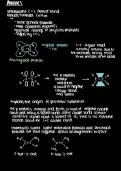
Alkenes are a class of hydrocarbons that contain at least one carbon-carbon double bond (C=C). Here are the key points about alkenes: Structure General Formula: The general formula for alkenes is C n H 2 n C n H 2n , where n n is the number of carbon atoms. Double Bond: The presence of a carbon-carbon double bond defines alkenes. This double bond consists of one sigma (σ) bond and one pi (π) bond. Nomenclature Naming: Alkenes are named by identifying the longest carbon chain that includes the double bond and using the suffix "-ene". The position of the double bond is indicated by the lowest numbered carbon atom involved in the double bond. Examples: Ethene (C₂H₄), commonly known as ethylene, is the simplest alkene. Propene (C₃H₆), with the double bond between the first and second carbon atoms. Isomerism Geometric Isomerism: Alkenes can exhibit cis-trans (or E-Z) isomerism due to restricted rotation around the double bond. Cis (Z): Substituents on the same side of the double bond. Trans (E): Substituents on opposite sides of the double bond. Structural Isomerism: Alkenes can also have different structural isomers where the connectivity of atoms varies. Properties Physical Properties: Alkenes are generally nonpolar and have lower boiling points compared to alkanes of similar molecular weight. They are insoluble in water but soluble in organic solvents. Chemical Properties: Alkenes are more reactive than alkanes due to the presence of the double bond. They undergo addition reactions where atoms add across the double bond, such as hydrogenation, halogenation, and hydrohalogenation. Reactions Addition Reactions: Common reactions of alkenes include: Hydrogenation: Addition of hydrogen (H₂) to form alkanes. Halogenation: Addition of halogens (e.g., Cl₂, Br₂) to form dihalides. Hydrohalogenation: Addition of hydrogen halides (e.g., HCl, HBr) to form haloalkanes. Hydration: Addition of water (H₂O) in the presence of an acid catalyst to form alcohols. Polymerization: Alkenes can polymerize to form polymers (e.g., ethene polymerizes to form polyethylene). Uses Industrial: Alkenes like ethene and propene are used as feedstocks for producing plastics, solvents, and other chemicals. Biological: Some alkenes play roles in biological processes and natural products. In summary, alkenes are unsaturated hydrocarbons with a carbon-carbon double bond, exhibiting unique structural features and reactivity that make them important in both industrial applications and biological systems.
Document information
- Study Level
- A/AS Level
- Subject
- A Level Chemistry
- Uploaded on
- July 1, 2024
- Number of pages
- 8
- Written in
- 2023/2024
- Type
- Class notes
- Professor(s)
- Abi
- Contains
- All classes


