BIO 280 - Final exam Questions & Answers Already Graded A+
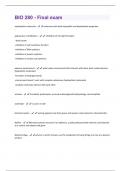
amphipathic molecules - molecules with both hydrophilic and hydrophobic properties approaches of antibiotics - -inhibition of cell wall formation --beta lactam -inhibition of cell membrane function -inhibition of DNA synthesis -inhibition of protein synthesis -inhibition of nucleic acid synthesis aqueous environment - -polar water environment that interacts with other polar molecules/ions (hydrophilic molecules) -formation of hydrogen bonds -environment doesn't react with nonpolar substances (hydrophobic molecules) -nonpolar molecules interact with each other archaea - Unicellular prokaryotes; unusual anatomy/genetics/physiology; extremophiles autotroph - C source is CO2 binomial system - naming organisms by their genus and species names based on characteristics Biofilm - Microbial colonies encased in an adhesive, usually polysaccharide material, and attached to a surface and expand and grow Biotechnology - process in which humans use the metabolism of living things to arrive at a desired productCarbohydrates - -monosaccharides, disaccharides, polysaccharides -formed by polymerization -sugars (glucose, fructose; sucrose) -starch, cellulose, glycogen -structural support -nutrient and energy storage carbon - -fundamental element of life -4 valence electrons -can form single/double/triple bonds -can form linear/ringed/branched molecules Cell envelope components - outer membrane (not on all), cell wall, glycocalyx (not on all), cytoplasmic membrane Chemolithotrophs - obtain energy from inorganic compounds Chemoorganotrophs - obtain energy from organic compounds chemotaxis - -runs become longer and fewer tumbles in presence of an attractant -also happens in the presence of a repellent, but moves away from it instead of towards it components of microbiology from largest to smallest - red blood cell (8 um), E. coli (3 x .6 um), hiv/flu virus (130 nm), hepatitis virus (45 nm), antibody (12 nm), glucose (900 pm) Cyanobactera - green/blue bacteria that lives in brackish water
Written for
- Institution
- BIO 280
- Course
- BIO 280
Document information
- Uploaded on
- June 26, 2024
- Number of pages
- 10
- Written in
- 2023/2024
- Type
- Exam (elaborations)
- Contains
- Questions & answers
Subjects

Also available in package deal