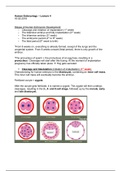
Human Embryology – Lecture 4
16-02-2018
Stages of Human Embryonic Development:
- Cleavage and initiation of implantation (1 st week)
- The bilaminar embryo and fully implantation (2 nd week)
- The trilaminar embryo (3rd week)
- The embryonic period (4th to 8th week)
- The fetal period (8th week to birth)
*From 8 weeks on, everything is already formed, except of the lungs and the
urogenital system. From 8 weeks onward (fetal period), there is only growth of the
embryo.
*The pronucleus of sperm + the pronucleus of an egg fuse, resulting in a
pronucleus. Cleavages will start after this fusing. At the moment of implantation
pregnancy has officially taken place Hcg gets secreted.
Cleavage and blastulation (initiation of implantation) (1st week):
Characterizing for human embryos is the blastocyst, containing an inner cell mass.
This inner cell mass will eventually become the embryo.
Fertilized oocyte = zygote.
After the oocyte gets fertilized, it is named a zygote. The zygote will then undergo
cleavages, resulting in the 2-, 4- and 8-cell stage, followed up by the morula, early
and late blastocyst.
, Zona pellucida: The zona pellucida (inner thick layer) is a glycoprotein layer
surrounding the plasma membrane of mammalian oocytes. The zona pellucida is
essential for oocyte growth and fertilization (Wikipedia)
Zona radiata: Outer layer, sticks to zona pellucida. Is the outer protective
glycoprotein layer of the ovum.
Trophoblast: Are cells forming the outer layer of a blastocyst, which will provide
nutrients to the embryo and will later develop into a large part of the placenta. These
are the first cells to differentiate from the fertilized egg.
Morula: late stage of compaction (5 days), beginning of cavitation
Compaction:
- Starts after the 8-cell stage
- Concentration of cell adhesion molecules around the apical surface of the
blastomeres (e.g. E-cadherin).
- Creation of a compact bowl early embryo.
Cavitation:
- Starts 4 days after fertilization
- Formation of blastocoel
(blastocyst cavity)
blastocyst
Zona pellucida gets mostly
degenerated blastocyst
‘hatches’ out of zona pellucida.
Embryonic and abembryonic
pole.
16-02-2018
Stages of Human Embryonic Development:
- Cleavage and initiation of implantation (1 st week)
- The bilaminar embryo and fully implantation (2 nd week)
- The trilaminar embryo (3rd week)
- The embryonic period (4th to 8th week)
- The fetal period (8th week to birth)
*From 8 weeks on, everything is already formed, except of the lungs and the
urogenital system. From 8 weeks onward (fetal period), there is only growth of the
embryo.
*The pronucleus of sperm + the pronucleus of an egg fuse, resulting in a
pronucleus. Cleavages will start after this fusing. At the moment of implantation
pregnancy has officially taken place Hcg gets secreted.
Cleavage and blastulation (initiation of implantation) (1st week):
Characterizing for human embryos is the blastocyst, containing an inner cell mass.
This inner cell mass will eventually become the embryo.
Fertilized oocyte = zygote.
After the oocyte gets fertilized, it is named a zygote. The zygote will then undergo
cleavages, resulting in the 2-, 4- and 8-cell stage, followed up by the morula, early
and late blastocyst.
, Zona pellucida: The zona pellucida (inner thick layer) is a glycoprotein layer
surrounding the plasma membrane of mammalian oocytes. The zona pellucida is
essential for oocyte growth and fertilization (Wikipedia)
Zona radiata: Outer layer, sticks to zona pellucida. Is the outer protective
glycoprotein layer of the ovum.
Trophoblast: Are cells forming the outer layer of a blastocyst, which will provide
nutrients to the embryo and will later develop into a large part of the placenta. These
are the first cells to differentiate from the fertilized egg.
Morula: late stage of compaction (5 days), beginning of cavitation
Compaction:
- Starts after the 8-cell stage
- Concentration of cell adhesion molecules around the apical surface of the
blastomeres (e.g. E-cadherin).
- Creation of a compact bowl early embryo.
Cavitation:
- Starts 4 days after fertilization
- Formation of blastocoel
(blastocyst cavity)
blastocyst
Zona pellucida gets mostly
degenerated blastocyst
‘hatches’ out of zona pellucida.
Embryonic and abembryonic
pole.