

LIMITS AND DERIVATIVES
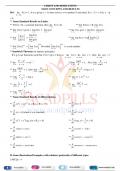
MAIN CONCEPTS AND RESULTS
Def : lim f(x) = l , if to a given > 0, there exists a +ve number S such that | f(x) - l | < for | x – a|
x a
< .
** Some Standard Results on Limits :
** If f(x) = K, a constant function, then lim f(x) = K. ** lim K.f(x) = K lim f(x)
x a x a x a
** lim [f(x) g(x)] = lim f(x) lim g(x) ** lim f(x). g(x) = lim f(x). lim g(x)
x a x a x a x a x a x a
f(x) lim f(x)
** lim = x a
. ** lim log f(x) = log lim f(x) .
x a
g(x) lim g(x) x a x a
x a
1/n 1/n
** lim [f(x)]1/n . = lim f(x) Provided lim f(x) is a real number.
x a x a x a
**Sandwich Theorem (or squeeze principle).
If f, g, h are functions such that F(x) g(x) h(x) as lim f(x) = lim h(x) = l , then lim g(x) = l
xa xa x a
x a
n n
sin θ θ
** lim = na n - 1 . ** lim = 1, Also lim =1
x a xa 0 θ 0 sin θ
tan θ θ ex - 1
** lim = 1, Also lim =1 ** lim = log e = 1
0 θ 0 tan θ x 0 x
ax -1
** lim = log a ** lim (1 + x)1/x = e
x 0 x x 0
n
1 sin-1 x
** lim 1 = C ** lim =1
n n x 0 x
tan -1 x
** lim =1
x 0 x
** Some Standard Results of differentiation
d n d
** ( x ) nx n 1 ( x R , n R , x 0) ** (x) 1
dx dx
d d x
** (c) 0 (where c is a constant) ** (e ) e x
dx dx
d x d 1
** (a ) a x loge a (a R , a 0) ** (loge x ) ( x 0)
dx dx x
d d
** (sin x ) cos x ** (cos x ) sin x
dx dx
d d
** (tan x ) sec2 x ** (cot x ) cos ec2 x
dx dx
d d
** (sec x ) sec x tan x ** (cos ecx) cos ecx cot x
dx dx
II. Some illustrations/Examples (with solution) preferably of different types.
i) MCQs : 4
80
, sinax
Q1. limx→0 is
bx
(a) 1 (b) 0 (c) a/b (d) b/a
sinax 0
Sol :-. limx→0 form
bx 0
sinax a
= limx→0 .a
bx
a sinax
=b limx→0 ax
a
=b . 1
a
=b Ans[c]
x dy
Q2. y = , then = …………..
tanx dx
tanx −secx tanx −xsec 2 x
a cos 2 x (b) sec 2 x(c) (d)
tan 2 x tan 2 x
Solution:
d d
dy tanx x −x tanx
= dx dx
dx tan2 x
dy tanx .1−x.sec 2 x
= ans (d)
dx tan 2 x
x m −1
Q3. Evaluate limx→1 x n −1
Solution:
xm − 1 xm − 1 x − 1
lim n = lim × n
x→1 x − 1 x→1 x − 1 x −1
m ∙ 1m−1 x n − an
= ∵ lim = nan−1
n ∙ 1n−1 x→a x − a
m∙1
=
n∙1
m
=
n
(a) 1 (b) 0 (c) m/n (d) n/m
Ans(c)
d
Q4.dx (2x2+3x+4) is
(a) 4x+3 (b) 4x-3 (c) 3+x (d) x-1
d
Solution: (2x2+3x+4)
dx
=4x+3
Ans ( a)
ii) Short answer type question:
sinax +bx
Q5. Evaluate limx→0 ax +sinbx , a, b, a + b ≠ 0
81
MAIN CONCEPTS AND RESULTS
Def : lim f(x) = l , if to a given > 0, there exists a +ve number S such that | f(x) - l | < for | x – a|
x a
< .
** Some Standard Results on Limits :
** If f(x) = K, a constant function, then lim f(x) = K. ** lim K.f(x) = K lim f(x)
x a x a x a
** lim [f(x) g(x)] = lim f(x) lim g(x) ** lim f(x). g(x) = lim f(x). lim g(x)
x a x a x a x a x a x a
f(x) lim f(x)
** lim = x a
. ** lim log f(x) = log lim f(x) .
x a
g(x) lim g(x) x a x a
x a
1/n 1/n
** lim [f(x)]1/n . = lim f(x) Provided lim f(x) is a real number.
x a x a x a
**Sandwich Theorem (or squeeze principle).
If f, g, h are functions such that F(x) g(x) h(x) as lim f(x) = lim h(x) = l , then lim g(x) = l
xa xa x a
x a
n n
sin θ θ
** lim = na n - 1 . ** lim = 1, Also lim =1
x a xa 0 θ 0 sin θ
tan θ θ ex - 1
** lim = 1, Also lim =1 ** lim = log e = 1
0 θ 0 tan θ x 0 x
ax -1
** lim = log a ** lim (1 + x)1/x = e
x 0 x x 0
n
1 sin-1 x
** lim 1 = C ** lim =1
n n x 0 x
tan -1 x
** lim =1
x 0 x
** Some Standard Results of differentiation
d n d
** ( x ) nx n 1 ( x R , n R , x 0) ** (x) 1
dx dx
d d x
** (c) 0 (where c is a constant) ** (e ) e x
dx dx
d x d 1
** (a ) a x loge a (a R , a 0) ** (loge x ) ( x 0)
dx dx x
d d
** (sin x ) cos x ** (cos x ) sin x
dx dx
d d
** (tan x ) sec2 x ** (cot x ) cos ec2 x
dx dx
d d
** (sec x ) sec x tan x ** (cos ecx) cos ecx cot x
dx dx
II. Some illustrations/Examples (with solution) preferably of different types.
i) MCQs : 4
80
, sinax
Q1. limx→0 is
bx
(a) 1 (b) 0 (c) a/b (d) b/a
sinax 0
Sol :-. limx→0 form
bx 0
sinax a
= limx→0 .a
bx
a sinax
=b limx→0 ax
a
=b . 1
a
=b Ans[c]
x dy
Q2. y = , then = …………..
tanx dx
tanx −secx tanx −xsec 2 x
a cos 2 x (b) sec 2 x(c) (d)
tan 2 x tan 2 x
Solution:
d d
dy tanx x −x tanx
= dx dx
dx tan2 x
dy tanx .1−x.sec 2 x
= ans (d)
dx tan 2 x
x m −1
Q3. Evaluate limx→1 x n −1
Solution:
xm − 1 xm − 1 x − 1
lim n = lim × n
x→1 x − 1 x→1 x − 1 x −1
m ∙ 1m−1 x n − an
= ∵ lim = nan−1
n ∙ 1n−1 x→a x − a
m∙1
=
n∙1
m
=
n
(a) 1 (b) 0 (c) m/n (d) n/m
Ans(c)
d
Q4.dx (2x2+3x+4) is
(a) 4x+3 (b) 4x-3 (c) 3+x (d) x-1
d
Solution: (2x2+3x+4)
dx
=4x+3
Ans ( a)
ii) Short answer type question:
sinax +bx
Q5. Evaluate limx→0 ax +sinbx , a, b, a + b ≠ 0
81


