

STATISTICS
CONCEPTS AND RESULTS
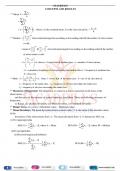
* * Mean x
xi
n
fi x i
fi
a i i h,
fu xi a
where a is the assumed mean , h is the class size and u i
f h
i
th
n 1
* * Median observations arranged in ascending or descending order & the number of observations
2
is odd.
th th
n n
mean of & 1 observations arranged in ascending or descending order & the number
2 2
of observations is odd.
n
cf
l 2 h where, l lower limit of median class, n number of observations,
f
cf cumulative frequency of class preceding the median class,f frequency of median class,
h class size .
f1 f 0
* * Mode l h, where l lower limit of the modal class, h size of the class interval,
2f1 f 0 f 2
f1 frequency of the modal class, f 0 frequency of the class preceding the modal class,
f 2 frequency of the class succeeding the modal class.
** Measures of Dispersion: The dispersion or scatter in a data is measured on the basis of the
observations
and the types of the measure of central tendency, used there. There are following measures of
dispersion:
(i) Range, (ii) Quartile deviation, (iii) Mean deviation, (iv) Standard deviation.
** Range: Range of a series = Maximum value – Minimum value.
** Mean Deviation : The mean deviation about a central value „a‟ is the mean of the absolute values
of the
deviations of the observations from „a‟. The mean deviation from „a‟ is denoted as M.D. (a).
(i) For ungrouped data
1 n 1 n
M.D.( x ) x i x , where x Mean
n i 1
M.D.( M) x i x , where M Median
n i 1
(ii) For grouped data
(a) Discretefrequency distribution
n
fi x i x 1 n 1 n
M.D.( x ) i 1
n
fi x i x
N i 1
M.D.( M) xi M
N i 1
fi
i 1
88
, (b) Continuous frequency distribution
f i x i x , u sin g x a i i h
1 n fu
M.D.( x )
N i 1 f
i
n
1 n cf
M.D.( M ) x i M , u sin g M l 2 h
N i 1 f
** Limitations of mean deviation : The sum of the deviations from the mean (minus signs ignored) is
more than the sum of the deviations from median. Therefore, the mean deviation about the mean is not
very scientific.Thus, in many cases, mean deviation may give unsatisfactory results. Also mean
deviation is calculated on the basis of absolute values of the deviations and therefore, cannot be
subjected to further algebraic treatment.
Chapter Test
General Instructions: All questions are compulsory.
Section A (MCQ)
Question 1. Find the mean and variance for each of the data
6, 7, 10, 12, 13, 4, 8, 12
A) 9 and 9.25
B) 19 and 9.25
C) 3and 19.25
D) 29 and 6.25
Question 2. Find the mean deviation about the mean for the data
4, 7, 8, 9, 10, 12, 13, 17
A) 4
B) 6
C) 3
D) 8
Question 3. Find the mean deviation about the median for the data
13, 17, 16, 14, 11, 13, 10, 16, 11, 18, 12, 17
A) 9
B) 1.2
C) 4
D) 2.33
Question 4. Find the mean and variance for each of the data
First 10 multiples of 3
A) 9 and 9.25
B) 16.5 and 74.25
C) 32 and 19.25
D) 19 and 61.25
89
CONCEPTS AND RESULTS
* * Mean x
xi
n
fi x i
fi
a i i h,
fu xi a
where a is the assumed mean , h is the class size and u i
f h
i
th
n 1
* * Median observations arranged in ascending or descending order & the number of observations
2
is odd.
th th
n n
mean of & 1 observations arranged in ascending or descending order & the number
2 2
of observations is odd.
n
cf
l 2 h where, l lower limit of median class, n number of observations,
f
cf cumulative frequency of class preceding the median class,f frequency of median class,
h class size .
f1 f 0
* * Mode l h, where l lower limit of the modal class, h size of the class interval,
2f1 f 0 f 2
f1 frequency of the modal class, f 0 frequency of the class preceding the modal class,
f 2 frequency of the class succeeding the modal class.
** Measures of Dispersion: The dispersion or scatter in a data is measured on the basis of the
observations
and the types of the measure of central tendency, used there. There are following measures of
dispersion:
(i) Range, (ii) Quartile deviation, (iii) Mean deviation, (iv) Standard deviation.
** Range: Range of a series = Maximum value – Minimum value.
** Mean Deviation : The mean deviation about a central value „a‟ is the mean of the absolute values
of the
deviations of the observations from „a‟. The mean deviation from „a‟ is denoted as M.D. (a).
(i) For ungrouped data
1 n 1 n
M.D.( x ) x i x , where x Mean
n i 1
M.D.( M) x i x , where M Median
n i 1
(ii) For grouped data
(a) Discretefrequency distribution
n
fi x i x 1 n 1 n
M.D.( x ) i 1
n
fi x i x
N i 1
M.D.( M) xi M
N i 1
fi
i 1
88
, (b) Continuous frequency distribution
f i x i x , u sin g x a i i h
1 n fu
M.D.( x )
N i 1 f
i
n
1 n cf
M.D.( M ) x i M , u sin g M l 2 h
N i 1 f
** Limitations of mean deviation : The sum of the deviations from the mean (minus signs ignored) is
more than the sum of the deviations from median. Therefore, the mean deviation about the mean is not
very scientific.Thus, in many cases, mean deviation may give unsatisfactory results. Also mean
deviation is calculated on the basis of absolute values of the deviations and therefore, cannot be
subjected to further algebraic treatment.
Chapter Test
General Instructions: All questions are compulsory.
Section A (MCQ)
Question 1. Find the mean and variance for each of the data
6, 7, 10, 12, 13, 4, 8, 12
A) 9 and 9.25
B) 19 and 9.25
C) 3and 19.25
D) 29 and 6.25
Question 2. Find the mean deviation about the mean for the data
4, 7, 8, 9, 10, 12, 13, 17
A) 4
B) 6
C) 3
D) 8
Question 3. Find the mean deviation about the median for the data
13, 17, 16, 14, 11, 13, 10, 16, 11, 18, 12, 17
A) 9
B) 1.2
C) 4
D) 2.33
Question 4. Find the mean and variance for each of the data
First 10 multiples of 3
A) 9 and 9.25
B) 16.5 and 74.25
C) 32 and 19.25
D) 19 and 61.25
89


