

TNCC pre exam 2024 Questions & Answers with complete solution
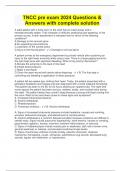
TNCC pre exam 2024 Questions & Answers with complete solution A adult patient with a knife injury to the neck has an intact airway and is hemodynamically stable. They complain of difficulty swallowing and speaking. In the primary survey, further assessment is indicated next for which of the following conditions? A.Damage to the cervical spine B.An expanding pneumothorax C.Laceration of the carotid artery D.Injury to the thyroid gland - Damage to cervical spine A patient arrives at the emergency department by private vehicle after sustaining an injury to the right lower extremity while using a saw. There is a large gaping wound to the right thigh area with significant bleeding. What is the priority intervention? A.Elevate the extremity to the level of the heart B.Initiate direct pressure C.Apply a tourniquet D.Cover the open wound with sterile saline dressings - B. The first step in controlling any bleeding is application of direct pressure. A patient fell two weeks ago, striking their head. Today, the patient presented with a persistent headache and nausea and was diagnosed with a small subdural hematoma. The patient has been in the ED for 24 hours awaiting an inpatient bed. The night shift nurse reports the patient has been anxious, restless, shaky, and vomited twice during the night. The patient states they couldn't sleep because a young child kept coming into the room. What is the most likely cause for these signs and symptoms? A. Increased intracranial pressure B. Alcohol withdrawal C. Rhabdomyolysis D. Pulmonary embolus - B- Alcohol withdrawal A: Signs of increased intracranial pressure include headache, nausea and vomiting, amnesia, behavioral changes, and altered level of consciousness. B: Alcohol withdrawal is a common delayed condition because symptoms are difficult to identify early. Signs include autonomic hyperactivity, hand tremors, nausea or vomiting, psychomotor agitation, anxiety, insomnia, transient hallucinations, or seizures. C: Signs of rhabdomyolysis include muscle pain or weakness, dark red or brown urine, general weakness or malaise, and elevated creatinine kinase levels. D: Signs of pulmonary embolus include anxiety, pleuritic chest pain, dyspnea, hypoxemia, hemoptysis, cough, orthopnea, adventitious lung sounds, decreased lung sounds, jugular vein distension, or hypotension.
Document information
- Uploaded on
- June 19, 2024
- Number of pages
- 4
- Written in
- 2023/2024
- Type
- Exam (elaborations)
- Contains
- Questions & answers


