

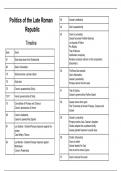
Politics of the Late Roman 65 Caesar’s aedileship
64 Cato’s quaestorship
Republic
63 Cicero’s consulship
Caesar becomes Pontifex Maximus
Timeline Lex Agraria of Rullus
Pro Rabirio
Date Event Trial of Murena
Catilinarian conspiracy
81 Sulla steps down from Dictatorship Senatus consultum ultimum on the conspirators
(December)
80 Sulla’s Consulship
62 The Bona Dea scandal
79 Sulla becomes a private citizen Cato’s tribuneship
Caesar’s praetorship
78 Sulla dies
Pompey returns from the east
75 Cicero’s quaestorship (Sicily)
61 Trial of Clodius
73-71 Verres’ governorship of Sicily Caesar’s governorship (Further Spain)
70 Consulships of Pompey and Crassus 60 Caesar returns from spain
Cicero’s prosecution of Verres First Triumvirate is formed: Pompey, Crassus and
Caesar
69 Cicero’s Aedileship
Caesar’s quaestorship (Spain) 59 Caesar’s consulship
Pompey marries Julia, Caesar’s daughter
67 Lex Gabinia - Granted Pompey Imperium against the Clodius adopted into a plebeian family
pirates Caesar granted Imperium to pacify Gaul
Cato Military Tribune
58 Clodius’ tribuneship
66 Lex Manilia - Granted Pompey Imperium against Cicero is exiled
Mithridates Caesar departs for Gaul
Cicero’s Praetorship Cato is sent to annex Cyprus
57 Cicero’s returns from exile
, 48 Caesar’s second consulship
Pompey’s five year Imperium to stabilise corn supply to Caesar’s dictatorship (11 days)
Rome Defeat of Pompey by Caesar at Pharsalus (August)
Gang warfare and rioting in Rome Death of Pompey in Egypt
56 The conference at Luca (April) 47 Caesar’s dictatorship in absence
Cato returns Caesar returns briefly to Italy then sails for North Africa
to confront anti-Caesarians led by Cato
55 Second consulship of Pompey and Crassus
Caesar given a further five year command in Gaul 46 Suicide of Cato after defeat at Thapsus
Pompey given five year command in Spain in absence Caesar’s dictatorship and third consulship; returns to
Crassus given five year command in Syria Rome, then leaves for Spain to deal with last anti-
Caesareans
54 Death of Julia
Pompey in Rome, governing Spain in absence 45 Last of Pompeians defeated by Caesar at Munda in
Caesar in Gaul and crosses over to Britain Spain
Crassus in Syria for Parthian campaign Caesar returns to Rome to great honours
Cato’s praetorship Caesar’s dictatorship and fourth consulship
Riots in Rome Cicero writes eulogy to Cato; Caesar writes Anti-Cato
53 Continued riots in Rome - no consul is elected 44 Caesar becomes dictator Perpetuo and assumes fifth
Death of Crassus at Carthage consulship
Assassination of Julius Caesar, 15th March (Ides of
52 Clodius killed by Milo March)
Pompey appointed sole consul (to August) Octavian named as heir and returns form Eprius
Antony receives command of Gaul
51 Cato fails to become Consul
Cicero starts to deliver the Philippics
51-50 Cicero’s governorship (Cilicia)
43 Outbreak of Civil War; Mark Antony is declared enemy
50 Curio’s tribuneship of the state
Siege of Mutina
49 Caesar crosses the Rubicon into Sicily Deaths of the Consuls Hirtius and Pansa
Civil War Octavian occupies Rome and assumes consulship
Senate is evacuated from Rome with Pompey to (August)
Greece; Cato and Cicero support Pompey Formation of the Second Triumvirate: Octavian, Antony
and Lepidus (November)
, Proscriptions Equites
Death of Cicero (7th December) ● Rank of Roman citizens who grew in wealth and status after
gaining revenue from commerce and finance.
● They were both wealthy and educated.
Social Hierarchy ● By 79 BC the roles of the social order had changed.
Patricians Organisation of the Senate
● Significant landowners
The Roman Republic, known as the Res Publica, consisted of the
● Occupied the privileged positions of society.
phrase Senatus Populusque Romanus (SPQR), the Senate
● Central to key areas:
and the People of Rome. The Senate was organised by the
○ Politics
political ladder known as the Cursus Honorum. The ladder was
○ Religion
designed so that each politician gained all of the knowledge
○ Legal
necessary for when they reached the top role. Each politician
○ Military
was meant to take all offices.
● Could trace their ancestry back to the early days of Rome.
They would have been the founding members of the ruling
In ancient Rome, although every male citizen theoretically could
aristocratic group from whom Romulus chose the first
aspire to high office, in practice, only the rich had realistic
Senators.
chances of attaining such positions. This was largely due to
the wealthy citizens' sway in the Assembly of the Centuries,
Plebeians where they outnumbered the poor in voting bodies.
● The majority of the citizen body. Their roles included labourers Additionally, since these offices were unpaid, poorer
and farmers. individuals lacked the means to sustain themselves while
● They were initially barred from all positions of authority. holding office.
● Patricians and Plebeians could not intermarry.
● By the 4th Century they were given the right to hold public Respect for tradition also played a significant role, as high political
office due to the need for capable admin due to their newly office was typically reserved for members of the nobility with
acquired territories. established political lineage. It was rare for a candidate to
● Wealth was no longer a discriminatory factor to distinguish the become consul without having a consul in the family lineage,
two classes. though some exceptions, like Cicero, were termed "novus
● Made up 95% of the population. homo" or "new men".
Following the Conflict of the Orders, structural principles were
established. Offices in the Cursus Honorum had minimum age
restrictions to ensure maturity in officeholders. A system of
, checks and balances was implemented, including having at ● The Consuls would alternate who was the main lead every
least two individuals hold the same office simultaneously, month, with one having a greater power over decisions than
intervals between successive offices, and laws prohibiting the other for that short moment in time.
repeat terms, though reforms by Lucius Cornelius Sulla ● The years were tracked by the names of the Consuls who
adjusted these rules. were elected for that duration.
● The Consuls were granted Imperium, the right to wield an
While the Roman Republic theoretically operated as a army, and were recognised as the chief military and political
participatory democracy, oligarchic elements prevailed, executives of the state.
primarily due to governance by a small elite class. ● If you attained the Consul positions, you were considered to
Representative elements existed through popular elections for have reached the peak of your political career.
offices and representation by tribunes for plebeian interests. ● The Consuls could command armies, the senate and preside
over the Comitia (the military assembly). They were able to
The Senate played a crucial role as the only permanent governing propose laws to the people, and they had the right over
body, comprising ex-magistrates appointed by consuls. It jurisdiction but the praetors were in control in cases of criminal
controlled finances, foreign affairs, and state administration, trials.
holding the highest prestige. It was made up of 200-300 ● Consuls presided over the Senate. They also presides over
Senators. The Senate was only an advisory body however, the three Roman Assemblies:
and could not pass laws. ○ Curiate
○ Centuriate
Attaining each office at the minimum age, known as "suo anno" or ○ Tribal
"in his year," was a significant political achievement. Failure to ● It was the job of the Consuls to meet with foreign dignitaries
become praetor at 39 meant disqualification for consulship at and ambassadors before they reached the senate. The
42. Cicero, for instance, took pride in becoming consul without Consuls were responsible for negotiating between Rome and
familial precedent and achieving it "in his year." foreign powers.
● Each Consul could command two legions of Soldiers. In some
However, as seen in earlier notes, the late Roman Republic cases they would march together, but this was very rare.
witnessed the disregard of office-holding rules, contributing to ● There were restrictions placed on the Consuls:
the system's collapse. While offices were ostensibly for public ○ They could only hold office for one year.
service, they often became avenues for personal gain and ○ Their duties were pre-determined by the Senate.
self-aggrandisement. ○ THey could not run for office immediately, they had to
wait 10 years.
Consul
● The top position on the Cursus Honorum. Praetor
● Two were elected every year with the minimum age being 42. ● A male citizen could run for Prator age 39.
● Praetors were voted in by the Assembly of the Centuries.
64 Cato’s quaestorship
Republic
63 Cicero’s consulship
Caesar becomes Pontifex Maximus
Timeline Lex Agraria of Rullus
Pro Rabirio
Date Event Trial of Murena
Catilinarian conspiracy
81 Sulla steps down from Dictatorship Senatus consultum ultimum on the conspirators
(December)
80 Sulla’s Consulship
62 The Bona Dea scandal
79 Sulla becomes a private citizen Cato’s tribuneship
Caesar’s praetorship
78 Sulla dies
Pompey returns from the east
75 Cicero’s quaestorship (Sicily)
61 Trial of Clodius
73-71 Verres’ governorship of Sicily Caesar’s governorship (Further Spain)
70 Consulships of Pompey and Crassus 60 Caesar returns from spain
Cicero’s prosecution of Verres First Triumvirate is formed: Pompey, Crassus and
Caesar
69 Cicero’s Aedileship
Caesar’s quaestorship (Spain) 59 Caesar’s consulship
Pompey marries Julia, Caesar’s daughter
67 Lex Gabinia - Granted Pompey Imperium against the Clodius adopted into a plebeian family
pirates Caesar granted Imperium to pacify Gaul
Cato Military Tribune
58 Clodius’ tribuneship
66 Lex Manilia - Granted Pompey Imperium against Cicero is exiled
Mithridates Caesar departs for Gaul
Cicero’s Praetorship Cato is sent to annex Cyprus
57 Cicero’s returns from exile
, 48 Caesar’s second consulship
Pompey’s five year Imperium to stabilise corn supply to Caesar’s dictatorship (11 days)
Rome Defeat of Pompey by Caesar at Pharsalus (August)
Gang warfare and rioting in Rome Death of Pompey in Egypt
56 The conference at Luca (April) 47 Caesar’s dictatorship in absence
Cato returns Caesar returns briefly to Italy then sails for North Africa
to confront anti-Caesarians led by Cato
55 Second consulship of Pompey and Crassus
Caesar given a further five year command in Gaul 46 Suicide of Cato after defeat at Thapsus
Pompey given five year command in Spain in absence Caesar’s dictatorship and third consulship; returns to
Crassus given five year command in Syria Rome, then leaves for Spain to deal with last anti-
Caesareans
54 Death of Julia
Pompey in Rome, governing Spain in absence 45 Last of Pompeians defeated by Caesar at Munda in
Caesar in Gaul and crosses over to Britain Spain
Crassus in Syria for Parthian campaign Caesar returns to Rome to great honours
Cato’s praetorship Caesar’s dictatorship and fourth consulship
Riots in Rome Cicero writes eulogy to Cato; Caesar writes Anti-Cato
53 Continued riots in Rome - no consul is elected 44 Caesar becomes dictator Perpetuo and assumes fifth
Death of Crassus at Carthage consulship
Assassination of Julius Caesar, 15th March (Ides of
52 Clodius killed by Milo March)
Pompey appointed sole consul (to August) Octavian named as heir and returns form Eprius
Antony receives command of Gaul
51 Cato fails to become Consul
Cicero starts to deliver the Philippics
51-50 Cicero’s governorship (Cilicia)
43 Outbreak of Civil War; Mark Antony is declared enemy
50 Curio’s tribuneship of the state
Siege of Mutina
49 Caesar crosses the Rubicon into Sicily Deaths of the Consuls Hirtius and Pansa
Civil War Octavian occupies Rome and assumes consulship
Senate is evacuated from Rome with Pompey to (August)
Greece; Cato and Cicero support Pompey Formation of the Second Triumvirate: Octavian, Antony
and Lepidus (November)
, Proscriptions Equites
Death of Cicero (7th December) ● Rank of Roman citizens who grew in wealth and status after
gaining revenue from commerce and finance.
● They were both wealthy and educated.
Social Hierarchy ● By 79 BC the roles of the social order had changed.
Patricians Organisation of the Senate
● Significant landowners
The Roman Republic, known as the Res Publica, consisted of the
● Occupied the privileged positions of society.
phrase Senatus Populusque Romanus (SPQR), the Senate
● Central to key areas:
and the People of Rome. The Senate was organised by the
○ Politics
political ladder known as the Cursus Honorum. The ladder was
○ Religion
designed so that each politician gained all of the knowledge
○ Legal
necessary for when they reached the top role. Each politician
○ Military
was meant to take all offices.
● Could trace their ancestry back to the early days of Rome.
They would have been the founding members of the ruling
In ancient Rome, although every male citizen theoretically could
aristocratic group from whom Romulus chose the first
aspire to high office, in practice, only the rich had realistic
Senators.
chances of attaining such positions. This was largely due to
the wealthy citizens' sway in the Assembly of the Centuries,
Plebeians where they outnumbered the poor in voting bodies.
● The majority of the citizen body. Their roles included labourers Additionally, since these offices were unpaid, poorer
and farmers. individuals lacked the means to sustain themselves while
● They were initially barred from all positions of authority. holding office.
● Patricians and Plebeians could not intermarry.
● By the 4th Century they were given the right to hold public Respect for tradition also played a significant role, as high political
office due to the need for capable admin due to their newly office was typically reserved for members of the nobility with
acquired territories. established political lineage. It was rare for a candidate to
● Wealth was no longer a discriminatory factor to distinguish the become consul without having a consul in the family lineage,
two classes. though some exceptions, like Cicero, were termed "novus
● Made up 95% of the population. homo" or "new men".
Following the Conflict of the Orders, structural principles were
established. Offices in the Cursus Honorum had minimum age
restrictions to ensure maturity in officeholders. A system of
, checks and balances was implemented, including having at ● The Consuls would alternate who was the main lead every
least two individuals hold the same office simultaneously, month, with one having a greater power over decisions than
intervals between successive offices, and laws prohibiting the other for that short moment in time.
repeat terms, though reforms by Lucius Cornelius Sulla ● The years were tracked by the names of the Consuls who
adjusted these rules. were elected for that duration.
● The Consuls were granted Imperium, the right to wield an
While the Roman Republic theoretically operated as a army, and were recognised as the chief military and political
participatory democracy, oligarchic elements prevailed, executives of the state.
primarily due to governance by a small elite class. ● If you attained the Consul positions, you were considered to
Representative elements existed through popular elections for have reached the peak of your political career.
offices and representation by tribunes for plebeian interests. ● The Consuls could command armies, the senate and preside
over the Comitia (the military assembly). They were able to
The Senate played a crucial role as the only permanent governing propose laws to the people, and they had the right over
body, comprising ex-magistrates appointed by consuls. It jurisdiction but the praetors were in control in cases of criminal
controlled finances, foreign affairs, and state administration, trials.
holding the highest prestige. It was made up of 200-300 ● Consuls presided over the Senate. They also presides over
Senators. The Senate was only an advisory body however, the three Roman Assemblies:
and could not pass laws. ○ Curiate
○ Centuriate
Attaining each office at the minimum age, known as "suo anno" or ○ Tribal
"in his year," was a significant political achievement. Failure to ● It was the job of the Consuls to meet with foreign dignitaries
become praetor at 39 meant disqualification for consulship at and ambassadors before they reached the senate. The
42. Cicero, for instance, took pride in becoming consul without Consuls were responsible for negotiating between Rome and
familial precedent and achieving it "in his year." foreign powers.
● Each Consul could command two legions of Soldiers. In some
However, as seen in earlier notes, the late Roman Republic cases they would march together, but this was very rare.
witnessed the disregard of office-holding rules, contributing to ● There were restrictions placed on the Consuls:
the system's collapse. While offices were ostensibly for public ○ They could only hold office for one year.
service, they often became avenues for personal gain and ○ Their duties were pre-determined by the Senate.
self-aggrandisement. ○ THey could not run for office immediately, they had to
wait 10 years.
Consul
● The top position on the Cursus Honorum. Praetor
● Two were elected every year with the minimum age being 42. ● A male citizen could run for Prator age 39.
● Praetors were voted in by the Assembly of the Centuries.


