

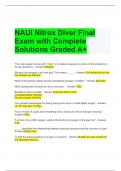
NAUI Nitrox Diver Final Exam with Complete Solutions Graded A+ The main reason to dive with "nitrox" is to reduce exposure to some of the probl ems in diving caused by: - Answer -Nitrogen We say that nitrogen is an inert gas. This means_____. - Answer -Our bodies do not use the nitrogen we breathe. What is the primary safety hazard of breathing nitrogen at depth? - Answer -Narcosis NAUI sanctioned enriched air nitrox training in: - Answer -1992 Benefits of nitrox include: - Answer -Extended bottom time Increased safety margins Shorter surface intervals The greatest advantages for diving using nitrox occur in what depth range? - Answer -
15- 33 msw (5 0-110 fsw) True or False: A scuba diver breathing nitrox avoids any risk of nitrogen narcosis. - Answer -False If a nitrox mix is 36% oxygen, what is the fraction of oxygen in the gas mix? - Answer -
0.36 _____ describes the relationship between absolute p ressure and the volume of a gas. - Answer -Boyle's Law To find the partial pressure of a gas in a mixture: - Answer -Multiply the gas fraction by the absolute pressure. The water pressure plus atmospheric pressure equals: - Answer -Absolute pressure What is the absolute pressure at 34 msw (111 fsw)? - Answer -4.4 ata What is the nitrogen partial pressure (PN2) in EAN35 at a depth of 26 msw (85 fsw)? - Answer -2.3 ata What is the oxygen partial pressure (PO2) of EAN38 at 27 msw (87 fsw)? - Answer -1.4 ata At what depth in the ocean is the absolute pressure 6.4 ata? - Answer -54 msw (178 fsw) If the PO2 at 30 msw (98 fsw) is 1.4 atmospheres, what is the oxygen fraction of the breathing mixture? - Answer -0.35 What is the partial pressure of nitrogen in a ir at 40 msw (130 fsw)? - Answer -3.9 ata True or False. Narcosis is reduced significantly when diving with enriched air nitrox. - Answer -False The mechanisms of nitrogen narcosis are thought to be similar to: - Answer -Anesthesia Oxygen is used by the bo dy in: - Answer -Metabolism The term used for low oxygen in the body is: - Answer -Hypoxia Breathing high partial pressures of oxygen can cause: - Answer -Convulsions The accepted oxygen partial pressure exposure limit for recreational nitrox diving is: - Answer -1.4 ata At the first signs or symptoms of oxygen toxicity, a diver should: - Answer -Terminate the dive. Historically, what are the two standard nitrox mixes? - Answer -32% oxygen and 36% oxygen What is the "best mix" to use for an oxygen partial pressure limit of 1.4 ata on a dive to 27 msw (90 fsw)? - Answer -EAN38 Standard NAUI Dive Tables can be used for altitudes up to about: - Answer -300 meters (1000 feet) NAUI RGBM sea level Dive Tables ca n be used for altitudes up to: - Answer -610 meters (2000 feet)
15- 33 msw (5 0-110 fsw) True or False: A scuba diver breathing nitrox avoids any risk of nitrogen narcosis. - Answer -False If a nitrox mix is 36% oxygen, what is the fraction of oxygen in the gas mix? - Answer -
0.36 _____ describes the relationship between absolute p ressure and the volume of a gas. - Answer -Boyle's Law To find the partial pressure of a gas in a mixture: - Answer -Multiply the gas fraction by the absolute pressure. The water pressure plus atmospheric pressure equals: - Answer -Absolute pressure What is the absolute pressure at 34 msw (111 fsw)? - Answer -4.4 ata What is the nitrogen partial pressure (PN2) in EAN35 at a depth of 26 msw (85 fsw)? - Answer -2.3 ata What is the oxygen partial pressure (PO2) of EAN38 at 27 msw (87 fsw)? - Answer -1.4 ata At what depth in the ocean is the absolute pressure 6.4 ata? - Answer -54 msw (178 fsw) If the PO2 at 30 msw (98 fsw) is 1.4 atmospheres, what is the oxygen fraction of the breathing mixture? - Answer -0.35 What is the partial pressure of nitrogen in a ir at 40 msw (130 fsw)? - Answer -3.9 ata True or False. Narcosis is reduced significantly when diving with enriched air nitrox. - Answer -False The mechanisms of nitrogen narcosis are thought to be similar to: - Answer -Anesthesia Oxygen is used by the bo dy in: - Answer -Metabolism The term used for low oxygen in the body is: - Answer -Hypoxia Breathing high partial pressures of oxygen can cause: - Answer -Convulsions The accepted oxygen partial pressure exposure limit for recreational nitrox diving is: - Answer -1.4 ata At the first signs or symptoms of oxygen toxicity, a diver should: - Answer -Terminate the dive. Historically, what are the two standard nitrox mixes? - Answer -32% oxygen and 36% oxygen What is the "best mix" to use for an oxygen partial pressure limit of 1.4 ata on a dive to 27 msw (90 fsw)? - Answer -EAN38 Standard NAUI Dive Tables can be used for altitudes up to about: - Answer -300 meters (1000 feet) NAUI RGBM sea level Dive Tables ca n be used for altitudes up to: - Answer -610 meters (2000 feet)


