MCAT Biology: Reproduction Exam Questions with Complete Solutions. Latest Edition
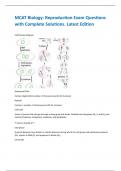
Cell Division Diagram Autosomal Cells Contain diploid (2n) number of chromosomes (46 for humans) Haploid Contain n number of chromosomes (23 for humans) Cell Cycle Series of events that cells go through as they grow and divide. Divided into Interphase (G₁, S, and G₂) and mitosis (Prophase, metaphase, anaphase, and telophase). "I Pee (on the) M.A.T." Interphase A period between two mitotic or meiotic divisions during which the cell grows and synthesizes proteins (G₁), copies its DNA (S), and prepares to divide (G₂) Chromatin The complex of DNA and proteins that makes up a eukaryotic chromosome. When the cell is not dividing, chromatin exists as a mass of very long, thin fibers that are not visible with a light microscope. chromatids Identical *chromosome copies* held together by a centromere, formed during the S-Phase of Interphase. Mitosis in eukaryotic cells, a process of cell division that forms two new nuclei, each of which has the same number of chromosomes. Prophase, Metaphase, Anaphase and Telophase. "I Pee (on the) M.A.T." Centrioles Paired, specialized subcellular organelles located in the centrosome. Responsible for correct division of DNA during mitosis. During prophase, they migrate to opposite poles of the cell and form spindle fibers, made from micotubules. Each fiber radiates outward from the centrioles, giving the chromosomes an attachment point during anaphase. Prophase -First and longest phase of mitosis -Chromosomes become visible (condense) -Centrioles separate, with spindle apparatus forming between them. -Nuclear membrane dissolves -Nucleoli become less distinct or disapear -Kinetochore fibers appear at centormere Metaphase -Centrioles are at opposite pole of the cell -Kinetochore fibers interact with spindle fibers, aligning chromosomes at the equatorial plate Anaphase -Centromeres split (each chromatid has own centromere), separating sister chromatids -Kinetochore fibers shorten, pulling the sister chromatids apart to opposite poles of the cell Telophase -The chromatids, now considered individual chromosomes, arrive at the poles. -Nuclear membrane reforms -Chromosome uncoil -Cytokinesis takes place Cytokinesis The final stage of the cell cycle, in which the cell's cytoplasm divides, distributing the organelles into each of the two new cells. Binary Fission a form of asexual reproduction in single-celled organisms by which one cell divides into two cells of the same size; no genetic diversity Budding Asexual reproduction in which a part of the parent organism pinches off and for
Written for
- Institution
- MCAT Biology
- Course
- MCAT Biology
Document information
- Uploaded on
- June 14, 2024
- Number of pages
- 8
- Written in
- 2023/2024
- Type
- Exam (elaborations)
- Contains
- Questions & answers
Subjects
-
mcat biology reproduction exam questions with co

Also available in package deal