

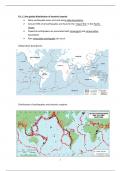
Ch.1.1 the global distribution of tectonic hazards
➢ Main earthquake zones are fund along plate boundaries
➢ Around 70% of all earthquakes are found in the ‘ring of fire’ in the Pacific
Ocean
➢ Powerful earthquakes are associated with convergent and conservative
boundaries
➢ Rare intra-plate earthquake can occur
Global plate boundaries:
Distribution of earthquakes and volcanic eruption
1
,Type of boundaries:
Convergent Divergent Conservative
Earthquake Strong Small and with low Strong
- Subduction hazard risk - Area of friction
zone - Mostly located
in ocean
Volcanic eruption More vigorous Nil Nil
- Magma is But a spreading
melted by ridge is formed
water
Tsunami Big Unlikely to trigger Nil
- Displace the
water
Affect to Destroy the Construct new Nil
lithosphere lithosphere lithosphere
Theoretical frameworks and plate movement
✓ Rock in the upper mantle is cool
and brittle
✓ Rock in the lower mantle is plastic
and hot
✓ The temperature decreases down
from the crust, it results in convection
⚫ Convection results in tectonic plates movement
⚫ Gravity causes the denser oceanic crust to subduct into the asthenosphere
Paleomagnetism: study of magnetic rocks and sediments to record the history of the
magnetic fields.
Plate tectonics: plates move in different direction
Slab pulls Pulling force exerted by a cold, dense oceanic plate plunging
into the mantle due to its own weight
Ridge push Proposed driving force for plate motion in plate tectonics
that occurs at mid-oceanic rides because of the rigid
2
, lithosphere sliding down the hot, raised asthenosphere
below the mid-ocean ridge
⚫ OFZ (Oceanic Fracture Zone) – This is a belt of activity through the oceans and
along the mid-ocean ridges through Africa, the Red Sea, the Dead Sea
⚫ CFZ (Continental Fracture Zone) – This is a belt of activity along the mountain
ranges from Spain through the Alps to the Middle East and to the Himalayas
Types of locked fault
3
➢ Main earthquake zones are fund along plate boundaries
➢ Around 70% of all earthquakes are found in the ‘ring of fire’ in the Pacific
Ocean
➢ Powerful earthquakes are associated with convergent and conservative
boundaries
➢ Rare intra-plate earthquake can occur
Global plate boundaries:
Distribution of earthquakes and volcanic eruption
1
,Type of boundaries:
Convergent Divergent Conservative
Earthquake Strong Small and with low Strong
- Subduction hazard risk - Area of friction
zone - Mostly located
in ocean
Volcanic eruption More vigorous Nil Nil
- Magma is But a spreading
melted by ridge is formed
water
Tsunami Big Unlikely to trigger Nil
- Displace the
water
Affect to Destroy the Construct new Nil
lithosphere lithosphere lithosphere
Theoretical frameworks and plate movement
✓ Rock in the upper mantle is cool
and brittle
✓ Rock in the lower mantle is plastic
and hot
✓ The temperature decreases down
from the crust, it results in convection
⚫ Convection results in tectonic plates movement
⚫ Gravity causes the denser oceanic crust to subduct into the asthenosphere
Paleomagnetism: study of magnetic rocks and sediments to record the history of the
magnetic fields.
Plate tectonics: plates move in different direction
Slab pulls Pulling force exerted by a cold, dense oceanic plate plunging
into the mantle due to its own weight
Ridge push Proposed driving force for plate motion in plate tectonics
that occurs at mid-oceanic rides because of the rigid
2
, lithosphere sliding down the hot, raised asthenosphere
below the mid-ocean ridge
⚫ OFZ (Oceanic Fracture Zone) – This is a belt of activity through the oceans and
along the mid-ocean ridges through Africa, the Red Sea, the Dead Sea
⚫ CFZ (Continental Fracture Zone) – This is a belt of activity along the mountain
ranges from Spain through the Alps to the Middle East and to the Himalayas
Types of locked fault
3


