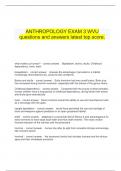
ANTHROPOLOGY EXAM 3 WVU questions and answers latest top score.
ANTHROPOLOGY EXAM 3 WVU questions and answers latest top score. what makes us human? - correct answer. Bipedalism, brains, skulls, Childhood dependency, tools, teeth biopedalism - correct answer. stresses the advantages it provided in a habitat increasingly dominated by dry, savanna-like conditions. Brains and skulls - correct answer. Early hominins had very small brains, Brain size has increased during hominin evolution, especially with the advent of the genus Homo. Childhood dependency - correct answer. Compared with the young of other primates, human children have a long period of childhood dependency, during which their brains and skulls grow dramatically. tools - correct answer. Early hominins shared the ability to use and manufacture tools as a homology with the apes. upright bipedalism - correct answer. would have permitted the use and carriage of tools and weapons against predators in an open grassland habitat. teeth - correct answer. adapting to a savannah diet of fibrous it was advantageous for early hominins to have large back teeth and thick tooth enamel. The rotary motion favored reduction of the canines and first premolars hominin - correct answer. human line after its split from ancestral chimps and emerge late miocene epoch hominid - correct answer. the taxonomic family that includes humans and the african apes and their immediate ancestors what are the three most important hominin evolutions? - correct answer. the Pliocene (5 to 2 m.y.a.), Pleistocene (2 m.y.a. to 10,000 B.P.) and Recent (10,000 B.P. to the present) epochs What is the earliest hominin? - correct answer. Ardipithecus - 5.8 to 4.4 m.y.a ( 6 million years ago) Ardipithecus ramidus - correct answer. the most recent discovery and it is dated to 4.4 million years ago. It was bipedal and 4 feet tall. It was a forest dweller. What are the six species in chronological order? - correct answer. 1. A. anamensis (4.2 to 3.9 m.y.a.). 2. A. afarensis (3.8? to 3.0 m.y.a.). 3. A. africanus (3.0? to 2.0? m.y.a.). 4. A. garhi (2.5 m.y.a.) 5. A. robustus (2.0? to 1.0? m.y.a.). 6. A. boisei (2.6? to 1.0 m.y.a.). australopithecus afarensis - correct answer. retained the apelike face with a sloping forehead, distinct ridge over the eyes, flat nose, and a chinless jaw. afarensis's brain capacity - correct answer. 450 cc and it was between 3'6 - 5' tall How did afarensis's relate to humans? - correct answer. It's build (ratio of weight to height) was about the same as humans but its head and face were much larger. Is the larger head with powerful jaws a feature to all species prior to homo sapiens sapiens? - correct answer. yes Lucy (A.afarensis) - correct answer. 3.2 million years old. Why was lucy's discovery so significant? - correct answer. shows evidence of a small skull capacity akin to that of apes and of bipedal upright walk akin to that of humans, providing further evidence that bipedalism preceded increase in brain size in human evolution. 40% of..... - correct answer. complete skeletons of an Australopithecus afarensis specimen were discovered by Donal Johannson and his team of researchers in 1974 at Hadar in the Awash Valley of Ethiopias Afar Depression When did the ancestors of homo split off? - correct answer. Between 3.5 and 2 m.y.a. and became isolated from later australopithecines until around 1.0 m.y.a Early homo appears - correct answer. They have contemporaneous sets of teeth, very different in size. This constitutes the earliest evidence of a split between the ancestors of Homo (H. habilis) and the later australopithecines (A. boisei) What are the distinctive early homo trends? - correct answer. rapid increase in brain size, increasingly elaborate toolmaking, and an increasing emphasis on hunting and gathering T/F Early homo remains were still a considerable debate as to when and in what population these trends led to speciation from an australopithecine to homo habilis - correct answer. true Oldowan tools - correct answer. The oldest known manufactured tools, dated at 2.5-2 m.y.a., were found in Ethiopia, Congo, and Malawi and are grouped under the name Oldowan pebble tools, given to them by L.S.B. and Mary Leakey in 1931 What did the tool makings play a role in? - correct answer. In the split between homo and the later australopithecines as it conferred a competitive advantage. What are the most common stone tools found at early african tool sites? - correct answer. Core tools and choppers What are core tools and choppers? - correct answer. Used for food processing, dismember game carcasses , and break open marrow cavities Australopithecus garhi - correct answer. found in Ethiopia associated with stone tools and the remains of butchered animals. The new fossils date to 2.5 m.y.a. Why was the discovering of Australopithecus garhi so important? - correct answer. a. It added a new potential ancestor to the human family tree. b. It demonstrated that the thigh bone elongated one million years before the forearm shortened—to create current human limb proportions. C.It showed that early stone tools were designed for obtaining meat and marrow from big game, suggesting a dietary revolution. What does the discovery of early stone tools with A. Garhi prove? - correct answer. It provides evidence for the emergent cultural capacities that grow with the appearance of Homo T/F With the increasing of reliance on hunting, toolmaking, and cultural abilities, homo became the most efficient exploiter of the savanna ecological niche. - correct answer. true T/F The last australopithecines, susuch as A. boisei, may have been out-competed and forced into ever-more-marginal areas. - correct answer. true evolution - correct answer. many scholars became interested in biological diversity and our position within the classification of plants and animals during the 18th century Creationism - correct answer. the idea that biological similarities and differences originated at the creation Linnaeus () - correct answer. Developed first comprehensive and still influential classification, or taxonomy, of plants and animals T/F Fossils discoveries during the 18th and 19th centuries raised doubts about creationism - correct answer. true catastrophism - correct answer. modified version of creationism that accounts for the fossil record by positing divinely authored worldwide disasters that wiped out creatures represented in the fossil record What is the alternative to creationism and catastrophism? - correct answer. transformism also called evolution What influenced darwin? - correct answer. Lyell's principle of uniformitarianism - present is the key to the past natural selection - correct answer. process by which nature selects the forms most suited to survive and reproduce in a given environment For natural selection to work on a given population there must be.... - correct answer. Variety within that population and competition for strategic resources Mendelian genetics - correct answer. studies ways in which chromosomes transmit genes across generations biochemical genetics - correct answer. examines structure, function, and changes in DNA population genetics - correct answer. investigates natural selection and other causes of genetic variation, stability, and change in breeding population What does population genetics study? - correct answer. stable and changing populations in which most breeding normally takes place gene pool - correct answer. refers to alleles and genotype within breeding population genetic evolution - correct answer. change in gene frequency: a change in the frequency of alleles in a breeding population from generation to generation Mutation - correct answer. changes in the DNA molecules of which genes and chromosomes are built. It is the most important source of variety upon which natural selection acts phenotype - correct answer. the organism's evident biological characteristics , e.g hair color, eye color, etc What does natural selection only act on? - correct answer. phenotypes T/F Environmental influence in phenotypes are extremely important - correct answer. TRUE Does a phenotype lend great plasticity to human biology? - correct answer. yes genotype - correct answer. refers to the genetic make up of an organism Random genetic drift - correct answer. loss of alleles from a population's gene pool through chance Lost alleles reappear in gene pools only through.... - correct answer. mutation gene flow - correct answer. exchange of genetic material between populations of the same species and alleles spread through gene flow even when selection is not operating on the alleles. species - correct answer. group of related organisms whose members can interbreed to produce offspring that live and reproduce speciation - correct answer. formation of new species gene flow tends to prevent.... - correct answer. speciation microevolution - correct answer. small scale changes in allele frequencies over just a few generations but without speciation macroevolution - correct answer. larger- scale genetic changes in a population over a longer time period, which result in speciation punctuated equilibrium - correct answer. longs period of stasis may be interrupted by evolutionary leaps What does sudden environmental change offer? - correct answer. it offers possibility for pace of evolution to speed up
Document information
- Uploaded on
- June 13, 2024
- Number of pages
- 10
- Written in
- 2023/2024
- Type
- Exam (elaborations)
- Contains
- Questions & answers