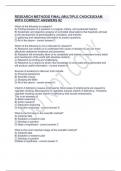
RESEARCH METHODS FINAL (MULTIPLE CHOICE)EXAM
WITH CORRECT ANSWERS #2
Which of the following is research?
A) Finding answers to a question in a logical, orderly, and systematic fashion
B) Systematic and objective analysis of controlled observations that hopefully will lead
to the development of generalizations, principles, and theories
C) gathering and interpreting information to answer questions
D) All of the above - correct answer D
Which of the following is not a rationale for research?
A) Research can enable us to understand the cause of disease so we can more
effectively determine treatment and prevention
B) Research will eventually allow us to completely and entirely understand every detail
and mechanism of the world with absolute certainty
C) Research is exciting and challenging
D) Research is a means by which new knowledge is continually being generated and
will produce useful information - correct answer B
Sources of evidence to discover truth include:
A) Personal experience
B) Scientific inquiry
C) Studying the Bible
D) All of the above - correct answer D
Vitamin A deficiency causes emphysema. Most cases of emphysema are caused by
cigarette smoking. Benzopyrene in cigarettes induces vitamin A deficiency. Therefore,
cigarette smoking causes vitamin A deficiency that causes emphysema.
This is an example of:
A) Basic reasoning
B) Action research
C) Deductive reasoning
D) Inductive reasoning - correct answer D
What is the first step in the scientific method?
A) Interpret data
B) Establish a research plan
C) Develop a question
D) State a hypothesis - correct answer C
What is the most important stage of the scientific method?
A) Interpret data
B) Establish a research plan
C) Develop a question
D)State a hypothesis - correct answer C
, ____questions determine how variables are associated with one another, but are not
used to establish cause and effect.
A) Relationship
B) Difference
C) Descriptive
D) Non-descriptive - correct answer A
____Studies do not require a hypothesis
A) Directional
B) Exploratory
C) Relationship
D) Methodical - correct answer B
Which of the following is not true about hypothesis?
A) Hypotheses are never proven or disproven
B) Hypothesis testing determines whether the likelihood of an observed outcome is due
to a chance occurrence
C) Hypotheses can be directional or nondirectional
D) If we fail to reject the null hypothesis, then the treatment had an effect on the
outcome - correct answer D
Delimitations of a study are all of the following except:
A) Include type and number of subjects
B) Narrow the scope of the research
C) Include the type of instruments necessary to carry out research
D) Describe the potential weaknesses of the study
E) All of the above are delimitations of a study - correct answer D
Which of the following best defines a limitation of a study?
A) Use of instruments to generate data
B) Using humans for a study
C) Using animals for a study
D) None of the above - correct answer D
___interviews involve asking the subject a set of specific, closed ended questions.
Interview guides are used to determine what can or cannot be asked.
A) Structured
B) Formed
C) Organized
D) Designed - correct answer A
A scientist conducts a study to determine whether a specific type of fertilizer has an
effect on the growth of plants. He treats some plants with fertilizer and others without
fertilizer. The fertilizer is an example of a____variable.
A) Predicting
B) Extraneous
WITH CORRECT ANSWERS #2
Which of the following is research?
A) Finding answers to a question in a logical, orderly, and systematic fashion
B) Systematic and objective analysis of controlled observations that hopefully will lead
to the development of generalizations, principles, and theories
C) gathering and interpreting information to answer questions
D) All of the above - correct answer D
Which of the following is not a rationale for research?
A) Research can enable us to understand the cause of disease so we can more
effectively determine treatment and prevention
B) Research will eventually allow us to completely and entirely understand every detail
and mechanism of the world with absolute certainty
C) Research is exciting and challenging
D) Research is a means by which new knowledge is continually being generated and
will produce useful information - correct answer B
Sources of evidence to discover truth include:
A) Personal experience
B) Scientific inquiry
C) Studying the Bible
D) All of the above - correct answer D
Vitamin A deficiency causes emphysema. Most cases of emphysema are caused by
cigarette smoking. Benzopyrene in cigarettes induces vitamin A deficiency. Therefore,
cigarette smoking causes vitamin A deficiency that causes emphysema.
This is an example of:
A) Basic reasoning
B) Action research
C) Deductive reasoning
D) Inductive reasoning - correct answer D
What is the first step in the scientific method?
A) Interpret data
B) Establish a research plan
C) Develop a question
D) State a hypothesis - correct answer C
What is the most important stage of the scientific method?
A) Interpret data
B) Establish a research plan
C) Develop a question
D)State a hypothesis - correct answer C
, ____questions determine how variables are associated with one another, but are not
used to establish cause and effect.
A) Relationship
B) Difference
C) Descriptive
D) Non-descriptive - correct answer A
____Studies do not require a hypothesis
A) Directional
B) Exploratory
C) Relationship
D) Methodical - correct answer B
Which of the following is not true about hypothesis?
A) Hypotheses are never proven or disproven
B) Hypothesis testing determines whether the likelihood of an observed outcome is due
to a chance occurrence
C) Hypotheses can be directional or nondirectional
D) If we fail to reject the null hypothesis, then the treatment had an effect on the
outcome - correct answer D
Delimitations of a study are all of the following except:
A) Include type and number of subjects
B) Narrow the scope of the research
C) Include the type of instruments necessary to carry out research
D) Describe the potential weaknesses of the study
E) All of the above are delimitations of a study - correct answer D
Which of the following best defines a limitation of a study?
A) Use of instruments to generate data
B) Using humans for a study
C) Using animals for a study
D) None of the above - correct answer D
___interviews involve asking the subject a set of specific, closed ended questions.
Interview guides are used to determine what can or cannot be asked.
A) Structured
B) Formed
C) Organized
D) Designed - correct answer A
A scientist conducts a study to determine whether a specific type of fertilizer has an
effect on the growth of plants. He treats some plants with fertilizer and others without
fertilizer. The fertilizer is an example of a____variable.
A) Predicting
B) Extraneous