

Advanced Pharmacology Exam 2
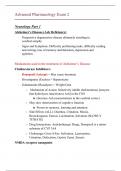
Advanced Pharmacology Exam 2 Neurology Part 1 Alzheimer’s Disease (Ach Deficiency) - Progressive degenerative disease ultimately resulting in cerebral atrophy - Signs and Symptoms: Difficulty performing tasks, difficulty reading and writing, loss of memory and delusions, depression and agitation. Medications used in the treatment of Alzheimer’s Disease: Cholinesterase Inhibitors: - Donepezil (Aricept) = May cause Insomnia - Rivastigmine (Exelon) = Hepatoxicity - Galantamine (Razadyne) = Weight Gain o Mechanism of Action: Selectively inhibit cholinesterase [enzyme that hydrolyzes (inactivates) Ach] in the CNS ▪ (Increase Ach concentrations in the cerebral cortex) o May slow deterioration of cognitive function ▪ Preserves memory, learning and attention. o Side Effects (ALL): Diarrhea, Urination, Miosis, Bronchospasm, Emesis, Lacrimation, Salvation (SLOWLY TITRATE) o Drug Interactions: Anticholinergic Drugs, Donepezil is a minor substrate of CYP 3A4 o Cholinergic Crisis S/Sxs: Salivation, Lacrimation, Urination, Defecation, Gastric Upset, Emesis NMDA receptor antagonist - Memantine (Namenda) o Mechanism of Action: NMDA (glutamate receptor) antagonist ▪ Attenuates excitotoxic effects of glutamate (neuroprotective) o No CYP 450 drug interactions o Indicated for moderate to severe disease ▪ Often used in combination with cholinesterase inhibitors o Adverse Effects: ▪ Constipation ▪ Headache, confusion, dizziness, hallucinations ▪ Hypertension o Available in combination with donepezil (Namzaric) o Both formulations given via oral route - Combination o Donepezil + Memantine (Namzaric) Parkinson’s Disease (Lack of Dopamine) - Degenerative disease of the basal ganglia, resulting in gradual decline in motor, autonomic and cognitive functioning. - Severe loss (about 80%) of dopaminergic neurons of the substantia nigra o Presence of Lewy Bodies (intracellular inclusions) o Creates imbalance of acetylcholine and dopamine - No treatment = progresses to an akinetic state (5-10 years) Mortality due to immobility (aspiration pneumonia, clotting disorders) - DA receptors (5 totals, grouped into D1 and 2) o D1 – stimulate synthesis of cyclic AMP (excitatory) o D2 – Inhibit cyclic AMP synthesis, suppress CA currents, activate K currents (inhibitory) Medications used in the Treatment of Parkinson’s Disease: Dopaminergic Agents: - Levodopa o Biosynthetic precursor of dopamine ▪ Increased the concentration of dopamine in the brain o Metabolized in the peripheral tissue Decarboxylase and Catechol-O- methyl transferase (COMT) o Less than 1% of administered drug reaches the brain if given as monotherapy (always need decarboxylase inhibitor and often also need COMT-inhibitor) o Adverse Effects: ▪ N/V (Antacid may help 30-60 minutes before dose) ▪ Orthostatic hypotension, sedation ▪ Depression, delirium, paranoia, delusions, hallucinations (CNS effects associated with long-term use) ▪ Motor fluctuations (end of dose wearing off; peak-dose dyskinesia) o ALWAYS given in combination with Carbidopa. Decarboxylase Inhibitor: - Carbidopa o Mechanism of Action: Inhibits conversion of levodopa to dopamine in peripheral tissues ▪ Increase amount of levodopa that enters the brain ▪ Decreases GI and cardiovascular adverse effects due to less conversion in peripheral tissue o Wearing off phenomenon ▪ Loss of efficacy over time (proven effective for 2-5 years) or fluctuation in response to the medication occurs over time higher doses may be needed o ALWAYS given in combination with Levodopa (Sinemet) o Titrate dose slowly to a minimum of 75mg of carbidopa daily ▪ Reduce incidence of peripheral conversion = reduced adverse effects COMT Inhibitors - Tolcapone, Entacapone, and Opicapone o Mechanism of Action: Inhibits peripheral metabolism of levodopa through inhibition of Catechol-O-methyl transferase (COMT) ▪ Used in combination with levodopa/carbidopa to enhance its effectiveness and manage wearing off o Adverse Effects: ▪ Hepatotoxicity (tolcapone) – requires close LFT monitoring (rarely used) ▪ Orthostatic hypotension ▪ Diarrhea ▪ Hallucinations ▪ Brown-orange urine discoloration o Entacapone combined with levodopa/carbidopa (Stalevo) Monoamine Oxidase (MAO) Inhibitors - Selegiline, Rasagiline, Safinamide o Mechanism of Action: Irreversible inhibits the monoamine oxidase (MAO) enzyme
Document information
- Uploaded on
- June 9, 2024
- Number of pages
- 25
- Written in
- 2023/2024
- Type
- Exam (elaborations)
- Contains
- Questions & answers


