

A Level Biology
WATER OCR A Module 2
Structure
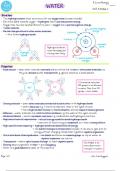
• Two hydrogen atoms share electrons with one oxygen atom (covalent bonds)
• Electrons pulled towards oxygen → hydrogens have a partial positive charge
• Oxygen has two lone (unshared) electron pairs → oxygen has a partial negative charge
• A polar molecule partial negative -
S ↳
• Partial charges attract other water molecules electrons charge ⑧ ⑧
→ this forms hydrogen bonds ⑧ ⑧
⑧
S-
.
⑧
.
nucleus
I
⑧
-
I
covalent
...
↓
⑧
I
bond
Hydrogen bonds are ⑧
-
-
I
.I
⑧
-
⑧
S-
.
weak individually but -
I
hydrogen
⑧ .
strong collectively.
⑧
·
. ⑧ ⑦
·
bonds I
I I
S -
S
-... >partial positive
.
⑧ +
I
,
charges
I
·
Properties
• Good solvent → polar water molecules surround and are attracted to ions or other polar molecules, so
they can dissolve and be transported e.g. glucose dissolves in blood plasma
XPx
⑦
X ⑧
⑧
-
X
⑧
X ⑧
⑧
⑧ .
⑧ ↳ ⑱
⑧
*
X
P 6x
⑧
⑧ ·
X x
&
⑧
X
x
I
=
⑤ ⑧ ⑧
If a molecule has polar
* ·
.X ⑧ ⑧.
⑧
X
⑧ ⑧
⑧
⑧ X
-
. 8. ⑧
X
⑧
**
-x
OH groups it will dissolve
IV at CL-
↳ ⑱
⑧
. -
-
X
in water. More free OH
. groups = more soluble.
⑧ X
⑧ X
6
1
x x
⑧ X
+ ⑧8.
⑧
⑰ ⑧
⑧
· ⑧
⑧ - ⑧
-
X
X
⑧
. .
⑧ P ⑧
*x
·
X x
&
· ⑧ ⑧
⑧
⑧. I
-y I -
I 8. ⑧
-...
• Strong cohesion → polar water molecules attracted to each other with hydrogen bonds
→ water flows well e.g. it forms an unbroken chain in the xylem vessels
→ has a high surface tension so forms droplets, and can support small organisms
• Adhesion → water molecules can stick to other surfaces e.g. the walls of the xylem vessels
• Useful metabolite → used in metabolic reactions e.g. condensation and hydrolysis reactions
• High latent heat of vaporisation → lots of energy needed to break hydrogen bonds
→ uses lots of heat energy to evaporate so it has a cooling effect
• High specific heat capacity → hydrogen bonds can absorb lots of energy
→ can buffer changes in temperature because it can lose or gain a lot of
energy without changing temperature (good for aquatic organisms)
• Ice is less dense than liquid water → ice floats and forms an insulating layer on top of water so
aquatic organisms can survive
• Transparent → allows light to pass through to reach aquatic plants See Module 3 for
• Density allows organisms to float → gives buoyancy more about water
• Water is a good habitat because of its properties transport in plants.
Page 1 of 1 © Dr Zoë Huggett
, A Level Biology
CARBOHYDRATES OCR A Module 2
• Carbohydrates contain carbon, hydrogen and oxygen, usually with the general formula CnH2nOn
Glucose a-glucose B-glucose
• A monosaccharide with the formula C6H12O6 6
CHOH
6
CHOH
2
carbon
2
numbers
• A hexose monosaccharide (six carbon atoms) in a
ring structure H
5C 0 H H
5C 0
I Of-
• Soluble in water → easily transported C4H H
I
C C4H HC
Of- Of-
• Main energy source for animals and plants 2 H
HO
C3 C
2 Of↓ HO
C3 C
→ chemical bonds store lots of energy
• Two isomers: α-glucose and β-glucose H OH H OH
→ H and OH groups on carbon 1 inverted in β-glucose
>
ribose
Ribose CH,OH O Monosaccharides are
Of-
• A monosaccharide with the formula C5H10O5
I
small soluble
/
4CH C carbohydrate monomers.
• A pentose monosaccharide (five carbon H H
3CC2 They also include
atoms) in a ring structure
-
11 fructose and galactose.
• A component of RNA nucleotides and ATP OH OH
Glycosidic bonds and condensation/hydrolysis reactions
• Condensation reaction: two molecules join to form a new chemical bond and
a water molecule is eliminated
Monosaccharides
• Condensation reactions form glycosidic bonds between monosaccharides
and disaccharides
to create disaccharides and polysaccharides are sugars.
• Hydrolysis reaction: a water molecule is inserted and the chemical bond is
broken (reverse of a condensation reaction → breaks glycosidic bonds)
CHOH CHOH polysaccharide with glycosidic bonds
lucOSe &
9
2 &
glucose ↓
-
-
-
↓ -
CH2OH H OH CH,OH
C C 0 H ↑
O I ↑
H O
H
-
1
'
- -
H
H 1
di I '
- -----
-Y
H
C C
H
C .... OH
,
C H OH
H
0
-OH
Of- I I H 1 I
-
I
HO
C C E
OHHO
C C
Of- I bit :iOH H
I
H Of- H OH H,0 inserted H,0inserted
condensation
reaction CHOH
CHOH
2
2
↓
maltose C H2OH hydrolysis reaction
↑
-
0 OH
C 0
H
I
-
C 0 H
10.
H H
H
OH
H C H2OH
C
C
H
H C C
Of-
H +
H,0 ↑
Of- -
0 OH
OH
H
i
HO 0 C C
C C -
↑ OH
glycosidic monosaccharides- 10 I
H Of-
bond
H Of-
H
Disaccharides
• Two monosaccharides joined together with a glycosidic bond in a condensation reaction
• Soluble in water
• Maltose = α-glucose + α-glucose
• Sucrose = α-glucose + fructose
• Lactose = β-glucose + galactose → this disaccharide has a β-glycosidic bond
Page 1 of 3 © Dr Zoë Huggett
, A Level Biology
CARBOHYDRATES OCR A Module 2
Polysaccharides
• Large insoluble polymers of monosaccharides joined with glycosidic bonds
• Starch and glycogen are large metabolically inactive energy storage molecules which cannot leave cells
Starch Iodine test for starch
• Glucose storage in plants → hydrolysed when glucose is needed 1) Add iodine in potassium iodide
• Insoluble in water → does not affect the water potential of solution to sample.
cells so water is not drawn in by osmosis 2) If starch is present: goes from
• Amylose → unbranched α-glucose polysaccharide (α1,4 glycosidic browny-orange to blue-black.
bonds)
amylose amylopectin
→ coiled structure so is compact >
-
I
• Amylopectin → branched α-glucose polysaccharide (α1,4 and α1,6 /
-
glycosidic bonds) so is compact
-
↑ -
-
=
-
&
-
/ -
→ branches mean enzymes can easily access more I
, glucosey.
--
glycosidic bonds = faster glucose release ↑
... -
-
Glycogen Cellulose
• Excess glucose storage in animals • Found in plant cell walls to give strength
→ easily hydrolysed when glucose is needed • Unbranched long and straight β-glucose polymers
• Insoluble in water → does not affect the water (β1,4 glycosidic bonds)
potential of cells so water is not drawn in by • Chains linked with many hydrogen bonds to form
osmosis inflexible microfibrils with high tensile strength
• Highly branched α-glucose polysaccharide (α1,4
and α1,6 glycosidic bonds) → more ends so glucose -
-
i
-
hydrogen
B-glucose!
-
bonds
can be released quickly by enzymes, and more ->
- -
- -
!
energy can be stored in a small space "
- - -
• More branched and compact that amylopectin
Benedict’s test for sugars Colour of precipitate depends
• Monosaccharides, maltose, and lactose are reducing sugars on the concentration of
• Sucrose is a non-reducing sugar reducing sugars:
1) Add an excess of blue Benedict’s reagent to liquid food sample
in a test tube. Blue
2) Heat the tube in a water bath set to boil. ↓
lower
3) If reducing sugars are present: coloured precipitate forms. concentration Green
End test here. ↓
4) If no reducing sugars are present: solution stays blue. Go to Yellow
step 5. ↓
5) Break down non-reducing sugars to monosaccharides: add dilute Orange
HCl to new sample and heat in a water bath set to boil. ↓
higher
6) Neutralise with sodium hydrogencarbonate, then repeat steps concentration Brick Red
1) and 2).
7) If coloured precipitate now forms, non-reducing sugars are You could filter, dry, and weigh
present in the sample. the precipitate to make more
8) If the solution is still blue, neither type of sugars are present. accurate comparisons.
Page 2 of 3 © Dr Zoë Huggett
WATER OCR A Module 2
Structure
• Two hydrogen atoms share electrons with one oxygen atom (covalent bonds)
• Electrons pulled towards oxygen → hydrogens have a partial positive charge
• Oxygen has two lone (unshared) electron pairs → oxygen has a partial negative charge
• A polar molecule partial negative -
S ↳
• Partial charges attract other water molecules electrons charge ⑧ ⑧
→ this forms hydrogen bonds ⑧ ⑧
⑧
S-
.
⑧
.
nucleus
I
⑧
-
I
covalent
...
↓
⑧
I
bond
Hydrogen bonds are ⑧
-
-
I
.I
⑧
-
⑧
S-
.
weak individually but -
I
hydrogen
⑧ .
strong collectively.
⑧
·
. ⑧ ⑦
·
bonds I
I I
S -
S
-... >partial positive
.
⑧ +
I
,
charges
I
·
Properties
• Good solvent → polar water molecules surround and are attracted to ions or other polar molecules, so
they can dissolve and be transported e.g. glucose dissolves in blood plasma
XPx
⑦
X ⑧
⑧
-
X
⑧
X ⑧
⑧
⑧ .
⑧ ↳ ⑱
⑧
*
X
P 6x
⑧
⑧ ·
X x
&
⑧
X
x
I
=
⑤ ⑧ ⑧
If a molecule has polar
* ·
.X ⑧ ⑧.
⑧
X
⑧ ⑧
⑧
⑧ X
-
. 8. ⑧
X
⑧
**
-x
OH groups it will dissolve
IV at CL-
↳ ⑱
⑧
. -
-
X
in water. More free OH
. groups = more soluble.
⑧ X
⑧ X
6
1
x x
⑧ X
+ ⑧8.
⑧
⑰ ⑧
⑧
· ⑧
⑧ - ⑧
-
X
X
⑧
. .
⑧ P ⑧
*x
·
X x
&
· ⑧ ⑧
⑧
⑧. I
-y I -
I 8. ⑧
-...
• Strong cohesion → polar water molecules attracted to each other with hydrogen bonds
→ water flows well e.g. it forms an unbroken chain in the xylem vessels
→ has a high surface tension so forms droplets, and can support small organisms
• Adhesion → water molecules can stick to other surfaces e.g. the walls of the xylem vessels
• Useful metabolite → used in metabolic reactions e.g. condensation and hydrolysis reactions
• High latent heat of vaporisation → lots of energy needed to break hydrogen bonds
→ uses lots of heat energy to evaporate so it has a cooling effect
• High specific heat capacity → hydrogen bonds can absorb lots of energy
→ can buffer changes in temperature because it can lose or gain a lot of
energy without changing temperature (good for aquatic organisms)
• Ice is less dense than liquid water → ice floats and forms an insulating layer on top of water so
aquatic organisms can survive
• Transparent → allows light to pass through to reach aquatic plants See Module 3 for
• Density allows organisms to float → gives buoyancy more about water
• Water is a good habitat because of its properties transport in plants.
Page 1 of 1 © Dr Zoë Huggett
, A Level Biology
CARBOHYDRATES OCR A Module 2
• Carbohydrates contain carbon, hydrogen and oxygen, usually with the general formula CnH2nOn
Glucose a-glucose B-glucose
• A monosaccharide with the formula C6H12O6 6
CHOH
6
CHOH
2
carbon
2
numbers
• A hexose monosaccharide (six carbon atoms) in a
ring structure H
5C 0 H H
5C 0
I Of-
• Soluble in water → easily transported C4H H
I
C C4H HC
Of- Of-
• Main energy source for animals and plants 2 H
HO
C3 C
2 Of↓ HO
C3 C
→ chemical bonds store lots of energy
• Two isomers: α-glucose and β-glucose H OH H OH
→ H and OH groups on carbon 1 inverted in β-glucose
>
ribose
Ribose CH,OH O Monosaccharides are
Of-
• A monosaccharide with the formula C5H10O5
I
small soluble
/
4CH C carbohydrate monomers.
• A pentose monosaccharide (five carbon H H
3CC2 They also include
atoms) in a ring structure
-
11 fructose and galactose.
• A component of RNA nucleotides and ATP OH OH
Glycosidic bonds and condensation/hydrolysis reactions
• Condensation reaction: two molecules join to form a new chemical bond and
a water molecule is eliminated
Monosaccharides
• Condensation reactions form glycosidic bonds between monosaccharides
and disaccharides
to create disaccharides and polysaccharides are sugars.
• Hydrolysis reaction: a water molecule is inserted and the chemical bond is
broken (reverse of a condensation reaction → breaks glycosidic bonds)
CHOH CHOH polysaccharide with glycosidic bonds
lucOSe &
9
2 &
glucose ↓
-
-
-
↓ -
CH2OH H OH CH,OH
C C 0 H ↑
O I ↑
H O
H
-
1
'
- -
H
H 1
di I '
- -----
-Y
H
C C
H
C .... OH
,
C H OH
H
0
-OH
Of- I I H 1 I
-
I
HO
C C E
OHHO
C C
Of- I bit :iOH H
I
H Of- H OH H,0 inserted H,0inserted
condensation
reaction CHOH
CHOH
2
2
↓
maltose C H2OH hydrolysis reaction
↑
-
0 OH
C 0
H
I
-
C 0 H
10.
H H
H
OH
H C H2OH
C
C
H
H C C
Of-
H +
H,0 ↑
Of- -
0 OH
OH
H
i
HO 0 C C
C C -
↑ OH
glycosidic monosaccharides- 10 I
H Of-
bond
H Of-
H
Disaccharides
• Two monosaccharides joined together with a glycosidic bond in a condensation reaction
• Soluble in water
• Maltose = α-glucose + α-glucose
• Sucrose = α-glucose + fructose
• Lactose = β-glucose + galactose → this disaccharide has a β-glycosidic bond
Page 1 of 3 © Dr Zoë Huggett
, A Level Biology
CARBOHYDRATES OCR A Module 2
Polysaccharides
• Large insoluble polymers of monosaccharides joined with glycosidic bonds
• Starch and glycogen are large metabolically inactive energy storage molecules which cannot leave cells
Starch Iodine test for starch
• Glucose storage in plants → hydrolysed when glucose is needed 1) Add iodine in potassium iodide
• Insoluble in water → does not affect the water potential of solution to sample.
cells so water is not drawn in by osmosis 2) If starch is present: goes from
• Amylose → unbranched α-glucose polysaccharide (α1,4 glycosidic browny-orange to blue-black.
bonds)
amylose amylopectin
→ coiled structure so is compact >
-
I
• Amylopectin → branched α-glucose polysaccharide (α1,4 and α1,6 /
-
glycosidic bonds) so is compact
-
↑ -
-
=
-
&
-
/ -
→ branches mean enzymes can easily access more I
, glucosey.
--
glycosidic bonds = faster glucose release ↑
... -
-
Glycogen Cellulose
• Excess glucose storage in animals • Found in plant cell walls to give strength
→ easily hydrolysed when glucose is needed • Unbranched long and straight β-glucose polymers
• Insoluble in water → does not affect the water (β1,4 glycosidic bonds)
potential of cells so water is not drawn in by • Chains linked with many hydrogen bonds to form
osmosis inflexible microfibrils with high tensile strength
• Highly branched α-glucose polysaccharide (α1,4
and α1,6 glycosidic bonds) → more ends so glucose -
-
i
-
hydrogen
B-glucose!
-
bonds
can be released quickly by enzymes, and more ->
- -
- -
!
energy can be stored in a small space "
- - -
• More branched and compact that amylopectin
Benedict’s test for sugars Colour of precipitate depends
• Monosaccharides, maltose, and lactose are reducing sugars on the concentration of
• Sucrose is a non-reducing sugar reducing sugars:
1) Add an excess of blue Benedict’s reagent to liquid food sample
in a test tube. Blue
2) Heat the tube in a water bath set to boil. ↓
lower
3) If reducing sugars are present: coloured precipitate forms. concentration Green
End test here. ↓
4) If no reducing sugars are present: solution stays blue. Go to Yellow
step 5. ↓
5) Break down non-reducing sugars to monosaccharides: add dilute Orange
HCl to new sample and heat in a water bath set to boil. ↓
higher
6) Neutralise with sodium hydrogencarbonate, then repeat steps concentration Brick Red
1) and 2).
7) If coloured precipitate now forms, non-reducing sugars are You could filter, dry, and weigh
present in the sample. the precipitate to make more
8) If the solution is still blue, neither type of sugars are present. accurate comparisons.
Page 2 of 3 © Dr Zoë Huggett


