

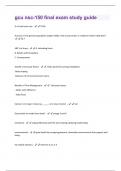
gcu nsc-150 final exam study guide Questions And Answers | 2024 Latest Study Solutions
% of max heart rate - 70-85 A person in the general population weighs 145lbs. How much protein is needed in his/her daily diet? - 52.7 ABC's of stress - A- Activating Event B- Beliefs and Perceptions C- Consequences benefit of muscular fitness - -Helps boost fat-burning metabolism -Body shaping -Reduces risk of neuromuscular injury Benefits of Time Management - - decreased stress - better work efficiency - helps focus Calcium is to major mineral as ______ is to trace mineral. - iron Eicasanoids are made from what? - omega 3 and 6 emotional - coping effectively with life and creating satisfying relationships environmental - good health by occupying pleasant, stimulation environments that support wellbeing Fat soluble vitamins - Vitamins A, D, E, Kfinancial - satisfaction with current and future financial situations function of proteins - -ensuring the growth and development of muscles, bones, hair, and skin -forming antibodies, hormones, and other essential substances -serving as a fuel source for cells and tissues when needed functions of vitamins - Organic and breaks down in water -Hard to find in natural food sources - Often taken as a supplement Good food sources of iron - a. liver b. shellfish c. turkey guidelines for physical activity for americans - 2 hours and 30 minutes a week of moderateintensity aerobic physical activity & 1 hour and 15 minutes a week of vigorous-intensity of physical activity Healthy body compositions for college-aged males and females - males 15-20 females 24-30 How are vitamins different from minerals - Vitamins are small organic ( carbon based) -minerals are non organic molecules such as Calcium, Iron, Zinc etc. How do you calculate for BMI? - (weight in pounds/height in inches^2) x 730 How does carbs affect Type 2 diabetes? - raises blood sugarhow does exercise effect blood cholesterol? - raises HDL's How to improve quality of sleep - don't use your phone too close to going to bed intellectual - recognizing creative abilities and finding ways to expand knowledge and skills Macronutrients- kcal/g of each - -Proteins=4 kcls -fats=9 kcals -carbs=4 kcals protein=stomach -carbs=small intestine -Fats=intestinal tract
Document information
- Uploaded on
- June 9, 2024
- Number of pages
- 6
- Written in
- 2023/2024
- Type
- Exam (elaborations)
- Contains
- Questions & answers


