
WGU C458 Health, Fitness, and Wellness Study . 350 Questions with Verified Answers. Latest Update 2024.
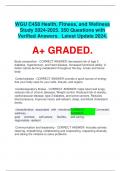
WGU C458 Health, Fitness, and Wellness Study . 350 Questions with Verified Answers. Latest Update 2024. A+ GRADED. Body composition - CORRECT ANSWER: decreased risk of type 2 diabetes, hypertension, and heart disease. Increased functional ability. A better calorie-burning metabolism throughout the day. A lean and toned body Carbohydrates - CORRECT ANSWER: provide a quick source of energy that your body uses for your cells, tissues, and organs. Cardiorespiratory fitness - CORRECT ANSWER: helps heart and lungs, reduces risk of chronic diseases. Weight control. Reduced risk of obesity, cardiovascular disease, type 2 diabetes, and some cancers. Reduces blood pressure, improves mood, self-esteem, sleep, and blood cholesterol levels. characteristics associated with emotional wellness. - CORRECT ANSWER: Connected, goal oriented, self-aware, flexible, self-caring, responsible, resilient Communication and leadership - CORRECT ANSWER: Includes actively listening, empathizing, collaborating and cooperating, respecting diversity, and taking the initiative to solve problems. Communication and leadership example - CORRECT ANSWER: They are able to create healthy relationships with people who may have different backgrounds and perspectives and can help lead themselves and others through change. Effective interpersonal communication and leadership skills help individuals build strong personal and professional connections that enable them to interact effectively with others and lead teams. Communication and leadership traits - CORRECT ANSWER: 1. Empathy 2. Conflict resolution 3. Teamwork and collaboration Difference between self-awareness and self-management - CORRECT ANSWER: one major difference is that self-awareness focuses on the recognition and identification of emotions while self-management focuses on how people handle their emotions and their ability to modify their external behavior in response to emotions. emotional intelligence - CORRECT ANSWER: Being self-aware managing emotions motivating oneself having empathy handling relationships Example of self-management - CORRECT ANSWER: People who can do this are able to set goals and motivate themselves to change behavior and make progress in their lives. Executive function - CORRECT ANSWER: the higher-order mental processes that help individuals manage complex tasks such as organizing and planning, remembering information, problem-solving, and regulating emotions. Executive function example - CORRECT ANSWER: are able to think critically and make responsible decisions. They are flexible thinkers who can innovate to find new ways to think about and solve problems. Executive function skills - CORRECT ANSWER: 1. Adaptability 2. Problem solving 3. Self- directed learning Fats - CORRECT ANSWER: help the body absorb fat-soluble vitamins (A, D, E, & K), make hormones and surround nerves needed for growth and development. Provide essential fats that the body cannot make (i.e. Omega-3) and make foods more flavorful, help the body feel fuller. Flexibility - CORRECT ANSWER: allows muscles to work at their full potential, reduces the risk of injury and pain, and improves posture and balance function of the reproductive system and its main organs and structures - CORRECT ANSWER: Female: vagina, cervix, uterus, fallopian tubes, and ovaries. Male: testis, scrotum, prostate, vas deferens, penis. GAS response pattern - CORRECT ANSWER: Alarm, Resistance, and Exhaustion immune system function - CORRECT ANSWER: Also known as the lymphatic system. It defends and protects the body from foreign invaders that can cause sickness and disease. Produces, stores, and carries white blood cells (leukocytes) around the body. It's made up of lymph, lymph nodes, bone marrow, tonsils, adenoids, spleen, and thymus gland. integumentary system - CORRECT ANSWER: Protects from the environment, encloses, lubricates, and regulates body temp. It's made up of skin, hair, and nails. key structures in the skeletal system - CORRECT ANSWER: Bones, joints, cartilage, ligament (bone to bone), tendons (muscle to bone) main organs of the digestive system - CORRECT ANSWER: Mouth, esophagus, stomach, small intestine, large intestine, anus main structures of the cardiovascular system - CORRECT ANSWER: The heart, arteries (blood from heart to body tissues), and veins (oxygen-poor blood to the heart) major organs of the urinary system - CORRECT ANSWER: Kidneys, ureter, bladder, urethra Mental Illness - CORRECT ANSWER: disorders that disrupt thinking, feeling, moods, and behaviors, and cause a varying degree of impaired functioning in daily life. They are believed to be caused by life events in some cases and by actual biochemical and/or brain dysfunction in others Muscular Endurance - CORRECT ANSWER: improves heart health, aids in weight loss, improves mood and sleep quality, prevents age- related decline, increases lifespan Muscular strength - CORRECT ANSWER: helps improve muscle strength, posture, ease of movement, and the ability to perform everyday activities. Makes tendons, ligaments, and bones stronger. non-REM sleep - CORRECT ANSWER: Stage 1 transitions between wakefulness and sleep. Stage 2 is reached when you are asleep. Stage 3 is called deep sleep or slow-wave sleep. The body needs this stage to feel refreshed in the morning Positive mental health - CORRECT ANSWER: positive and upbeat outlook of the world to be able to realize full potential, cope with the stresses of life, work more productively, and make meaningful contributions to the communities. Proteins - CORRECT ANSWER: the body needs this from the foods eaten to build and maintain bones, muscles, cartilage, blood, and skin. relationship between sleep and health - CORRECT ANSWER: Sleep deficiency is linked to many chronic health problems, including high blood pressure, heart disease, diabetes, obesity, and depression. self-awareness - CORRECT ANSWER: describes an individuals' ability to recognize their own emotions and related reactions. Self-awareness example - CORRECT ANSWER: People who are self-aware are mindful of the attitudes, beliefs, and practices that shape their behavior. Self-awareness helps individuals assess their strengths and limitations and determine how they can grow and change. Self-management - CORRECT ANSWER: is about individuals' ability to regulate their emotions in different situations, control impulses, and manage stress. self-management - CORRECT ANSWER: the ability to accept responsibility for, be accountable for, and effectively manage one's own emotions, behaviors, actions, and well-being. Skills associated with self-awareness - CORRECT ANSWER: 1. Recognizing emotions 2. Self-efficacy (A person's belief in their own ability to address challenges, achieve their goals, and succeed in life) 3. Growth mindset skills associated with self-management - CORRECT ANSWER: 1. Stress management 2. Goal setting 3. Self-discipline Social awareness - CORRECT ANSWER: an individual's ability to engage, react, and respond in a variety of social situations with diverse groups of people. Social awareness - CORRECT ANSWER: describes individuals' ability to look outward and consider the needs of others and the world at large. Social awareness example - CORRECT ANSWER: People who are this understand and practice empathy for others, including those who may have a different culture, background, or perspective form their own. They appreciate diversity and respect others. It can help them make a positive impact on their community and the world around them. strategies for achieving better sleep - CORRECT ANSWER: Set a sleep schedule Exercise 20-30 mins a day but no later than a few hours before bed Avoid caffeine and nicotine late in the day and alcoholic drinks before bed Avoid using digital devices 30 mins before bed Relax before bed Create a room for sleep Don't lie in bed awake See a doctor if having trouble sleeping Strategies for managing stress - CORRECT ANSWER: - eat nutritious foods - get enough sleep - talk with others - stay physically active - relax - think positively - use your time wisely the endocrine system - CORRECT ANSWER: Produces hormones which influence growth, development, and energy-producing activities. The overall function is to keep the body in a state of homeostasis. the pathway of blood through the heart - CORRECT ANSWER: Oxygenated blood enters into the left side of the heart, which pumps it out of the heart through the aorta. Arteries and capillaries deliver the oxygenated blood to the cells in the organs. Veins carry oxygen-poor blood and wastes (carbon dioxide and water) from cells back toward the lungs, where it receives oxygen. the structures of the upper and lower respiratory tract - CORRECT ANSWER: Upper: nose, pharynx (throat) and larynx (voice box) Lower: trachea (windpipe), bronchial tree and lungs the two main divisions of the nervous system - CORRECT ANSWER: a. Central nervous system: Brain and spinal cord b. Peripheral nervous system: All the nerves outside brain & spinal cord/ relay messages between CNS and other areas of the body. Communicates with sensory organs three types of muscle found in the body - CORRECT ANSWER: Striated muscle (skeletal muscle, moves all bones), smooth muscle (lines the walls of the internal organs), cardiac muscle (both striated and smooth/ only found in the heart) U.S. Dietary Guidelines for a healthy diet. - CORRECT ANSWER: 1: Follow a Healthy Eating Pattern across the Life Span. 2: Focus on Variety, Nutrient Density, and Amount 3: Limit sugars and Saturated Fats and reduce sodium intake. 4: Shift to healthier food and beverage choices. 5: Support healthy eating patterns in all situations. Warning signs of drug addiction - CORRECT ANSWER: No money, bloodshot eyes, secretive, angry (mood swings) Acquired active immunity - CORRECT ANSWER: Immunity developed during life in response to disease, vaccination, or exposure. Acquired immunodeficiency syndrome (AIDS) - CORRECT ANSWER: Extremely virulent sexually transmitted disease that renders the immune system inoperative. Ageism - CORRECT ANSWER: The term for discriminating against someone based on his or her age Aging - CORRECT ANSWER: The patterns of life changes that occur in members of all species as they grow older Alcohol - CORRECT ANSWER: colorless, flammable liquid formed by the fermentation of fruits, juices, or cereal grains Alcoholism - CORRECT ANSWER: when a person is unable to choose whether he or she will drink and is unable to stop drinking Allergy - CORRECT ANSWER: Hypersensitive reaction to a specific antigen or allergen in the environment in which the body produces excessive antibodies to that antigen or allergen. Alveoli - CORRECT ANSWER: Tiny air sacs of the lungs where all gas exchange must occur Alzheimer's disease - CORRECT ANSWER: a progressive and irreversible disease involving the death of nerve cells and deposition of plaques of amyloid (a protein) in the brain Amino acids - CORRECT ANSWER: building blocks necessary for performing many body functions Amphetamines - CORRECT ANSWER: uppers. Have limited legitimate and useful medical applications, but because of their wide availability, they are often abused. Ritalin, Sudafed, Adderall. Anesthetics - CORRECT ANSWER: create a loss of sensation Anorexia nervosa - CORRECT ANSWER: literally means loss of appetite, but this is a misnomer: A person with this is hungry, but denies the hunger because of an irrational fear of becoming fat. Self-starvation, food preoccupation and rituals, compulsive exercising, and often an absence of menstrual cycles in women. Untreated, can be fatal. Antagonist - CORRECT ANSWER: blocks or interferes with the function of another drug when used in combination with it, or it may inhibit a normal biological compound, such as a hormone. Antibodies - CORRECT ANSWER: combat infection. Synthesized from proteins in response to infectious agent. destroy or lessen the effects of the invading antigen. Antigen - CORRECT ANSWER: Substance capable of triggering an immune response antigen (foreign body) - CORRECT ANSWER: Anything that invades the body and causes the immune system to react Antioxidants - CORRECT ANSWER: slow the aging process. Reduce cellular damage by binding with free radicals produced during oxidation reactions Arthritis - CORRECT ANSWER: Painful inflammatory disease of the joints. Artificial immunity - CORRECT ANSWER: acquired by vaccination when killed or attenuated (weakened) organisms or toxins (poisons) are injected into the body to stimulate antibody formation. Asthma - CORRECT ANSWER: A chronic respiratory disease characterized by attacks of wheezing, shortness of breath, and coughing spasms.
Document information
- Uploaded on
- June 8, 2024
- Number of pages
- 58
- Written in
- 2023/2024
- Type
- Exam (elaborations)
- Contains
- Questions & answers


