
4. Water, aquatic food production systems and societies
4.1 Introduction to water systems
The hydrological cycle:
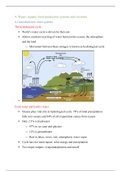
World’s water cycle is driven by then sun
Allows constant recycling of water between the oceans, the atmosphere
and the land
o Movement between these storages is known as hydrological cycle
Fresh water and Earth’s water:
Oceans play vital role in hydrological cycle: 74% of total precipitation
falls over oceans and 84% of all evaporation comes from oceans
Only 2.5% is freshwater
o 87% in ice caps and glaciers
o 12% is groundwater
o Rest in lakes, rivers, soil, atmospheric water vapor
Cycle has two main inputs: solar energy and precipitation
Two major outputs: evapotranspiration and runoff
, Flows:
o Evotranspiration (combined loss of water though transpiration and
evaporation
o Sublimation (ice changing to water vapor)
o Condensation (water vapor changing to liquid)
o Evaporation (liquid to gas)
o Precipitation
o Freezing
4.2 Access to fresh water
Effect of climate change:
Likely that over next few decades some areas will become drier as result of
global warming, so water resources will be reduced
Increasing demand for water:
Concept of water scarcity: water availability to the demands of water
Demand for water increases with population growth, the need for more
food, industrialization and urbanization
70% water use for farming
20% water use for industry
As societies become richer, demand for water increases
4.3 Aquatic food production systems
Demand for aquatic food resources: continues to increase as human population
grows, standards of living rise and diets change
Photosynthesis and aquatic food webs:
Highest rates of productivity found in shallow seas and near coastal areas
In aquatic systems, most food is harvested from higher trophic levels
where total storages are much smaller


