
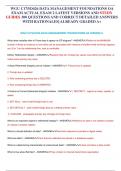
lOMoARcPSD|4777880 WGU C175/D426 DATA MANAGEMENT FOUNDATIONS OA EXAM ACTUAL EXAM 2 LATEST VERSIONS AND STUDY GUIDES 300 QUESTIONS AND CORRECT DETAILED ANSWERS WITH RATIONALES | ALREADY GRADED A+ WGU C175/D426 DATA MANAGEMENT FOUNDATIONS OA VERSION A What does modality refer to? How does it appear on ER diagram? –ANSWER ✔✔Refers to the MINIMUM number of times an instance in one entity can be associated with instance of another entity (minima) Appears as a 0 or 1 on the relationship line, next to cardinality Define: Referential Integrity - ANSWER ✔✔Requires that ALL foreign key values must either be fully NULL or match some primary key value 4 Ways Referential Integrity can be violated - ANSWER ✔✔1. Primary key is updated 2. Foreign key is updated 3. Row containing primary key is DELETED 4. Row containing foreign key is INSERTED 4 Actions to Correct Referential Integrity Violation - ANSWER ✔✔1. RESTRICT - rejects an insert, update, or delete 2. SET NULL - sets invalid foreign keys to null 3. SET DEFAULT - sets invalid foreign keys to a default primary value 4. CASCADE - propagates primary key changes to foreign keys What is an important aspect to referential integrity? - ANSWER ✔✔reference to data in one relation is based on values in another relation What is a broad definition of data? - ANSWER ✔✔Raw facts captured on printed or digital media What are data? - ANSWER ✔✔Facts that are collected and stored in a database system What is a determining characteristic of unstructured data? - ANSWER ✔✔It does not follow a data model What is true about flat files? - ANSWER ✔✔They contain no internal hierarchical organization lOMoARcPSD|4777880 How were data retrieved before database management systems? - ANSWER ✔✔Sequentially from simple files What is an attribute or group of attributes that uniquely identify a tuple in a relation? - ANSWER ✔✔Primary Key corresponding foreign key in another relation of the same database - ANSWER ✔✔A Domain of Values What uniquely identifies each entity in a collection of entities but is not the primary key? - ANSWER ✔✔Alternate key What is the term for a set of columns in a table that can uniquely identify any record in that table without referring to other data? - ANSWER ✔✔Candidate key What happens to the original data in database indexing? - ANSWER ✔✔It is copied to the index Why are indexes created in a physical database design? - ANSWER ✔✔To retrieve data DIRECTLY using a pointer Why is an index created on a database column? - ANSWER ✔✔To optimize data retrievals Define: Functional Dependency - ANSWER ✔✔Each value of a column relates to at MOST one value of another column Dependence of one column on another What term is used to describe: a value of one particular attribute associated with a specific single value of another attribute? - ANSWER ✔✔Functional Dependency Rules/Appearance of First Normal Form - ANSWER ✔✔All non -key columns depend on primary key - Each table cell contains one value - A table with no duplicate rows Rules/Appearance of Second Normal Form - ANSWER ✔✔When all non -key columns depend on the WHOLE primary key - Must be in 1NF - Non-key column can not depend on just one part of a composite key - a single primary key is automatically in 2NF Rules/Appearance of Third Normal Form - ANSWER ✔✔All non -key columns depend ONLY on the primary key - Tables are totally free of data redundancy What are the 4 ways that operational and analytical databases differ? - ANSWER ✔✔1. Volatilty 2. Detail 3. Scope 4 History Define: Volatility; How it applies to Operational? Analytical? - ANSWER ✔✔Database updates in real time - Operational Data is Volatile - Analytical Data is NOT Volatile lOMoARcPSD|4777880 Define: Detail; How it applies to operational and analytical DB? - ANSWER ✔✔A database that keeps record of individual transactions; line items - Operational: Detailed - Analytical: Detailed A database that keeps record of individual transactions; line items - Operational: Detailed - Analytical: Detailed - ANSWER ✔✔How far a database can reach, Operational: incompatible, Operational: incompatible Define: History; How it applies to operational and analytical DB? - ANSWER ✔✔Whether DB is current or tracks all data - Operational: Current only - Analytical: Tracks trends Data warehouses are refreshed periodically with a 5 -step process: - ANSWER ✔✔1. Extraction 2. Cleanse 3. Integrate 4. Restructure 5. Load What happens during Extraction? (ETL) - ANSWER ✔✔Data extracted and put into staging area What happens during Cleanse? (ETL) - ANSWER ✔✔Errors are eliminated from data; standard abbreviations applied What happens during Integrate? (ETL) - ANSWER ✔✔Data is put into a uniform structure; Data converted to uniform structure What happens during Restructure? (ETL) - ANSWER ✔✔Data is structured in a design that is optimal for analysis What happens during Load? - ANSWER ✔✔Data is loaded to the data warehouse What is an issue that is focused on the 'Load' component of ETL? - ANSWER ✔✔Monitor refreshing volume and frequency During which step in the ETL Process, is raw data aggregated? - ANSWER ✔✔Transformation steps What are the 6 different data mining activities? - ANSWER ✔✔1. Clustering & Segmentation 2. Classification 3. Estimation 4. Prediction 5. Affinity Grouping 6. Description Define: Clustering & Segmentation - when is it helpful? - ANSWER ✔✔Taking large entity and dividing into smaller groups of entities - Useful when unsure of what looking for Define: Classification (Data Mining) - ANSWER ✔✔Organizing data into predefined classes Define: Estimation (Data Mining) - ANSWER ✔✔Assigning a numeric value to an object Define: Prediction (Data Mining) - ANSWER ✔✔Classifying objects according to an expected future behavior Define: Affinity Grouping - ANSWER ✔✔Evaluating relationships between data elements that demonstrate lOMoARcPSD|4777880 some kind of affinity between objects Where does affinity grouping occur in data mining? - ANSWER ✔✔Between objects What is the uniquely identifiable element about which data can be categorized in an entity -relationship diagram? - ANSWER ✔✔Entity types Which 3 rules for referential integrity are provided by modern relational database management systems? - ANSWER ✔✔Insert Update Delete What does the DISTINCT clause do? - ANSWER ✔✔Returns only unique or 'distinct' values; Filters Data Results What does the ORDER BY clause do? - ANSWER ✔✔Modifies presentation of data results Which SQL statement alphabetizes customer names within the same satellite -office city? - ANSWER ✔✔ORDER BY SATCITY, CUSTNAME What is a heap file? - ANSWER ✔✔A file where records can be placed anywhere in the memory What is a hash file? - ANSWER ✔✔A file that uses Hash function computation on some fields of the records, and the result of that computation determines where the record is stored What are the different types of major Joins? - ANSWER ✔✔LEFT JOIN - RIGHT JOIN - INNER JOIN - FULL JOIN What do joins do? - ANSWER ✔✔Joins *usually* compare the foreign key of one table to the primary key of another table (but can join any columns) - joining together data from two tables into one table selects all the rows from the left table, and only matching rows from the right table - ANSWER ✔✔LEFT JOIN selects all the rows from the right table, and only matching rows from the left table - ANSWER ✔✔RIGHT JOIN Any join that selects unmatched rows; LEFT, RIGHT, or FULL JOINS - ANSWER ✔✔OUTER JOIN Joins together only rows that match from both tables - contains no unmatched rows - ANSWER ✔✔INNER JOIN Fully joins two tables together, even unmatched rows - places a NULL in any cell that does not match the other table - ANSWER ✔✔FULLY JOIN What is the difference between Signed and Unsigned data? - ANSWER ✔✔SIGNED: a number that may be negative - UNSIGNED: a number that can NOT be negative
Preview 4 out of 119 pages
Exam (elaborations)
Wgu C175/D426 Data Management Foundations Oa Exam Actual Exam 2 Latest Versions And Study Guides 300 Questions And Correct Detailed Answers With Rationales| Already Graded A+
Preview 4 out of 119 pages
WGU C175/D426 DATA MANAGEMENT FOUNDATIONS OA EXAM ACTUAL EXAM 2 LATEST VERSIONS AND STUDY GUIDES 300 QUESTIONS AND CORRECT DETAILED ANSWERS WITH RATIONALES| ALREADY GRADED A+
Content preview
Document information
- Uploaded on
- June 7, 2024
- Number of pages
- 119
- Written in
- 2023/2024
- Type
- Exam (elaborations)
- Contains
- Questions & answers
$20.49
Wrong document? Swap it for free
Within 14 days of purchase and before downloading, you can choose a different document. You can simply spend the amount again.
Written by students who passed
Immediately available after payment
Read online or as PDF

Reputation scores are based on the amount of documents a seller has sold for a fee and the reviews they have received for those documents. There are three levels: Bronze, Silver and Gold. The better the reputation, the more your can rely on the quality of the sellers work.

