

Quiz Bowl – Philosophy Study Guide
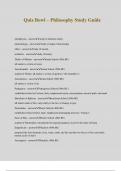
Quiz Bowl – Philosophy Study Guide metaphysics - answerstudy of ultimate reality epistemology - answerstudy of origin of knowledge ethics - answerstudy of morals aesthetics - answerstudy of beauty Thales of Miletus - answerIonian School (500s BC) all matter is a form of water Anaximander - answerIonian School (500s BC) student of Thales; all matter is a form of apeiron ("the boundless") Anaximenes - answerIonian School (500s BC) all matter is a form of air Pythagoras - answerPythagorean School (500s BC) established school in Crotona, Italy; emphasized myths, reincarnation, musical pitch, and math Heraclitus of Ephesus - answerHeraclitean School (500s BC) all matter made of fire; only reality is the law of change, Logos Parmenides - answerEleatic School (400s BC) established school in Elea, Italy; emphasized unchanging universe; "being is" Zeno of Elea - answerEleatic School (400s BC) student of Parmenides; introduced four logical paradoxes to prove the unity of being Empedocles - answerPluralists (400s BC) proposed the four elements of air, water, earth, and fire and the two forces of love and strife; eternal cycle of chaos Anaxagoras - answerPluralists (400s BC) all matter is composed of tiny seeds; proposed cosmic evolution Democritus - answerAtomists (300s BC) student of Leucippus; proposed atomic theory and deterministic materialism Protagoras - answerSophists (400s BC) "Man is the measure of all things"; natural science and religion are worthless; one should only be ethical if it is to his advantage; sophists were known as deceitful and insincere Socrates - answerSocratic School (400s BC) sentenced to death 399 BC; refused payment for his lectures; held that all people have full knowledge of ultimate truth; Socrates' paradox: no man does evil voluntarily Plato - answerPlatonic School (300s BC) student of Socrates; recorded Socrates' teachings in his dialogues; virtue=wisdom; proposed theory of Ideas, doctrine of Forms, the intelligible and sensible realms, and the Absolute Idea of the Good; wrote the Republic (discussion of justice), Meno (Socrates shows innate knowledge of all people by teaching a slave the Pythagorean theorem), Apology (Socrates' trial defense), Crito (Socrates' defense of obedience to the state), Phaedo (death of Socrates), Symposium (a drama), Parmenides (theory of Forms), Laws (political discussions), Timaeus (thoughts on cosmology and science) Aristotle - answerAristotelian School (300s BC) student of Plato; tutor to Alexander the Great; founded the Lyceum and Peripatetic ("walking") school; founded logic, syllogism, scientific method; forms contained in objects; natural hierarchical order of inanimate, vegetative, animal, rational, and heavenly ether; emphasized happiness; wise king best government but limited democracy a good compromise; wrote Organon ("instrument" logic), Physics, Metaphysics, Poetics (literary criticism, definitions of drama) Diogenes of Sinope - answerCynics (300s BC) held civilization in contempt as artificial; advocated self-sufficient simple life; called "Kyon" (dog) Epicurus - answerEpicureanism (200s BC) "philosopher of the garden"; proposed atomic theory with uniform downward motion; emphasized free will and attaining maximum pleasure Lucretius - answerEpicureanism (200s BC) wrote On the Nature of Things Zeno of Citium - answerStoicism (200s BC) insensitive to material comforts; adopted Heraclitean ideas of fire and Logos; each person is part of God; natural law Marcus Aurelius - answerStoicism (200s
Document information
- Uploaded on
- June 7, 2024
- Number of pages
- Unknown
- Written in
- 2023/2024
- Type
- Exam (elaborations)
- Contains
- Questions & answers


