

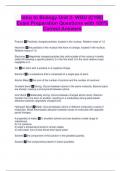
Intro to Biology Unit 2 - WGU (C190) Exam Preparation Questions with 100% Correct Answe rs Protons ✅Positively charged particles; located in the nucleus. Relative mass of 1.0 Neutrons ✅the particles of the nucleus that have no charge, located in the nucleus. Relative mass of 1.0 Electrons ✅Negatively charged particles that orbit outside of the nucleus in shells; shells fill following a specific pattern( 2 in the first shell, 8 in the next) relative mass: negligible or 0. Ion ✅An atom with a positive or a negative charge. Element ✅is a substance that is composed of a single type of atom. Atomic Mass ✅the sum of the number of protons and the number of neutrons. Covalent bond ✅Strong. Occurs between atoms in the same molecule, Electron pairs are shared, creating a strong bond between atoms. Ionic Bond ✅Moderately strong. Occurs between charged atoms (ions). Electron transfer from one atom to another, resulting in a moderately strong electrostatic attraction between oppositely charged ions. Hydrogen Bond ✅Weak. Occurs between atoms in different molecules or parts of molecules. Weak electrostatic attraction between areas of molecules with opposite partial charges. 4 properties of water ✅1) excellent solvent and can dissolve a wide range of substances. 2) it is cohesive. 3) water's temperature tends to remain stable. 4) solid water (ice) is less dense than liquid water. Solvent ✅the component of the solution in the greatest quantity. Solutes ✅The components present in lower quantities. Hydrophilic ✅water loving Hydrophobic ✅water -fearing or water -hating. Cohesion ✅Attraction between molecules of the same substance Surface tension ✅the capacity of a liquid's surface to resist being ruptured when placed under tension or stress. Adhesion ✅the attraction between water molecules and other molecules. Water molecules form hydrogen bonds because water is ___________. ✅Polar Organic Molecule ✅an molecule that contains a carbon to hydrogen (C -H) covalent bond. Examples: glucose, methane, DNA, protein, and fat. Inorganic Molecules ✅are relatively stable, simple, and store little chemical potential energy. Examples: water, oxygen, gas, carbon dioxide, and sodium chloride. Monomers ✅a small organic molecule that may bind chemically to other molecules to form a polymer. Polymers ✅large molecules consisting of repeating structural units or monomers, connected by covalent chemical bonds. 4 major classes of biological macro -molecules: ✅1) Charbohydrates 2) Protiens 3) nucleic acids 4) lipids Charbohydrates ✅are essential for energy storage, cellular communication and structural support. Made up of sugars. Nucleic Acids ✅are essential for information storage within a cell and passing on this information to the next generation. (DNA) made up of nucleotides Lipids ✅are essential for energy storage and maintaining a boundary between the living organism and its environment. Made up of fatty acids. Proteins ✅are essential for carrying out most of the necessary functions of life. Made up of amino acids. Charbohydrates ✅are organic molecules that consist of carbon, hydrogen, and oxygen atoms in a 1:2:1 ratio.
Preview 2 out of 5 pages
Exam (elaborations)
Intro to Biology Unit 2- WGU (C190) Exam Preparation Questions with 100% Correct Answers
Preview 2 out of 5 pages
Protons Positively charged particles; located in the nucleus. Relative mass of 1.0 Neutrons the particles of the nucleus that have no charge, located in the nucleus. Relative mass of 1.0 Electrons Negatively charged particles that orbit outside of the nucleus in shells; shells fill following a specific pattern( 2 in the first shell, 8 in the next) relative mass: negligible or 0. Ion An atom with a positive or a negative charge. Element is a substance that is composed of a single type of atom. Atomic Mass the sum of the number of protons and the number of neutrons. Covalent bond Strong. Occurs between atoms in the same molecule, Electron pairs are shared, creating a strong bond between atoms. Ionic Bond Moderately strong. Occurs between charged atoms (ions). Electron transfer from one atom to another, resulting in a moderately strong electrostatic attraction between oppositely charged ions. Hydrogen Bond Weak. Occurs between atoms in different molecules or parts of molecules. Weak electrostatic attraction between areas of molecules with opposite partial charges. 4 properties of water 1) excellent solvent and can dissolve a wide range of substances. 2) it is cohesive. 3) water's temperature tends to remain stable. 4) solid water (ice) is less dense than liquid water.
Content preview
Document information
- Uploaded on
- June 4, 2024
- Number of pages
- 5
- Written in
- 2023/2024
- Type
- Exam (elaborations)
- Contains
- Questions & answers
$10.49
Wrong document? Swap it for free
Within 14 days of purchase and before downloading, you can choose a different document. You can simply spend the amount again.
Written by students who passed
Immediately available after payment
Read online or as PDF

Available in package deal
Package deal
WGU Biology C190 Q&A Exam Bundle

