

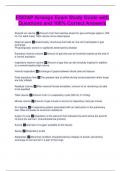
FISDAP Airways Exam Study Guide with Questions and 100% Correct Answers
Alveolar air volume Amount of air that reaches alveoli for gas exchange (approx. 350 ml. For adult male) Tidal volume minus dead space Dead air space Anatomically: structures that hold air, but can't participate in gas exchange. Physiologically: alveoli or capillaries destroyed by disease Expiratory reserve volume Amount of gas that can be forcefully expired at the end of a normal expiration Inspiratory reserve volume Amount of gas that can be forcefully inspired in addition to a normal breaths tidal volume Internal respiration Exchange of gases between blood cells and tissues Peak expiratory flow The greatest rate of airflow during forced expiration when lungs are fully inflated Residual volume After maximal forced exhalation, amount of air remaining not able to be expelled Tidal volume Amount of air in a respiratory cycle (500 ml, 5-7ml/kg) Minute volume Amount of gas moved in and out of respiratory tract per minute Air trapping A respiratory pattern associated with an obstruction in the pulmonary tree. Rate increases to overcome resistance Angle of Louis Angulation of the sternum that indicates the point where the second rib joins the sternum. (manubriosternal junction) Anoxia total lack of oxygen available to the tissues Apnea Respiratory arrest Atelectasis Abnormal condition characterized by collapse of alveoli, preventing exchange of co2 and o2 in a part of the lungs
Document information
- Uploaded on
- June 4, 2024
- Number of pages
- 7
- Written in
- 2023/2024
- Type
- Exam (elaborations)
- Contains
- Questions & answers


