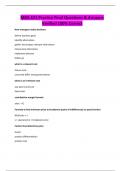
NR511 Final Exam Davis Practice Questions with 100% correct answers
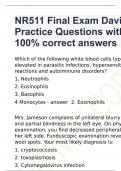
Which of the following white blood cells types are elevated in parasitic infections, hypersensitivity reactions and autoimmune disorders? 1. Neutrophils 2. Eosinophils 3. Basophils 4 Monocytes 2. Eosinophils Mrs. Jameson complains of unilateral blurry vision and partial blindness in the left eye. On physical examination, you find decreased peripheral vision on her left side. Funduscopic examination reveals cotton wool spots. Your most likely diagnosis is: 1. cryptococcosis 2. toxoplasmosis 3. Cytomegalovirus infection 4. Herpes simplex virus infection 3. Cytomegalovirus infection The classic signs and symptoms of cytomegalovirus infection on funduscopic examination include cotton wool spots, a "cottage cheese and ketchup" appearance, hemorrhage, and exudates. Decreased peripheral vision, blurriness, and partial blindness are other clinical manifestations. Referral to an ophthalmologist is imperative. Your client Mrs. Young, age 64, is here to see you because she has pain in her left breast. She reports no pain in her right breast and no noted lesions or masses on breast self-exam, which she performs monthly. You know that: 1. At her age, you do not need to worry about breast cancer. 2. Initial presentation of breast pain is usually not suspicious for malignancy. 3. She must be sent for a mammogram as soon as possible 4. she has no personal history of breast cancer; therefore you are not concerned 3. She must be sent for a mammogram ASAP In postmenopausal women, pain in one breast is highly suggestive of a malignant process despite past personal and/or family history. Additionally, you know that age 64 puts this client at a high risk of breast cancer. You must send her for a mammogram as soon as possible even if she had a negative one less than a year before. When the donor and recipient of a transplant are identical twins, this is referred to as what type of transplant? 1. isograft 2. autograft 3. allograft 4. xenograft An isograft is a transplant in which the donor and recipient are identical twins. Frank, a 66-year-old white male who is on diuretic therapy, presents with an elevated hematocrit. He also has splenomegaly on examination as well as subjective complaints of blurred vision, fatigue, headache, and tinnitus. You suspect: 1. Multiple myeloma 2. Waldenstrom macroglobulinemia 3. dehydration related to the use of diuretics 4. polycythemia vera 4. Polycythemia vera An elevated hematocrit due to contracted plasma volume, rather than increased red blood cell mass, may be due to diuretic use or may occur without obvious cause. However, the associated signs and symptoms of splenomegaly, blurred vision, fatigue, headache, and tinnitus lead you to suspect polycythemia vera. An elevated hematocrit due to contracted plasma volume is often called spurious polycythemia, and a number of conditions, such as hypoxia and high-altitude exposure, can cause a secondary polycythemia, but splenomegaly is absent in these cases. Primary polycythemia vera is an acquired myeloproliferative disorder that causes an overproduction of all 3 hematopoietic cell lines. Your client Mr. Jones has Sjögren syndrome. Which treatment do you suggest? 1. artificial tears and chewing sugarless gum 2. frequent rinsing of the mouth with mouthwash 3. drinking at least 1 glass of milk per day 4. removing wax from the ears at regular intervals 1. Artificial tears and chewing sugarless gum. Sjögren syndrome is a multisystem autoimmune disease characterized by dysfunction of the exocrine glands; it is specifically notable for dry eyes and dry mouth. Treatment is aimed at increasing comfort and lubrication. Artificial tears can be self-administered as needed; preservative-free products are usually better tolerated. For dry mouth, increasing hydration and chewing sugarless gum may be helpful. Oral pilocarpine (Salagen) 5 mg 4 times a day and cevimeline (Evoxac) 30 mg 3 times a day have been shown to increase saliva production. Mandy's 16-year-old daughter has hepatitis A. Which of the following statements made by Mandy indicates she understands the teaching you've just completed? 1. "I guess she needs to be hospitalized until she's recovered" 2. " we'll keep her at home with strict isolation precautions" 3. "we'll stop at the store and buy plastic eating utensils" 4. we'll stop at the drug store and pick up prescription medications immediately" 3. We'll stop at the store and buy plastic eating utensils Clients with hepatitis A should have their eating and drinking utensils kept separate, or they should use disposable ones. You are examining Joseph, age 9 months, and note a palpable right supraclavicular lymph node. You know that this finding is suspicious for: 1. candidiasis 2. cryptococcosis 3. lymphoma of the mediastinum 4. abdominal malignancy 3. lymphoma of the mediastinum Palpable supraclavicular lymph nodes are not normal in infants, children, or adults. A palpable right-sided node is more commonly associated with lymphoma of the mediastinum. Which of the following cancers is associated with Epstein-Barr virus? 1. burkitt lymphoma 2. kaposi sarcoma 3. lymphoma 4. adult t-cell leukemia 1. burkitt lymphoma Your client Shirley has an elevated mean corpuscular volume (MCV). What should you be considering in terms of diagnosis? 1. iron deficiency anemias 2. hemolytic anemias 3. lead poisoning 4. liver disease 4 liver disease MCV indicates the average size of individual red blood cells (RBCs). The normal (normocytic) range is 76 to 96 fL. MCV is increased (macrocytic) in megaloblastic anemias (ie, vitamin B12 deficiency and folate deficiency) and liver disease (such as that resulting from alcohol abuse) as well as with the use of some drugs (eg, zidovudine). A 28-year-old female presents to your primary care office for an annual physical. She denies any complaints other than heavy menstrual bleeding, which is something she has experienced her whole life. On routine complete blood count (CBC) evaluation, her hemoglobin is 11.0. Other pertinent values include a decreased serum ferritin and elevated total iron-binding capacity (TIBC). Her mean corpuscular volume (MCV) is 75. Which of the following is the likely cause of her anemia? 1. iron deficiency anemia 2. thalassemia 3. sideroblastic anemia 4. anemia of chronic disease (ACD) 1. iron deficiency anemia This patient's lab values point toward microcytic anemia. With low iron stores and high ability to bind iron, iron deficiency anemia is the best choice. Which of the following is the most common cause of megaloblastic anemia? 1. vitamin B12 deficiency 2. pernicious anemia 3. latrogensis 4. folate deficiency 2. pernicious anemia Pernicious anemia is the most common cause of megaloblastic anemia, as it causes vitamin B12 deficiency. A 15-year-old male presents to your office complaining of fatigue, shortness of breath, and joint pain for 2 weeks. The parent has blamed these symptoms on a "growth spurt." On physical exam, you notice multiple areas of bruising. His throat is not erythematous, and no exudates are seen. He has palpable splenomegaly, and his rapid strep and mono tests are negative. Which of the following is the most likely diagnosis? 1. acute lymphocytic leukemia (ALL) 2. chronic myelogenous leukemia (CML) 3. acute myelogenous leukemia (AML) 4. chronic lymphocytic leukemia (CLL) 1. ALL ALL is the most common form of pediatric leukemia.
Written for
- Institution
- NR511
- Module
- NR511
Document information
- Uploaded on
- June 3, 2024
- Number of pages
- 63
- Written in
- 2023/2024
- Type
- Exam (elaborations)
- Contains
- Questions & answers
Subjects
-
nr511 final exam davis practice

Also available in package deal