

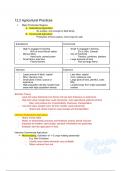
12.2 Agricultural Practices
I. Major Production Regions
A. Subsistence Agriculture
- No surplus, only enough to feed family
B. Commercial Agriculture
- Production of food surplus, most crops for sale
Subsistence Commercial
- High % engaged in farming - Small % engaged in farming
- 60% in most African states - 2% in USA, Canada
- Manual labor - Use of machines
- Hand tools, animal power - Tractors, combines, planters
- Small farms, less land - Large amounts of land
- Family farmers - Few but large farms
Intensive Extensive
- Large amount of labor, capital - Less labor, capital
- Rice, intensive crop - Corn, extensive crop
- Small plots of land, scarce or - Large plots of land, plentiful, costs
expensive little
- High population density, located near - Located away from major populated
areas with high population density centers
Bid-Rent Theory
- Land and value determine how farmer will use land (intensive vs extensive)
- High land value: bought less; used intensively; more agricultural yield/unit of land
- Dairy and produce b/c of perishability, freshness, transportation
- Low land value: bought more; far from market; used extensively
- Grains and cereal crops b/c easy storage and transportation
Intensive Subsistence Agriculture
- Heavy human labor
- Relies on stewardship practices and fertilizers (mainly animal manure)
- Impacted by weather, seed quality, use/lack of fertilizers and pesticides
- Example: wet-rice agriculture of Asia
Intensive Commercial Agriculture
➢ Monocropping: cultivation of 1~2 crops rotating seasonally
- E.g. Dole Company
- Usually what market demands very profitable
- Strips nutrients from soil
, - Monoculture: agricultural system of planting one crop or raising one type of
animal annually
- Specialization, maximizes efficiency, simplifies cultivation → higher yields
- Profitable for plantations, large corporate farms
- Hurts soil, decrease biodiversity
- Can be prevented with crop rotation: varying of crops from year to year to
allow restoration of valuable nutrients and continuing productivity of soil
➢ Plantation agriculture: large-scale commercial farming of one particular crop grown for
markets often distant from plantation
- Common in peripheral and semi-peripheral economies
- Labor intensive operations, cost of labor is low
➢ Market gardening: producing fruits, vegetables, flowers for specific market or urban area
- Driven by perishability
- Invest in technology like greenhouses, high quality seeds, fertilizers, pesticides
➢ Truck Farming: serves markets distant from farm
- Transport speciality crops to distant markets with refrigerated crops
➢ Mixed crop and livestock systems: both crops and livestock raised for profit
- On-farm: crops and livestock raised on same farm
- Between-farm: two farmers share resources; one grows crops other raise
livestock
Extensive Subsistence Agriculture
➢ Shifting cultivation: growing crops or grazing animals on piece of land for year or two;
abandon land after nutrients depleted; repeat
➢ Slash and burn: clear land by cutting down trees/brush, burning “slash” for nutrient-rich
ash fertilizer; rotate after infertile
- Type of shifting cultivation
- Increases air pollution
➢ Nomadic herding/pastoral nomadism: move animal seasonally/as needed to allow best
grazing
- Requires far-reaching areas of land to prevent overgrazing
➢ Transhumance: movement of herds between cooler, higher elevation during summer and
lower elevations during winter
Extensive Commercial Agriculture
➢ Ranching: livestock allowed to roam over an established area
- Livestock ranching common in western states of US
Rural Survey Methods:
1. Metes and bounds
- Spread from Great Britain to North American colonies in 17th century through
relocation diffusion
- Property boundaries in terms of lines (=metes) in certain direction for specific
distance from clear points of reference (=bounds)
, - Points include natural features (e.g. crest of hill, particular tree)
2. Long-lot survey system
- Property divided into series of adjacent long strips of land stretching back from
frontage along river/lake
- Equal access to waterway and mix of soils
3. Township and range system
- Cadastral system creating rectangular land lots
- Survey townships of 6 mi * 6 mi
Rural Settlement Patterns:
1. Clustered settlement
a. Nucleated settlement
b. Promotes social unity
c. Share common resources and expand land outward
2. Dispersed settlement
a. Exists in areas with difficult terrain (fertile land and water scarce)
b. Promote independence and self-sufficiency but lack social interaction
3. Linear settlement
a. People settle for access to water or transportation
12.3 Agricultural Origins and Diffusion
1. Origins of Agriculture
A. Agriculture: Deliberate tending of crops and livestock to produce food and fiber
- People living in different places domesticated different plants and animals
- Domestication: deliberate effort to grow plants and raise animals, making
plants/animals adapt to human demands, selective breeding
B. Foraging to Farming
➢ Foragers: small nomadic groups with primarily plant-based diets and ate
small animals or fish for protein
- Population growth -> pressure on environment -> wild food became
scarce -> require cultivation of stable surplus
- First domesticated animals: sheep and goats (supplied hides, milk, meat)
C. Ancient Hearths
➢ Agricultural Hearth: each area where different groups began to
domesticate plants and animals
- Sometimes difficult to know if region is hearth or diffused area
Agricultural Hearth Crops Animals
Fertile Crescent Wheat, barley, rye, legumes Sheeps, goats, cattle, pigs
SE Asia Sugarcanes, root vegetables Pigs
I. Major Production Regions
A. Subsistence Agriculture
- No surplus, only enough to feed family
B. Commercial Agriculture
- Production of food surplus, most crops for sale
Subsistence Commercial
- High % engaged in farming - Small % engaged in farming
- 60% in most African states - 2% in USA, Canada
- Manual labor - Use of machines
- Hand tools, animal power - Tractors, combines, planters
- Small farms, less land - Large amounts of land
- Family farmers - Few but large farms
Intensive Extensive
- Large amount of labor, capital - Less labor, capital
- Rice, intensive crop - Corn, extensive crop
- Small plots of land, scarce or - Large plots of land, plentiful, costs
expensive little
- High population density, located near - Located away from major populated
areas with high population density centers
Bid-Rent Theory
- Land and value determine how farmer will use land (intensive vs extensive)
- High land value: bought less; used intensively; more agricultural yield/unit of land
- Dairy and produce b/c of perishability, freshness, transportation
- Low land value: bought more; far from market; used extensively
- Grains and cereal crops b/c easy storage and transportation
Intensive Subsistence Agriculture
- Heavy human labor
- Relies on stewardship practices and fertilizers (mainly animal manure)
- Impacted by weather, seed quality, use/lack of fertilizers and pesticides
- Example: wet-rice agriculture of Asia
Intensive Commercial Agriculture
➢ Monocropping: cultivation of 1~2 crops rotating seasonally
- E.g. Dole Company
- Usually what market demands very profitable
- Strips nutrients from soil
, - Monoculture: agricultural system of planting one crop or raising one type of
animal annually
- Specialization, maximizes efficiency, simplifies cultivation → higher yields
- Profitable for plantations, large corporate farms
- Hurts soil, decrease biodiversity
- Can be prevented with crop rotation: varying of crops from year to year to
allow restoration of valuable nutrients and continuing productivity of soil
➢ Plantation agriculture: large-scale commercial farming of one particular crop grown for
markets often distant from plantation
- Common in peripheral and semi-peripheral economies
- Labor intensive operations, cost of labor is low
➢ Market gardening: producing fruits, vegetables, flowers for specific market or urban area
- Driven by perishability
- Invest in technology like greenhouses, high quality seeds, fertilizers, pesticides
➢ Truck Farming: serves markets distant from farm
- Transport speciality crops to distant markets with refrigerated crops
➢ Mixed crop and livestock systems: both crops and livestock raised for profit
- On-farm: crops and livestock raised on same farm
- Between-farm: two farmers share resources; one grows crops other raise
livestock
Extensive Subsistence Agriculture
➢ Shifting cultivation: growing crops or grazing animals on piece of land for year or two;
abandon land after nutrients depleted; repeat
➢ Slash and burn: clear land by cutting down trees/brush, burning “slash” for nutrient-rich
ash fertilizer; rotate after infertile
- Type of shifting cultivation
- Increases air pollution
➢ Nomadic herding/pastoral nomadism: move animal seasonally/as needed to allow best
grazing
- Requires far-reaching areas of land to prevent overgrazing
➢ Transhumance: movement of herds between cooler, higher elevation during summer and
lower elevations during winter
Extensive Commercial Agriculture
➢ Ranching: livestock allowed to roam over an established area
- Livestock ranching common in western states of US
Rural Survey Methods:
1. Metes and bounds
- Spread from Great Britain to North American colonies in 17th century through
relocation diffusion
- Property boundaries in terms of lines (=metes) in certain direction for specific
distance from clear points of reference (=bounds)
, - Points include natural features (e.g. crest of hill, particular tree)
2. Long-lot survey system
- Property divided into series of adjacent long strips of land stretching back from
frontage along river/lake
- Equal access to waterway and mix of soils
3. Township and range system
- Cadastral system creating rectangular land lots
- Survey townships of 6 mi * 6 mi
Rural Settlement Patterns:
1. Clustered settlement
a. Nucleated settlement
b. Promotes social unity
c. Share common resources and expand land outward
2. Dispersed settlement
a. Exists in areas with difficult terrain (fertile land and water scarce)
b. Promote independence and self-sufficiency but lack social interaction
3. Linear settlement
a. People settle for access to water or transportation
12.3 Agricultural Origins and Diffusion
1. Origins of Agriculture
A. Agriculture: Deliberate tending of crops and livestock to produce food and fiber
- People living in different places domesticated different plants and animals
- Domestication: deliberate effort to grow plants and raise animals, making
plants/animals adapt to human demands, selective breeding
B. Foraging to Farming
➢ Foragers: small nomadic groups with primarily plant-based diets and ate
small animals or fish for protein
- Population growth -> pressure on environment -> wild food became
scarce -> require cultivation of stable surplus
- First domesticated animals: sheep and goats (supplied hides, milk, meat)
C. Ancient Hearths
➢ Agricultural Hearth: each area where different groups began to
domesticate plants and animals
- Sometimes difficult to know if region is hearth or diffused area
Agricultural Hearth Crops Animals
Fertile Crescent Wheat, barley, rye, legumes Sheeps, goats, cattle, pigs
SE Asia Sugarcanes, root vegetables Pigs


