
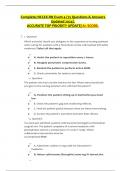
Complete; NCLEX-RN Exam 4 (75 Questions & Answers Updated 2024). ACCURATE TOP PRIORITY UPDATE| A+ SCORE.
Complete; NCLEX-RN Exam 4 (75 Questions & Answers Updated 2024). ACCURATE TOP PRIORITY UPDATE| A+ SCORE. 1. 1. Question Which action(s) should you delegate to the experienced nursing assistant when caring for a patient with a thrombotic stroke with residual left-sided weakness? Select all that apply. o A. Assist the patient to reposition every 2 hours. o B. Reapply pneumatic compression boots. o C. Remind the patient to perform active ROM. o D. Check extremities for redness and edema. • 2. Question The patient who had a stroke needs to be fed. What instruction should you give to the nursing assistant who will feed the patient? o A. Position the patient sitting up in bed before you feed her. o B. Check the patient’s gag and swallowing reflexes. o C. Feed the patient quickly because there are three more waiting. o D. Suction the patient’s secretions between bites of food. • 3. Question You have just admitted a patient with bacterial meningitis to the medical-surgical unit. The patient complains of a severe headache with photophobia and has a temperature of 102.60 F orally. Which collaborative intervention must be accomplished first? o A. Administer codeine 15 mg orally for the patient’s headache. o B. Infuse ceftriaxone (Rocephin) 2000 mg IV to treat the infection. o C. Give acetaminophen (Tylenol) 650 mg orally to reduce the fever. o D. Give furosemide (Lasix) 40 mg IV to decrease intracranial pressure. • 4. Question You are mentoring a student nurse in the intensive care unit (ICU) while caring for a patient with meningococcal meningitis. Which action by the student requires that you intervene immediately? o A. The student enters the room without putting on a mask and gown. o B. The student instructs the family that visits are restricted to 10 minutes. o C. The student gives the patient a warm blanket when he says he feels cold. o D. The student checks the patient’s pupil response to light every 30 minutes. • 5. Question A 23-year-old patient with a recent history of encephalitis is admitted to the medical unit with new-onset generalized tonic- clonic seizures. Which nursing activities included in the patient’s care will be best to delegate to an LPN/LVN whom you are supervising? Select all that apply. o A. Document the onset time, nature of seizure activity, and postictal behaviors for all seizures. o B. Administer phenytoin (Dilantin) 200 mg PO daily. o C. Teach the patient about the need for good oral hygiene. o D. Develop a discharge plan, including physician visits and referral to the Epilepsy Foundation. o E. Gather information about the seizure activity • 6. Question While working in the ICU, you are assigned to care for a patient with a seizure disorder. Which of these nursing actions will you implement first if the patient has a seizure? o A. Place the patient on a non-rebreather mask will the oxygen at 15 L/minute. o B. Administer lorazepam (Ativan) 1 mg IV. o C. Turn the patient to the side and protect the airway. o D. Assess level of consciousness during and immediately after the seizure. • 7. Question A patient recently started on phenytoin (Dilantin) to control simple complex seizures is seen in the outpatient clinic. Which information obtained during his chart review and assessment will be of greatest concern? o A. The gums appear enlarged and inflamed. o B. The white blood cell count is 2300/mm3. o C. Patient occasionally forgets to take the phenytoin until after lunch. o D. Patient wants to renew his driver’s license next month. • 8. Question After receiving a change-of-shift report at 7:00 AM, which of these patients will you assess first? o A. A 23-year-old with a migraine headache who is complaining of severe nausea associated with retching. o B. A 45-year-old who is scheduled for a craniotomy in 30 minutes and needs preoperative teaching. o C. A 59-year-old with Parkinson’s disease who will need a swallowing assessment before breakfast. o D. A 63-year-old with multiple sclerosis who has an oral temperature of 101.80 F and flank pain. • 9. Question All of these nursing activities are included in the care plan for a 78-year-old man with Parkinson’s disease who has been referred to your home health agency. Which ones will you delegate to a nursing assistant (NA)? Select all that apply. o A. Check for orthostatic changes in pulse and blood pressure. o B. Monitor for improvement in tremor after levodopa (L- dopa) is given. o C. Remind the patient to allow adequate time for meals. o D. Monitor for abnormal involuntary jerky movements of extremities. o E. Assist the patient with prescribed strengthening exercises. o F. Adapt the patient’s preferred activities to his level of function. • 10. Question As the manager in a long-term-care (LTC) facility, you are in charge of developing a standard plan of care for residents with Alzheimer’s disease. Which of these nursing tasks is best to delegate to the LPN team leaders working in the facility? o A. Check for improvement in resident memory after medication therapy is initiated. o B. Use the Mini-Mental State Examination to assess residents every 6 months. o C. Assist residents to the toilet every 2 hours to decrease the risk for urinary intolerance. o D. Develop individualized activity plans after consulting with residents and family. • 11. Question An 89-year-old female patient who has been admitted to the medical unit with new-onset angina also has a diagnosis of Alzheimer’s disease. The patient’s husband reports to you that he rarely gets a good night’s sleep because he needs to make sure his wife does not wander during the night. He insists on checking each of the medications you give her to be sure they are the same as the ones she takes at home. Based on this information, which nursing diagnosis is most appropriate for this patient? o A. Decreased Cardiac Output related to poor myocardial contractility o B. Caregiver Role Strain related to continuous need for providing care o C. Ineffective Therapeutic Regimen Management related to poor patient memory o D. Risk for Falls related to patient wandering behavior during the night • 12. Question You are caring for a patient with recurrent glioblastoma who is receiving dexamethasone (Decadron) 4 mg IV every 6 hours to relieve symptoms of right arm weakness and headache. Which assessment information concerns you the most? o A. The patient does not recognize family members. o B. The blood glucose level is 234 mg/dL. o C. The patient complains of a continued headache. o D. The daily weight has increased 1 kg. • 13. Question A 70-year-old alcoholic patient with acute lethargy, confusion, and incontinence is admitted to the hospital ED. His wife tells you that he fell down the stairs about a month ago, but “he didn’t have a scratch afterward.” She feels that he has become gradually less active and sleepier over the last 10 days or so. Which of the following collaborative interventions will you implement first? o A. Place on the hospital alcohol withdrawal protocol. o B. Transfer to radiology for a CT scan. o C. Insert a retention catheter to straight drainage. o D. Give phenytoin (Dilantin) 100 mg PO. • 14. Question Which of these patients in the neurologic ICU will be best to assign to an RN who has floated from the medical unit? o A. A 26-year-old patient with a basilar skull structure who has clear drainage coming out of the nose. o B. A 42-year-old patient admitted several hours ago with a headache and diagnosed with a ruptured berry aneurysm. o C. A 46-year-old patient who was admitted 48 hours ago with bacterial meningitis and has an antibiotic dose due. o D. A 65-year-old patient with an astrocytoma who has just
Document information
- Uploaded on
- June 2, 2024
- Number of pages
- 26
- Written in
- 2023/2024
- Type
- Exam (elaborations)
- Contains
- Questions & answers


