

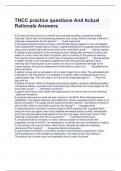
TNCC practice questions
TNCC practice questions And Actual Rationale Answers A 22-year-old was struck by a vehicle way crossing the street, sustaining multiple fractures. She is alert and answering questions and crying. What is the best method for initial pain assessment for this patient? - A self-report tool. A 32 weeks pregnant woman arrives in the ER after being trapped in a car that flipped. Initial assessment reveals signs of shock, vaginal bleeding and a palpable asymmetrical uterus and a slowly fetal heart tones what is the most likely cause? - Uterine rupture. A college student presents to the emergency room stating after arriving at a party, she awoke in a dorm room she didn't recognize, with no memory of the previous evening. The trauma nurse prepares for which type of following examination? - Sexual assault A patient arrives in the emergency department after being pinned against a brick retaining wall. Knowing that crush injuries can result in a significant damage to the muscle tissues, the priority assessment for the trauma nurse is for: - Myoglobinemia and renal failure A patient arrives with an amputation of an index finger from a knife. The amputated part is brought in with the patient. It is wrapped in a sterile, saline moistened gauze and a sealed plastic bag. The next step in the care of the amputated part is? - Place the bag onto ice A patient involved in MVA to develops asymmetric pupillary reactivity, bilateral pupillary nonreactive dilation, and abnormal motor posturing. What does the nurse expect as the most likely cause? - Herniation syndrome A patient with injury to the middle meningeal artery is at risk for which of the following? - Epidural hematoma A properly restrained six week old was involved in the MVA. After Intial assessment stabilization, the patient becomes more difficult to arouse, responding with a weak cry to painful simulation. The pupils remain equal and briskly reactive. The anterior fontanel is soft and flat. What is most likely cause for this change? - Hypoglycemia A restrained driver involved in a severe head on MVA presents with a seatbelt Mark along the neck and upper chest area, bilateral decreased breath sounds, hemophysis, and a few subcutaneous emphysema to the neck and upper chest area. which of the following is associated with this injury pattern? - Tracheobronchial injury A unrestrained driver involved in a motor vehicle accident in which alcohol the suspected, arrives to the ER. On assessment, he denies any pain numbness or tingling in. According to the nexus criteria, which factor indicates the need for radiologic clearance of the C-spine? - Suspected alcohol intoxication. An adult patient involved in a brushfire arrives to the Emergency department. Upon initial assessment in the emergency department, the most concerning finding is: - The patient has a horse voice and repeatedly tries to clear his throat. An older adult patient fell in the bathtub three days ago. Now she is exhibiting decreased level of consciousness's and difficulty with speaking and walking. Which of the following injuries is most likely? - Subdural hematoma. An unrestrained driver is brought into the emergency room following a frontal impact motor vehicle collision. She was pale, anxious, and complains of shortness of breath. Which of the following potential injuries would be the trauma nurses primary concern for this patient? - Liver laceration And occlusive dressing has been applied to a patient with a penetrating injury to the chest. Upon assessment, the nurse notes that the patient is in respiratory distress and has absent breath sounds on the affected side. What is the priority intervention? - Remove the dressing to the wound And unrestrained driver was involved in a frontal collision without an airbag deployment . She is hypotensive and tachycardic with shallow respirations distended jugular vein's, and muffled heart tones. The nurse prepares for which immediate intervention? - Pericardiocentesis
Document information
- Uploaded on
- June 1, 2024
- Number of pages
- 4
- Written in
- 2023/2024
- Type
- Exam (elaborations)
- Contains
- Questions & answers


