
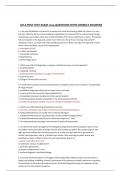
ATLS POST TEST EXAM 2024.QUESTIONS WITH CORRECT ANSWERS
ATLS POST TEST EXAM 2024.QUESTIONS WITH CORRECT ANSWERS 1. A 20-year-old athlete is involved in a motorcycle crash after having ridden for hours on a very hot day. When he arrives in the emergency department, he shouts that he cannot move his legs. On physical examination, there are no abnormalities of the chest, abdomen, or pelvis. The patient has no sensation in his legs and cannot move them, but his arms are moving. The patient's respiratory rate is 22, heart rate is 88, and blood pressure is 80/60 mm Hg. He is pale and sweaty. What is the most likely cause of his hypotension? a. neurogenic shock b. cardiac tamponade c. myocardial contusion d. hyperthermia e. hemorrhagic shock 2. Which one of the findings below requires a definitive airway in trauma patients? a. facial lacerations b. repeated vomiting c. partial thickness facial burns, cough, and hoarseness d. sternal fracture e. Glasgow Coma Scale score of 12 3. Twenty-seven patients are seriously injured in an airplane crash at a local airport. The principles of triage include: a. establish a triage site within the hot zone of the crush site b. treat only the most severely injured patients first c. immediately transport all patients to the nearest hospital d. treat the greatest number of patients in the shortest period of time e. produce the greatest number of survivors based on available resources 4. Which one of the following statements is correct? A. Cerebral contusions may coalesce to form an intracerebral hematoma. b. Epidural hematomas are usually seen in the frontal region. c. Subdural hematomas are caused by injury to the middle meningeal artery. d. subdural hematomas typically have a lenticular shape on CT scan. e. The associated brain damage is more severe in epidural hematomas. 5. An 18-year-old male is brought to the emergency department after having been shot. He has one bullet wound just below the right clavicle and another just below the costal margin in the right posterior axillary line. His blood pressure is 110/60 mm Hg. heartrate is 90 beats per minute, and respiratory rate is 34 breaths per minute. After ensuring a patent airway and inserting two large- caliber IV lines, the next appropriate step is to: a. obtain a portable chest x-ray b. administer a bolus of additional IV c. perform a laparotomy d. obtain an abdominal CT scan e. perform diagnostic peritoneal lavage 6. A 47-year-old house painter is brought to the hospital after falling 6 meters (20 feet) from a ladder and landing straddling a fence Examination of his perineum reveals extensive ecchymosis. There is blood in the external urethral nicatus. The initial diagnostic study for evaluation of the urinary tract in this patient should be : a cystoscopy b. cystography c. intravenous pyelography d. CT scan e. retrograde urethrography a. hypotension b. vasodilation c. bradycardia d. neurologic deficit e. narrowed pulse pressure 7. Which one of the following statements is false concerning Rh isoimmunization in pregnant trauma patients? a. It occurs in blunt or penetrating abdominal trauma. b. It is produced by minor degrees of fetomaternal hemorrhage. c. Rh immunoglobulin therapy should be administered to pregnant females who have sustained a gunshot wound to the leg. D. Isoimmunization is not a problem in Rh-positive pregnant patients. E. Initiation of Rh immunoglobulin therapy does not require proof of fetomaternal hemorrhage. Rh imunoglobulin rh (-) pada luka dimana tmnya bayi 8. An 18-year-old motorcyclist collides head-on with a pick-up truck and sustains massive facial injuries. In the emergency department his blood pressure is 150/38mm Hg. heartrate is 88 beats per minute and regular, and respiratory rate is 26 breaths per minute. His respirations are labored and sonorous. His Glasgow Coma Scale score is 7. Attempts at orotracheal intubation with restriction of cervical spinal motion are unsuccessful due to bleeding and distorted anatomy. The patient becomes apneic. The best procedure for airway management in this situation is: a. nasotracheal intubation
Document information
- Uploaded on
- May 30, 2024
- Number of pages
- 9
- Written in
- 2023/2024
- Type
- Exam (elaborations)
- Contains
- Questions & answers


