

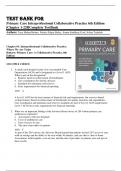
TEST BANK FOR Primary Care Interprofessional Collaborative Practice 6th Edition |Chapter 1 -228|Complete TestBank Authors: Terry Mahan Buttaro , Patricia Polgar -Bailey , Joanne Sandb erg-Cook , JoAnn Trybulski Chapter 01: Interprofessional Collaborative Practice: Where We Are Today Buttaro: Primary Care: A Collaborative Practice, 6th Edition MULTIPLE CHOICE 1. A small, rural hospital is part of an Accountable Care Organization (ACO) and is designated as a Level 1 ACO. What is part of this designation? a. Bonuses based on achievement of benchmarks b. Care coordination for chronic di seases c. Standards for minimum cash reserves d. Strict requirements for financial reporting ANS: A A Level 1 ACO has the least amount of financial risk and requirements, but receives shared savings bonuses based on achievement of benchmarks for quali ty measures and expenditures. Care coordination and minimum cash reserves standards are part of Level 2 ACO requirements. Level 3 ACOs have strict requirements for financial reporting. 2. What was an important finding of the Advisory Board survey of 2014 about primary care preferences of patients? a. Associations with area hospitals b. Costs of ambulatory care c. Ease of access to care d. The ratio of providers to patients ANS: C As part of the 2014 survey, the Advisory Board learned that patients d esired 24/7 access to care, walk -in settings and the ability to be seen within 30 minutes, and care that is close to home. Associations with hospitals, costs of care, and the ratio of providers to patients were not part of these results. MEDCONNOISSEUR MULTIPLE RESPONSE 1. Which assessments of care providers are performed as part of the value -based purchasing (VBP) initiative? ( Select all that apply. ) a. Appraising costs per case of care for Medicare patients b. Assessing patients’ satisfaction with hospital care c. Evaluating available evidence to guide clinical care guidelines d. Monitoring mortality rates of all patients with pneumonia e. Requiring advanced IT standards and minimum cash reserves ANS: A, B, D Value -based purchasing looks at five domain areas of processes of care, including efficiency of care (cost per case), experience of care (patient satisfaction measures), and outcomes of care (mortality rates for certain conditions). Evaluation of evidence to guide clinical care is part of evidence -based pra ctice. The requirements for IT standards and financial status are part of Accountable Care Organization standards. Chapter 02: Translating Research into Clinical Practice Buttaro: Primary Care: A Collaborative Practice, 6th Edition MULTIPLE CHOICE 1. What is the purpose of Level II research? a. To define characteristics of interest of groups of patients b. To demonstrate the effectiveness of an intervention or treatment c. To describe relationships among characteristics or variables d. To evaluate th e nature of relationships between two variables ANS: C Level II research is concerned with describing the relationships among characteristics or variables. Level I research is conducted to define the characteristics of groups of patients. Level II resea rch evaluates the nature of the relationships between variables. Level IV research is conducted to demonstrate the effectiveness of interventions or treatments. 2. Which is the most appropriate research design for a Level III research study? a. Epidemiol ogical studies b. Experimental design c. Qualitative studies d. Randomized clinical trials ANS: B The experimental design is the most appropriate design for a Level III study. Epidemiological studies are appropriate for Level II studies. Qualitative designs are useful for Level I studies. Randomized clinical trials are used for Level IV studies. MEDCONNOISSEUR 3. What is the purpose of clinical research trials in the spectrum of translational research? a. Adoption of interventions and clinical practices into routi ne clinical care b. Determination of the basis of disease and various treatment options c. Examination of safety and effectiveness of various interventions d. Exploration of fundamental mechanisms of biology, disease, or behavior ANS: C Clinical rese arch trials are concerned with determining the safety and effectiveness of interventions. Adoption of interventions and practices is part of clinical implementation. Determination of the basis of disease and treatment options is part of the preclinical res earch phase. Exploration of the fundamental mechanisms of biology, disease, or behavior is part of the basic research stage. Chapter 03: Empowering Patients as Collaborative partners: A New Model for Primary Care Buttaro: Primary Care: A Collaborative Pra ctice, 6th Edition MULTIPLE CHOICE 1. Which statement made by a health care provider demonstrates the most appropriate understanding for the goal of a performance report? a. ―This process allows me to critique the performance of the rest of the staff.‖ b. ―Most organizations require staff to undergo a performance evaluation yearly.‖ c. ―It is hard to be personally criticized but that’s how we learn to change.‖ d. ―The comments should help me improve my management skills.‖ ANS: D The goal of the per formance report is to provide guidance to staff in the areas of professional development, mentoring, and leadership development. A peer review is written by others who perform similar skills (peers). The remaining options may be true but do not provide evi dence of understanding of the goal of this professional requirement. MULTIPLE RESPONSE 1. Which assessment question would a health care provider ask when engaging in the previsit stage of the new model for primary care? ( Select all that apply .) a. ―Are you ready to discuss some of the community resources that are available?‖ b. ―Are you experiencing any side effects from your newly prescribed medications?‖ c. ―Do you anticipate any problems with adhering to your treatment plan?‖ d. ―Are you ready to d iscuss the results of your laboratory tests?‖ e. ―Do you have any questions about the lab tests that have been ordered for you?‖ ANS: B, C, E MEDCONNOISSEUR The nursing responsibilities in the previsit stage include assessing the patient’s tolerance of prescribed med ications, understanding of existing treatment plan, and education about required lab testing. The primary care provider is responsible for screening lab data and discussing community resources during the actual visit. Chapter 04: Coordinated Chronic Care Buttaro: Primary Care: A Collaborative Practice, 6th Edition MULTIPLE CHOICE 1. To reduce adverse events associated with care transitions, the Centers for Medicare and Medicaid Service have implemented which policy? a. Mandates for communication among p rimary caregivers and hospitalists b. Penalties for failure to perform medication reconciliations at time of discharge c. Reduction of payments for patients readmitted within 30 days after discharge d. Requirements for written discharge instructions for patients and caregivers ANS: C As a component of the Affordable Care Act, the Centers for Medicare and Medicaid Service developed the Readmissions Reduction Program reducing payments for certain patients readmitted within 30 days of discharge. The CMS did not mandate communication, institute penalties for failure to perform medication reconciliations, or require written discharge instructions. 2. According to multiple research studies, which intervention has resulted in lower costs and fewer rehospita lizations in high -risk older patients? a. Coordination of posthospital care by advanced practice health care providers b. Frequent posthospital clinic visits with a primary care provider c. Inclusion of extended family members in the outpatient plan of c are d. Telephone follow -up by the pharmacist to assess medication compliance ANS: A Research studies provided evidence that high -risk older patients who had posthospital care coordinated by an APN had reduced rehospitalization rates. It did not include clinic visits with a primary care provider, inclusion of extended family members in the plan of care, or telephone follow -up by a pharmacist. MULTIPLE RESPONSE 1. Which advantages are provided to the chronically ill patient by personal electronic monit oring devices? ( Select all that apply. ) a. Helps provide more patient control their health and lifestyle b. Eliminates need for regular medical and nursing follow -up visits c. Helps the early identification of patient health -related problems d. Helps he alth care providers in keeping track of the patient’s health status e. Cost is often covered by Medicare MEDCONNOISSEUR
Preview 4 out of 268 pages
Exam (elaborations)
Test Bank For Primary Care Interprofessional Collaborative Practice 6th Edition By Buttaro 9780323570152 Chapter 1-228 Complete Guide.
Preview 4 out of 268 pages
Test Bank For Primary Care: A Collaborative Practice 6th Edition By Terry Mahan Buttaro; Patricia Polgar-Bailey; Joanne Sandberg-Cook; JoAnn Trybulski. Chapter 1 Interprofessional Collaborative Practice 2 Translating Research Into Clinical Practice 3 Empowering Patients as Collaborative Partners 4 Coordinated Chronic Care 5 An Introduction to Health Care Disparities and Culturally Responsive Primary Care 6 Patient/Family Education and Health Literacy 7 Genetic Considerations in Primary Care 8 Risk Management 9 Adolescent Issues 10 LGBTQ Patient Care 11 Pregnancy, Prenatal Care, and Lactation 12 Human Trafficking 13 Aging and Common Geriatric Syndromes 14 Palliative Care 15 Acute, Chronic, Oncologic, and End-of-Life Pain Management in Primary Care 16 Wellness 17 Obesity and Weight Management 18 Principles of Occupational and Environmental Health in Primary Care 19 College Health 20 Presurgical Clearance 21 Preparticipation Sports Physical 22 Acute Bronchospasm 23 Anaphylaxis 24 Bites and Stings 25 Bradycardia and Tachycardia 26 Chemical Exposure 27 Electrical Injuries 28 Environmental and Food Allergies 29 Head Trauma 30 Hypotension 31 Poisoning 32 Sexual Assault 33 Syncope 34 Thermal Injuries 35 Examination of the Skin and Approach to Diagnosis of Skin Disorders 36 Surgical Office Procedures 37 Principles of Dermatologic Therapy 38 Screening for Skin Cancer 39 Adnexal Disease 40 Alopecia 41 Animal and Human Bites 42 Benign Skin Lesions 43 Bullous Pemphigoid 44 Burns (Minor) 45 Cutaneous Adverse Drug Reactions 46 Eczematous Dermatitis 47 Infections and Infestations 48 Nail Disorders 49 Maculopapular Skin Disorders 50 Pigmentation Changes 51 Wound Management 52 Evaluation of the Eyes 53 Cataracts 54 Blepharitis, Hordeolum, and Chalazion 55 Conjunctivitis 56 Corneal Surface Defects and Ocular Surface Foreign Bodies 57 Dry Eye Syndrome 58 Nasolacrimal Duct Obstruction and Dacryocystitis 59 Preseptal and Orbital Cellulitis 60 Pingueculae and Pterygia 61 Traumatic Ocular Disorders 62 Auricular Disorders 63 Cerumen Impaction 64 Cholesteatoma 65 Impaired Hearing 66 Inner Ear Disturbances 67 Otitis Externa 68 Otitis Media 69 Tympanic Membrane Perforation 70 Chronic Nasal Congestion and Discharge 71 Epistaxis 72 Nasal Trauma 73 Rhinitis 74 Sinusitis 75 Smell and Taste Disturbances 76 Tumors and Polyps of the Nose 77 Dental Abscess 78 Diseases of the Salivary Gland 79 Epiglottitis 80 Oral Infections 81 Parotitis 82 Peritonsillar Abscess 83 Pharyngitis and Tonsillitis 84 Acute Bronchitis 85 Asthma 86 Chest Pain (Noncardiac) 87 Chronic Cough 88 Chronic Obstructive Pulmonary Disease 89 Dyspnea 90 Hemoptysis 91 Lung Cancer 92 Pleural Effusions and Pleurisy 93 Pneumonia 94 Pneumothorax 95 Pulmonary Embolism 96 Pulmonary Hypertension 97 Sarcoidosis 98 Cardiac Diagnostic Testing 99 Abdominal Aortic Aneurysm 100 Cardiac Arrhythmias 101 Carotid Artery Disease 102 Chest Pain and Coronary Artery Disease 103 Heart Failure 104 Hypertension 105 Infective Endocarditis 106 Myocarditis 107 Peripheral Arterial and Venous Insufficiency 108 Valvular Heart Disease and Cardiac Murmurs 109 Abdominal Pain and Infections 110 Anorectal Complaints 111 Cholelithiasis and Cholecystitis 112 Cirrhosis 113 Constipation 114 Diarrhea, Noninfectious 115 Diverticular Disease 116 Oropharyngeal Dysphagia in Adults 117 Gastroesophageal Reflux Disease 118 Gastrointestinal Hemorrhage 119 Hepatitis 120 Inflammatory Bowel Disease 121 Irritable Bowel Syndrome 122 Jaundice 123 Nausea and Vomiting 124 Pancreatitis 125 Tumors of the Gastrointestinal Tract 126 Peptic Ulcer Disease 127 Incontinence 128 Prostate Cancer 129 Prostatic Hyperplasia (Benign) 130 Proteinuria and Hematuria 131 Renal Failure 132 Sexual Dysfunction (Male) 133 Testicular Disorders 134 Urinary Calculi 135 Urinary Tract Infections and Sexually Transmitted Infections 136 Uropathies (Obstructive) and Tumors of the Genitourinary Tract (Kidneys, Ureters, and Bladder) 137 Amenorrhea 138 Bartholin Gland Cysts and Abscesses 139 Breast Disorders 140 Chronic Pelvic Pain 141 Abnormal Uterine Bleeding 142 Dysmenorrhea 143 Dyspareunia 144 Ectopic Pregnancy 145 Fertility Control 146 Genital Tract Cancers 147 Infertility 148 Menopause 149 Cervical Cancer Screening Abnormalities 150 Pelvic Inflammatory Disease 151 Sexual Dysfunction (Female) 152 Unplanned Pregnancy 153 Vulvar and Vaginal Disorders 154 Ankle and Foot Pain 155 Bone Lesions 156 Bursitis 157 Fibromyalgia and Myofascial Pain Syndrome 158 Gout 159 Septic Arthritis 160 Low Back Pain 161 Hip Pain 162 Knee Pain 163 Metabolic Bone Disease 164 Neck Pain 165 Osteoarthritis 166 Osteomyelitis 167 Shoulder Pain 168 Sprains, Strains, and Fractures 169 Elbow Pain 170 Hand and Wrist Pain 171 Amyotrophic Lateral Sclerosis 172 Bell Palsy 173 Cerebrovascular Events 174 Dementia 175 Dizziness and Vertigo 176 Guillain-Barré Syndrome 177 Headache 178 Infections of the Central Nervous System 179 Movement Disorders and Essential Tremor 180 Multiple Sclerosis 181 Parkinson Disease 182 Seizure Disorder 183 Trigeminal Neuralgia 184 Intracranial Tumors 185 Adrenal Gland Disorders 186 Diabetes Mellitus 187 Hirsutism 188 Hypercalcemia and Hypocalcemia 189 Hyperkalemia and Hypokalemia 190 Hypernatremia and Hyponatremia 191 Lipid Disorders 192 Metabolic Syndrome 193 Parathyroid Gland Disorders 194 Thyroid Disorders 195 Polymyalgia Rheumatica and Giant Cell Arteritis 196 Raynaud Phenomenon 197 Rheumatoid Arthritis 198 Seronegative Spondyloarthropathies 199 Systemic Lupus Erythematosus 200 Vasculitis 201 Diving-Related Maladies 202 Fatigue 203 Fever 204 Immunodeficiency 205 Lymphadenopathy 206 Sleep Disorders 207 Unintended Weight Loss 208 Emerging and Reemerging Infectious Diseases 209 HIV Infection 210 Influenza 211 Infectious Diarrhea 212 Infectious Mononucleosis 213 Tick-Borne Diseases 214 Tuberculosis 215 Mosquito-Borne Illness 216 Anemia 217 Blood Coagulation Disorders 218 Leukemias 219 Lymphomas 220 Myelodysplastic Syndromes 221 Interprofessional Collaborative Management of the Oncology Patient 222 Basic Principles of Oncology Treatment 223 Oncology Complications, Paraneoplastic Syndromes, and Cancer Survivorship 224 Carcinoma of Unknown Primary 225 Anxiety Disorders 226 Mood Disorders 227 Substance Use Disorders 228 Other Mental Health Disorders
Content preview
Connected book
Document information
- Uploaded on
- May 30, 2024
- Number of pages
- 268
- Written in
- 2023/2024
- Type
- Exam (elaborations)
- Contains
- Questions & answers
$20.49
Wrong document? Swap it for free
Within 14 days of purchase and before downloading, you can choose a different document. You can simply spend the amount again.
Written by students who passed
Immediately available after payment
Read online or as PDF

Reputation scores are based on the amount of documents a seller has sold for a fee and the reviews they have received for those documents. There are three levels: Bronze, Silver and Gold. The better the reputation, the more your can rely on the quality of the sellers work.


