Corporate Innovation and Entrepreneurship - Lectures
Lecture 1 – Introduction
Key Concepts
Entrepreneurship: The process of creating value by bringing together a unique combination of
resources to exploit an opportunity.
this can be done within an existing organization. This is entrepreneurial behavior inside
established mid-sized and large organizations.
Total Early-Stage Entrepreneurial Activity (TEA).
Researchers agree that corporate entrepreneurship has a positive effect on financial performance. It
also has a positive effect on the strategic performance of the company.
Organizations that engage in intrapreneurial activities are expected to achieve higher levels of
profitability and growth.
Why is coporate entrepeneurship (almost) mission impossible for established organizations?
- Stuck in routines
- It’s a paradox: they have the investments, people, resources to do it, but it’s hard to be
innovative
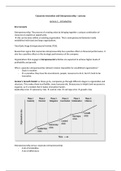
Greiner’s Growth Model: as times go by, companies go through different stages in organization and
structure. This makes them less flexible, more bureaucratic. Bureaucracy is helpful and necessary to
organize, so it’s needed. But it makes innovation harder.
leadership crisis autonomy crisis control crisis red tape crisis growth crisis
Entrepreneurship versus corporate entrepreneurship
- A lot of similarities
- A lot of differences
,Organizational politics:
- People in organizations differ in terms of their needs, objectives, values and capabilities
- Plays a big role in the success or failure of any entrepreneurial initiative within a company
Organizational politics is one of the main reasons why corporate entrepreneurs leave the company
- Unequal distribution of available opportunities within the organization
- They are not willing to go through all the politics and want to start a business for themselves
Three challenges faced by the corporate entrepreneur:
1. Achieving credibility or legitimacy
2. Obtaining resources
3. Overcoming inertia and resistance a company just wants to keep doing what it is doing
Four reasons why corporate entrepreneurs remain:
1. Size of the resource base
2. Potential to operate on a fairly significant scope
3. Potential to scale fairly quickly
4. Job security
Synonyms of corporate entrepreneurship:
intrapreneurship: not a huge difference, it means corporate entrepreneurship, but we use the
term CE.
entrepreneurial employee activity (EEA)
organizational entrepreneurship
Corporate entrepreneurship exists of:
- Corporate Venturing
- Strategic Entrepreneurship
Lecture 2 – Entrepreneurial Orientation, Corporate Venturing and Strategic Entrepreneurship
Entrepreneurial Orientation is a concept that is mostly seen in large corporation. It means to what
extent they take up entrepreneurial activities. It depends on five dimensions (the book only names
three, but in the article, there are two more):
1. Innovativeness: it can take different forms. It is related to what extent firms are open to new
ideas and turn them into new products/services/processes. Making a better process, less
expensive, is also innovation.
a. Dilemmas in innovativeness:
i. How to control the unknown? can you know what people want?
ii. How to balance freedom and discipline? inside the organization, employees,
making sure it won’t be chaotic. Finding a balance between a detailed planning
and freedom
iii. How to deal with cannibalization by innovation? you already have some
products in the market, but then you introduce new and updated versions of the
same products (iPhone 6, 7, 8 etc.). It is a sort of cannibalization, because your
own products compete with your own products.
iv. How to deliver ‘good enough’ products? in order to get more market share or
higher costumer value, you need to know in what extent your product needs to
be better.
, Open innovation = “The use of purposive inflows and outflows of knowledge to accelerate internal
innovation, and expand the markets for external use of innovation, respectively”.
Providing open platforms where people can give input to customers who help to develop the
product. Information and ideas flow in and out. The necessary skills can come from outside. The
results? A greater chance on more success and a quicker process.
The closed innovation model versus the open innovation model:
Closed innovation model: only a few ideas will make it, and they have to be in line with the company.
Open innovation model: people outside the firm can help in different stages and in various ways.
Two kinds of open innovation:
- Outside-in: drawing on the capacities of individuals, organizations, and even small start-ups
from around the globe.
- Inside-out: we make our skills and resources available to the outside world
2. Risk taking: willingness to commit significant resources to opportunities that have reasonavle
chance of failure as well as success. It means that you try to calculate risk. You don’t just jump off
the cliff – it is important to keep in mind what you know and what you don’t. Many companies
Lecture 1 – Introduction
Key Concepts
Entrepreneurship: The process of creating value by bringing together a unique combination of
resources to exploit an opportunity.
this can be done within an existing organization. This is entrepreneurial behavior inside
established mid-sized and large organizations.
Total Early-Stage Entrepreneurial Activity (TEA).
Researchers agree that corporate entrepreneurship has a positive effect on financial performance. It
also has a positive effect on the strategic performance of the company.
Organizations that engage in intrapreneurial activities are expected to achieve higher levels of
profitability and growth.
Why is coporate entrepeneurship (almost) mission impossible for established organizations?
- Stuck in routines
- It’s a paradox: they have the investments, people, resources to do it, but it’s hard to be
innovative
Greiner’s Growth Model: as times go by, companies go through different stages in organization and
structure. This makes them less flexible, more bureaucratic. Bureaucracy is helpful and necessary to
organize, so it’s needed. But it makes innovation harder.
leadership crisis autonomy crisis control crisis red tape crisis growth crisis
Entrepreneurship versus corporate entrepreneurship
- A lot of similarities
- A lot of differences
,Organizational politics:
- People in organizations differ in terms of their needs, objectives, values and capabilities
- Plays a big role in the success or failure of any entrepreneurial initiative within a company
Organizational politics is one of the main reasons why corporate entrepreneurs leave the company
- Unequal distribution of available opportunities within the organization
- They are not willing to go through all the politics and want to start a business for themselves
Three challenges faced by the corporate entrepreneur:
1. Achieving credibility or legitimacy
2. Obtaining resources
3. Overcoming inertia and resistance a company just wants to keep doing what it is doing
Four reasons why corporate entrepreneurs remain:
1. Size of the resource base
2. Potential to operate on a fairly significant scope
3. Potential to scale fairly quickly
4. Job security
Synonyms of corporate entrepreneurship:
intrapreneurship: not a huge difference, it means corporate entrepreneurship, but we use the
term CE.
entrepreneurial employee activity (EEA)
organizational entrepreneurship
Corporate entrepreneurship exists of:
- Corporate Venturing
- Strategic Entrepreneurship
Lecture 2 – Entrepreneurial Orientation, Corporate Venturing and Strategic Entrepreneurship
Entrepreneurial Orientation is a concept that is mostly seen in large corporation. It means to what
extent they take up entrepreneurial activities. It depends on five dimensions (the book only names
three, but in the article, there are two more):
1. Innovativeness: it can take different forms. It is related to what extent firms are open to new
ideas and turn them into new products/services/processes. Making a better process, less
expensive, is also innovation.
a. Dilemmas in innovativeness:
i. How to control the unknown? can you know what people want?
ii. How to balance freedom and discipline? inside the organization, employees,
making sure it won’t be chaotic. Finding a balance between a detailed planning
and freedom
iii. How to deal with cannibalization by innovation? you already have some
products in the market, but then you introduce new and updated versions of the
same products (iPhone 6, 7, 8 etc.). It is a sort of cannibalization, because your
own products compete with your own products.
iv. How to deliver ‘good enough’ products? in order to get more market share or
higher costumer value, you need to know in what extent your product needs to
be better.
, Open innovation = “The use of purposive inflows and outflows of knowledge to accelerate internal
innovation, and expand the markets for external use of innovation, respectively”.
Providing open platforms where people can give input to customers who help to develop the
product. Information and ideas flow in and out. The necessary skills can come from outside. The
results? A greater chance on more success and a quicker process.
The closed innovation model versus the open innovation model:
Closed innovation model: only a few ideas will make it, and they have to be in line with the company.
Open innovation model: people outside the firm can help in different stages and in various ways.
Two kinds of open innovation:
- Outside-in: drawing on the capacities of individuals, organizations, and even small start-ups
from around the globe.
- Inside-out: we make our skills and resources available to the outside world
2. Risk taking: willingness to commit significant resources to opportunities that have reasonavle
chance of failure as well as success. It means that you try to calculate risk. You don’t just jump off
the cliff – it is important to keep in mind what you know and what you don’t. Many companies