

THE AENEID BY VIRGIL (NOTES BY ROJI)
BOOK 1
I think at the beginning of the Aeneid, Aeneas is presented as stoic. The reason being is that
“he kept his misery deep in his heart” after the hardships his family and himself endured from
escaping Troy. Stoicism is when a person suffers but doesn’t complain and perseveres
throughout their journey. This is what Aeneas does throughout his journey. Aeneas is also
presented as a motivator to his men, as his dialogue is a motivational speech to bring some
optimism to his people and make them keep their hopes as they progress to find a home for
safety. For instance Aeneas says “summon up your courage once again”, advising his
followers to not lose hope and be brave when facing inevitable dangers throughout their
journeys. In his dialogue, Aeneas does not complain about the hardships him and his
followers faced, which links in with Virgil’s characterisation of Aeneas’ stoicism.
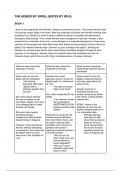
What we learn about the What we learn about the What we learn about the
character of Venus character of Aeneas relationship between the two
characters
Venus cries as her son Aeneas has a stoic Venus cares for her son
deals with the hardships. approach when it comes to deeply (maternal instinct)
- “Her shining dealing with his misfortunes and was upset about the
brimming with tears” at Troy. sack of Troy.
- “Spoke with a - “He kept his misery
sadness greater than deep in his heart” Aeneas however is
his own” frustrated towards his
He is also recognised for his mother, because he thinks
She cares about Aeneas’ pietas. that Venus is being distant
life and complains to her - “I am Aeneas, known towards him.
own father Jupiter, as to why for my devotion”
is he allowing fate to make (MISTRANSLATION- IRONY: Venus is the
Aeneas’ life harder. replace devotion with Goddess of Love but she
pietas). ditches Aeneas when he is
She even does augury in a vulnerable state.
(fortelling Aeneas’ However he craves for the - Perhaps Aeneas
prophecy) to help Aeneas, human physical attention was going to talk
despite being in disguise. from his mother Venus, but about his traumas he
he doesn’t receive them faced at Troy but
However, since she leaves (perhaps since Venus is a since Venus leaves,
Aeneas without answering goddess and doesn’t this is why he asks
his questions, she comes off express emotional actions in questions about her
as distant which is ironic a mortal manner) uses of disguise etc.
since she is the Goddess of - “Why do you so
Love. often mock your own
son by taking on
these disguises?”
- “Why am I never
allowed to take your
hand in mine”
,SCHOLARSHIP: Joe Romero- “Venus is involved with Aeneas’ affairs because she is his
mother. Venus isn't a matronal figure but is a goddess.”
- Contrast with how Venus wept when she was worried for Aeneas’ safety, whilst
Jupiter says his prophecy to comfort her.
Dido’s Carthage
Virgil uses a romanticised style of pastoralism to describe the setting of Carthage. For
instance, Virgil uses a simile to compare the Tyrians to bees- such as “they were like bees at
the beginning of the summer, busy in the sunshine all through the flowery meadows”. This
was used to convey the hard-working and structured nature of the Carthaginian people, yet
also creates a peaceful imagery of a peaceful society working together to cultivate their
citadel of Carthage. As a result, Virgil presents Carthage in a positive aspect to build up
Carthage’s image to perhaps compare with Rome’s image on equal terms as superpowers of
the Ancient World- even more since Rome and Carthage were rival nations.
“Doomed Dido”- foreshadowed to die as part of fate.
- Perhaps a reference to the fall of Carthage → Dido was the ruler of Carthage.
- Carthage was an Enemy of Rome so the fall of Carthage is ancient Roman
propaganda that Carthage was a “weak nation” fated to fall just like how Dido was
fated to die.
, BOOK 2
Dreams in the Ancient world are a common concept in their stories. Oneiromancy is the term
for dreams that foretell the future (supernatural and fate concepts). Based on this Ancient
Greek dream book called the Oneirocritica.
To some extent I disagree that Aeneas was an effective Pater Familias. In Book 2 as his
family and himself, Creussa (his wife) is forgotten by Aeneas and is presumed to be killed off
scene. Later on Aeneas sees “her ghost” in a “larger state”, and finds out Creussa has
passed away from being killed by the Greeks who invaded Troy.
Rape of Cassandra is committed by Ajax (a Greek who was part of sacking Troy)
- showcased women being treated as objects and were violated during wars
- war crimes being committed which were normalised during the Ancient Times. To a
Modern Audience, it creates a huge sense of shock and sympathy towards
Cassandra- a rape victim.
- Rape of Cassandra is also looked down upon in Ancient Rome as she was a virgin
who was physically dragged away from a temple- she was holding onto a statue of a
deity.
- Focuses on the morality aspect (ROME HATED SACRILEGE)
- Also villainises the Greeks (remember- the Greeks were evil in the Roman Eye)
BOOK 3
Which Flashback scene was the most effective?
- Odyssey: Books 9-12
- Aeneid: Books 2-3
Consider the plot, style of writing and characterisation.
Flashback continuation of Aeneas journey from Troy up to being at Dido’s shores. He’s
basically explaining his journey to Dido. Continuation of Book 2’s flashback narrative.
After setting sail for Crete, Aeneas and his crew start to construct a new city, but a dreadful
epidemic soon breaks out. In a dream, the gods of Troy show Aeneas that his father is
mistaken: Italy, the ancestral home of Dardanus, the source of the Trojans' name
Dardanians, is the ancestral place to which Apollo refers. Furthermore, these gods reiterate
the prophecy of Roman propaganda, saying, "You must prepare great walls for a great race."
Involved supernatural elements such as:
- Harpies in the island of Strophades
- Fate
Aeneas and the Trojans encounter the Harpies after leaving Carthage for venturing out to
Italy to establish a new city (fated to be Rome).
BOOK 1
I think at the beginning of the Aeneid, Aeneas is presented as stoic. The reason being is that
“he kept his misery deep in his heart” after the hardships his family and himself endured from
escaping Troy. Stoicism is when a person suffers but doesn’t complain and perseveres
throughout their journey. This is what Aeneas does throughout his journey. Aeneas is also
presented as a motivator to his men, as his dialogue is a motivational speech to bring some
optimism to his people and make them keep their hopes as they progress to find a home for
safety. For instance Aeneas says “summon up your courage once again”, advising his
followers to not lose hope and be brave when facing inevitable dangers throughout their
journeys. In his dialogue, Aeneas does not complain about the hardships him and his
followers faced, which links in with Virgil’s characterisation of Aeneas’ stoicism.
What we learn about the What we learn about the What we learn about the
character of Venus character of Aeneas relationship between the two
characters
Venus cries as her son Aeneas has a stoic Venus cares for her son
deals with the hardships. approach when it comes to deeply (maternal instinct)
- “Her shining dealing with his misfortunes and was upset about the
brimming with tears” at Troy. sack of Troy.
- “Spoke with a - “He kept his misery
sadness greater than deep in his heart” Aeneas however is
his own” frustrated towards his
He is also recognised for his mother, because he thinks
She cares about Aeneas’ pietas. that Venus is being distant
life and complains to her - “I am Aeneas, known towards him.
own father Jupiter, as to why for my devotion”
is he allowing fate to make (MISTRANSLATION- IRONY: Venus is the
Aeneas’ life harder. replace devotion with Goddess of Love but she
pietas). ditches Aeneas when he is
She even does augury in a vulnerable state.
(fortelling Aeneas’ However he craves for the - Perhaps Aeneas
prophecy) to help Aeneas, human physical attention was going to talk
despite being in disguise. from his mother Venus, but about his traumas he
he doesn’t receive them faced at Troy but
However, since she leaves (perhaps since Venus is a since Venus leaves,
Aeneas without answering goddess and doesn’t this is why he asks
his questions, she comes off express emotional actions in questions about her
as distant which is ironic a mortal manner) uses of disguise etc.
since she is the Goddess of - “Why do you so
Love. often mock your own
son by taking on
these disguises?”
- “Why am I never
allowed to take your
hand in mine”
,SCHOLARSHIP: Joe Romero- “Venus is involved with Aeneas’ affairs because she is his
mother. Venus isn't a matronal figure but is a goddess.”
- Contrast with how Venus wept when she was worried for Aeneas’ safety, whilst
Jupiter says his prophecy to comfort her.
Dido’s Carthage
Virgil uses a romanticised style of pastoralism to describe the setting of Carthage. For
instance, Virgil uses a simile to compare the Tyrians to bees- such as “they were like bees at
the beginning of the summer, busy in the sunshine all through the flowery meadows”. This
was used to convey the hard-working and structured nature of the Carthaginian people, yet
also creates a peaceful imagery of a peaceful society working together to cultivate their
citadel of Carthage. As a result, Virgil presents Carthage in a positive aspect to build up
Carthage’s image to perhaps compare with Rome’s image on equal terms as superpowers of
the Ancient World- even more since Rome and Carthage were rival nations.
“Doomed Dido”- foreshadowed to die as part of fate.
- Perhaps a reference to the fall of Carthage → Dido was the ruler of Carthage.
- Carthage was an Enemy of Rome so the fall of Carthage is ancient Roman
propaganda that Carthage was a “weak nation” fated to fall just like how Dido was
fated to die.
, BOOK 2
Dreams in the Ancient world are a common concept in their stories. Oneiromancy is the term
for dreams that foretell the future (supernatural and fate concepts). Based on this Ancient
Greek dream book called the Oneirocritica.
To some extent I disagree that Aeneas was an effective Pater Familias. In Book 2 as his
family and himself, Creussa (his wife) is forgotten by Aeneas and is presumed to be killed off
scene. Later on Aeneas sees “her ghost” in a “larger state”, and finds out Creussa has
passed away from being killed by the Greeks who invaded Troy.
Rape of Cassandra is committed by Ajax (a Greek who was part of sacking Troy)
- showcased women being treated as objects and were violated during wars
- war crimes being committed which were normalised during the Ancient Times. To a
Modern Audience, it creates a huge sense of shock and sympathy towards
Cassandra- a rape victim.
- Rape of Cassandra is also looked down upon in Ancient Rome as she was a virgin
who was physically dragged away from a temple- she was holding onto a statue of a
deity.
- Focuses on the morality aspect (ROME HATED SACRILEGE)
- Also villainises the Greeks (remember- the Greeks were evil in the Roman Eye)
BOOK 3
Which Flashback scene was the most effective?
- Odyssey: Books 9-12
- Aeneid: Books 2-3
Consider the plot, style of writing and characterisation.
Flashback continuation of Aeneas journey from Troy up to being at Dido’s shores. He’s
basically explaining his journey to Dido. Continuation of Book 2’s flashback narrative.
After setting sail for Crete, Aeneas and his crew start to construct a new city, but a dreadful
epidemic soon breaks out. In a dream, the gods of Troy show Aeneas that his father is
mistaken: Italy, the ancestral home of Dardanus, the source of the Trojans' name
Dardanians, is the ancestral place to which Apollo refers. Furthermore, these gods reiterate
the prophecy of Roman propaganda, saying, "You must prepare great walls for a great race."
Involved supernatural elements such as:
- Harpies in the island of Strophades
- Fate
Aeneas and the Trojans encounter the Harpies after leaving Carthage for venturing out to
Italy to establish a new city (fated to be Rome).


