

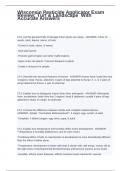
Wisconsin Pesticide Applicator Exam Review: Turf & Landscape With Accurate Answers
Ch.4 Describe factors that complicate management of pest mammals (5) - ANSWER-Mobility, Unpredictability, Public Perception, Legal Status, Management Techniques Ch.4 Explain the regulations regarding the use of pesticides to control mammals - ANSWER-Using pesticides to control mammals and birds is strictly regulated and often involves obtaining special permits from the WI Dept of Ag, Trade, and Consumer Protection (DATCP) and/or the WI DNR Ch.4 Describe the damage that pests discussed in this chapter can cause to turf and landscapes - ANSWER--Meadow Mice: girdle roots, kill/injure trees and shrubs. -Rabbits: browse on bark and branches of trees and shrubs. -Moles: tunnels interfere with mowing, expose roots to air killing grass/other plants. -Ground Squirrels: problem in gardens and lawns. -Skunks: mostly beneficial, disliked because of stink -Deer: damage woody plants by feeding on buds and young branches, rubbing, trampling. Ch.4 Outline your management options for controlling the pests discussed in this chapter - ANSWER--Meadow Mice: rodenticide baits -Rabbits: no lethal pesticides; virtually impossible to eliminate. -Moles: poison baits with food. -Ground Squirrels: toxic bait or rodenticides for large areas. -Skunks: no lethal pesticides; trapping or habitat destruction. -Deer: repellents, scare devices, fencing Chapter 4 Know the Law - ANSWER-You need a use permit to use any pesticide for the control of mammals (other than rats and mice) or to use strychnine or 1080 Ch.5 Define the word pesticide and explain how the word differs from specific types of pesticides - ANSWER-Any substance used to directly control pest populations or to prevent or reduce pest damage Ch.5 Contrast the difference between organic, inorganic, and microbial pesticides - ANSWER--Organic: the compound contains the element carbon; some derived from plant extracts; some synthetic. -Inorganic: derived from minerals that occur in nature; toxic to many organisms; less effective than organic compounds. -Microbial: are bacteria, fungi, viruses that cause disease. Ch.5 Explain the difference between the different types of pesticide names (3) - ANSWER-1. Chemical Names: given to each active ingredient; name is long, hard to pronounce, difficult to use. 2. Common Names: refers to an active ingredient, regardless of manufacturer/formulator. 3. Trade Names: manufacturer specific name for each formulation of an active ingredient. Ch.5 Explain the difference between contact and systemic insecticides - ANSWER--Contact: not absorbed by treated plants; pesticides must directly touch the pest or pest site to be effective. -Systemic: absorbed through leaves or roots of treated plants; translocated within plant Ch.5 Outline the characteristics of the insecticide groups discussed in this chapter (5) - ANSWER-1. Synthetic Organic Insecticides: most widely used group; manufactured. 2. Botanicals: plant-derived; nonpersistent; can be very toxic to humans. 3. Oils: derived from crude petroleum oil; suffocates pests; requires thorough coverage. 4. Insecticidal Soaps: fats; disrupt the respiratory system and cell membranes; coverage is critical. 5. Microbial Insecticides: -- Bt: naturally occurring bacteria; targets caterpillar pests. -- Milky Spore Powders: bacterium; causes milky spore disease in Japanese Beetles
Document information
- Uploaded on
- May 29, 2024
- Number of pages
- 43
- Written in
- 2023/2024
- Type
- Exam (elaborations)
- Contains
- Questions & answers


