

Psychology 2301 Chapter 1 Questions And Answers With Verified Study Solutions
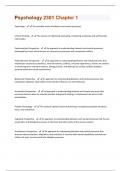
Psychology - The scientific study of behavior and mental processes Critical Thinking - The process of objectively evaluating, comparing, analyzing, and synthesizing information. Psychoanalytic Perspective - An approach to understanding behavior and mental processes developed by Freud, which focuses on unconscious processes and unresolved conflicts. Psychodynamic Perspective - An approach to understanding behavior and metal processes that emphasizes unconscious dynamics, internal motives, conflicts, and past experiences; actions are viewed as stemming from inherited instincts, biological drive, and attempts to resolve conflicts between personal needs and social requirements. Behavioral Perspective - An approach to understanding behavior and mental processes that emphasizes objective, observable environmental influences on overt behavior. Humanistic Perspective - An approach to understanding behavior and mental processes that perceives human nature as naturally positive and growth seeking; it emphasizes free will and selfactualization. Positive Psychology - The study of optimal human functioning; it emphasizes positive emotions, traits, and institutions. Cognitive Perspective - An approach to understanding behavior and mental processes that focuses on genetics and biological processes in the brain and other parts of the nervous system. Evolutionary Perspective - An approach to understating behavior and mental processes that stresses natural selection, adaptation, and evolution; it assumes that mental capabilities evolved over millions of years to serve particular adaptive purposes.Sociocultural Perspective - An approach to understanding behavior and mental processes that emphasizes the social interaction and cultural determinants of behavior and mental processes. Biopsychosocial Model - An integrative, unifying theme of modern psychology that sees biological, psychological, and social processes as interacting forces. Biopsychologist/Neuroscientist - investigates the relationship between biology, behavior, and mental processes, including how physical and chemical processes affect the structure and function of the brain and nervous system. Clinical Psychologist - Specializes in the evaluation, diagnosis, and treatment of psychological disorders. Cognitive Psychologist - Examines "higer" mental processes, including thought, memory, intelligence, creativity, and language. Comparative Psychologist - Studies the behavior and mental processes of nonhuman animals; emphasizes evolution and cross-species comparisons.
Document information
- Uploaded on
- May 29, 2024
- Number of pages
- 10
- Written in
- 2023/2024
- Type
- Exam (elaborations)
- Contains
- Questions & answers


