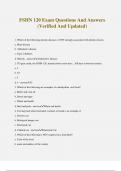
FSHN 120 Exam Questions And Answers (Verified And Updated)
FSHN 120 Exam Questions And Answers (Verified And Updated) 1. Which of the following chronic diseases is NOT strongly associated with dietary choices a. Heart disease b. Alzheimer's disease c. Type 2 diabetes d. Obesity - answerAlzheimer's Disease 2. TO gain credit, the FSHN 120, journal entries must have _ full days in between entries a. 3 b. 10 c. 5 d. 4 - answer5 3. Which of the following are examples of carbohydrate -rich food? a. Butter and corn oil b. Bacon and eggs c. Wheat and lentils d. Beef and pork - answerWheat and lentils 4. Craving food when frustrated, worried, or bored is an example of a. Sensory cue b. Biological hunger cue c. Emotional cue d. Cultural cue - answerEmotional Cue 5. Which of the following is NOT required on a food label? a. Taste of the food b. name and address of the vendor c. Statement of identity d. Net contents of the package - answerTaste of the Food 6. A set of principles developed by the USDA and the USDHHS to help reduce the risk of developing chronic disease is called a. Dietary guideline for americans b. Food fundamentals c. DASH Diet d. South Beach Diet - answerDietary Guideline for americans 7. Which of the following is NOT one of the improvements in the 2010 revision of the Dietary guideline for ? a. Increased emphasis on eating more legumes, vegetables, fruits, whole grains, and nuts b. Cutting out red meat, butter, cheese, and sugar c. Replacing unhealthy fats with healthy fats d. Replacing red meat with fish and chicken - answerb. Cutting out red meat, butter, cheese, and sugar According to the Acceptable Macronutrient Distribution Rance (AMDR), up to what percentage of your daily Calories should be provided by carbohydrates a. 70% b. 75% c. 35% d. 65% - answer65 9. Which statement if FALSE concerning the field of nutrition? a. Nutrition involves studying the factors that influence eating patterns b. Nutrition is the study of how food nourishes the body c. Nutrition is an ancient science that dates back to the fourteenth century d. Nutrition encompasses how we consume, digest, absorb, and store food - answerc. Nutrition is an ancient science that dates back to the fourteenth century 10. Bile is made in the liver and stored in the a. Small intestine b. Stomach c. Pancreas d. Gallbladder - answerGallbladder 11. Which dietary standard, expressed as percentage of total energy, defines the recommended intake range for the macronutrient? a. Estimated average requirement b. Tolerable upper intake level c. Recommended dietary allowance d. Acceptable Macronutrient Distribution Range - answerd. Acceptable Macronutrient Distribution Range 12. When the stomach is full, it can expand to hold approximately a. 1/2 gallon of food or water b. 2 cups of food or water c. 4 cups of food or water d. 1 gallon of food or water - answerc. 4 cups of food or water 13. Planning a meal that includes many different colored foods in an example of which characteristic of a healthful diet? a. Adequacy b. Variety c. Moderation d. Balance - answerVariety 14. Jane consumed a breakfast that contained 85 grams of carbohydrate, 20 grams of protein, and 18 grams of fat. How many kilocalories did Jane eat at breakfast? a. 123 b. 1007 c. 582 d. 152 - answer582 15. Organic food a. Is more nutritious than conventionally raised food b. Contains no pesticides c. Is grown on farmland that meets very specific USDA rules d. Is always cheaper - answerContains no pesticides 16. After FSHN score have been posted in Compass, you have _ to challenge the score a. Two weeks b. The rest of the semester c. One week d. One day - answerOne week 17. The term used to describe the process in which foods are broken down into their component molecules is a. Digestion b. Segmentation c. Elimination d. Absorption - answerDigestion 18. What is the primary cause of peptic ulcers? a. Eating too many spicy foods b. Helicobacter pylori c. Stress d. Prolonged use of asipirin - answerHelicobacter pylori 19. What term is commonly used to describe foods that are grown without the use of synthetic pesticides? a. Inorganic b. Vegetarian c. GMO d. Organic - answerOrganic 20. The goals of the recent "food movement" include a) Protecting the environment and reducing food supply monopolies b) Subsidizing grain crops and increasing centralization of food production
Document information
- Uploaded on
- May 28, 2024
- Number of pages
- 40
- Written in
- 2023/2024
- Type
- Exam (elaborations)
- Contains
- Questions & answers