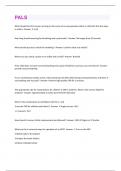
PALS Latest Questions With Passed Solutions!!
What should the first rescuer arriving on the scene of an unresponsive infant or child do? (Put the steps in order.) -Answer- 2,1,4,3 How long should assessing for breathing and a pulse take? -Answer- No longer than 10 seconds What should you do to check for breathing? -Answer- Look for chest rise and fall Where can you check a pulse on an infant and a child? -Answer- Brachial If the child does not have normal breathing and a pulse of 64/min is present, you will need to -Answerprovide rescue breathing For an unwitnessed cardiac arrest, what should you do after determining unresponsiveness and there is no breathing and no pulse? -Answer- Perform high-quality CPR for 2 minutes The appropriate rate for compressions for children is 100 to 120/min. What is the correct depth for children? -Answer- Approximately 2 inches (one third AP diameter) What is the compression-to-ventilation ratio for 1- and 2-rescuer CPR for children and infants? -Answer- • Single rescuer: 30:2 • 2 rescuers: 15:2 How should 1-rescuer infant compressions be delivered? -Answer- With 2 fingers or 2 thumbs What are the 4 universal steps for operation of an AED? -Answer- 1 Turn on the AED 2 Attach pads to the patient 3 Analyze the heart rhythm 4 Deliver indicated shockIf the AED indicates no shock advised, what should be the next action? -Answer- Start chest compressions What does A-B-C in the Pediatric Assessment Triangle (PAT) stand for? -Answer- Appearance B Work of breathing c Circulation When is the Pediatric Assessment Triangle (PAT) performed to make an initial assessment? -Answer- During the "from the doorway" observation What sequence is used when caring for a seriously ill or injured child to help determine the best treatment or intervention? The__________sequence. -Answer- Evaluate Identify Intervene The evaluate-identify-intervene sequence should be continued until -Answer- The child is stable The primary assessment includes the ABCDE approach. What does it assess? -Answer- Airway, breathing, circulation, disability, and exposure How is the airway assessed? -Answer- Determining if the airway is open/patent In the primary assessment, how should you open the airway of a child who is not suspected of having a cervical spine injury? -Answer- With a head tilt-chin lift In infants, the abdomen may move______the chest -Answer- more than What is a characteristic of normal chest rise? -Answer- Symmetrical during inspirationWhere can you check a pulse on an infant and a child? -Answer- Infant Brachial Child Femoral _______is usually high-pitched breathing during inspiration, whereas________is usually during expiration. -Answer- Stridor wheezing Snoring and gurgling are a result of_____airway obstruction. -Answer- upper Oxygen saturation less than_____indicates low oxygen saturation, which is known as hypoxemia. -Answer- 94% Pulse oximetry indicates oxygen______but not oxygen delivery. -Answer- saturation Determine the respiratory rate by counting the number of times the chest rises in______seconds and multiplying by -Answer- 30 2 Tachypnea is often the first sign of respiratory_______in infants -Answer- distress Conditions that______air resistance lead to increased respiratory______ -Answer- increase effort What are signs of increased respiratory effort that can lead to fatigue and respiratory failure? -AnswerHead bobbing Seesaw respirations RetractionsNasal flaring
Written for
- Institution
- PALS
- Course
- PALS
Document information
- Uploaded on
- May 28, 2024
- Number of pages
- 41
- Written in
- 2023/2024
- Type
- Exam (elaborations)
- Contains
- Questions & answers
Subjects

Also available in package deal