D265 Critical Thinking Study, Question well done 2024.
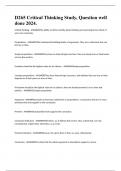
Critical Thinking - ANSWERSThe ability to think carefully about thinking and reasoning/to be critical of your own reasoning. Propositions - ANSWERSThe fundamental building blocks of arguments. They are a statement that can be true or false. Simple propositions - ANSWERSThey have no internal logic structure, they are simply true or false based on how the world is. Freedom should be the highest value for its citizens. - ANSWERSSimple proposition Complex propositions - ANSWERSThey have internal logic structure, and whether they are true or false depends on if their parts are true or false. If freedom should be the highest value for its citizens, then we should promote it in our laws and policies. - ANSWERSComplex proposition Argument - ANSWERSContains at least two statements or propositions: a conclusion and one or more premises that lend support to the conclusion. Premise - ANSWERSA proposition that supports the conclusion. Conclusion Indicators - ANSWERSTherefore, so, it follows that, hence, thus, entails that, we may conclude that, implies that, wherefore, as a result. Premise Indicators - ANSWERSBecause, for, given that, in that, as, since, indicated by. Conclusion - ANSWERSThe claim that the whole argument is intended to support or prove. Deduction - ANSWERSArguments where the premises guarantee or necessitate the conclusion. Types of arguments that are deductive - ANSWERSMathematical arguments, logical arguments, arguments from definition. Induction - ANSWERSArguments where the premises make the conclusion likely to be true. Types of arguments that are inductive/ampliative - ANSWERSAnalogies, authority, casual inferences, scientific reasoning, extrapolations. P1: Monty is in Bejing P2: It is impossible to get here from Bejing in an afternoon Conclusion: Monty won't be at the party - ANSWERSDeductive argument P1: Monty is really shy P2: Monty rarely goes to parties Conclusion: Monty won't be at the party - ANSWERSInductive/ampliative argument Soundness/Validity - ANSWERSElements of a deductive argument Validity - ANSWERSIf true, the premises make the conclusion true Soundness - ANSWERSThe argument's premises guarantee the conclusion when true (Validity), and all premises are true Strength/Cogency - ANSWERSElements of an inductive argument Strength - ANSWERSThe premises give probable support for the conclusion. Cogent - ANSWERSThe premises give probable support towards the conclusion when true (Strength), and all premises are true Fallacy - ANSWERSA defect in reasoning Formal Fallacy - ANSWERSA defect in the structure of an argument Informal Fallacy - ANSWERSA defect in the content of an argument Modus Ponens (Affirming the Antecedent) basic structure - ANSWERSP1. If X, then Y P2. X C: Therefore, Y No Formal Fallacy P1. If I'm in Rome, then I'm in Italy P2. I am in Rome. C: Therefore, I am in Italy - ANSWERSModus Ponens (Affirming the Antecedent) Affirming the Consequent basic structure - ANSWERSP1. If X, then Y P2. Y C: Therefore, X Commits Formal Fallacy P1. If I am in Rome, then I'm in Italy. P2. I am in Italy. C: Therefore, I am in Rome - ANSWERSAffirming the Consequent Modus Tollens (Denying the Consequent) basic structure - ANSWERSP1. If X, then Y P2. Not Y C: Therefore, not X No Formal Fallacy P1. If I'm in Rome, then I'm in Italy P2. I am not in Italy C: Therefore, I am not in Rome - ANSWERSModus Tollens (Denying the Consequent) Denying the Antecedent basic structure - ANSWERSP1. If X, then Y P2. Not X C: Therefore, not Y Commits Formal Fallacy P1. If I'm in Rome, then I'm in Italy P2. I am not in Rome C: Therefore, I am not in Italy - ANSWERSDenying the Antecedent Begging the Question/Circular Reasoning - ANSWERSAn argument where the premise restates the conclusion instead of supporting it. Arguing in a circle. P1. The Earth is ball-shaped C: Therefore, the Earth is a sphere - ANSWERSBegging the Question (Informal Fallacy) The Fallacy Fallacy - ANSWERSOccurs when the fact that a fallacy has been committed is used to justify rejecting someone's conclusion. They have committed the fallacy of begging the question, therefore we should reject their conclusion. - ANSWERSThe Fallacy Fallacy Bias - ANSWERSSupporting a particular conclusion regardless of the evidence The Principle of Charity - ANSWERSInterpreting a speaker's reasoning in the best possible light. This makes their position as strong and defensible as possible. Shae said, "It seems that the Earth is flat." Shae must mean that the Earth looks flat to observers on the ground even though our planet is really round. - ANSWERSThe Principle of Charity Confirmation Bias - ANSWERSThe tendency to focus on evidence that confirms what an individual already believes, and to ignore evidence to the contrary. Cognitive Bias - ANSWERSThe way we naturally categorize and make sense of the world around us. Alief - ANSWERSAn automatic belief-like attitude that can explain how our instinctual responses can conflict with our reasoned out beliefs. Heuristic - ANSWERSa rule-of-thumb problem-solving strategy that doesn't work all of the time, but one that gets us where we need to go most of the time. _______ can become issues when we want to engage in good reasoning, fair-mindedness, or intellectual virtue. - ANSWERSHeuristics The Representative Heuristic - ANSWERSa mental Heuristic whereby people try to understand/judge a situation by means of situations in memories that bear similarities to it Anchoring and Adjustment Heuristic - ANSWERSWhen someone clusters their guesses around a given anchor
Written for
- Institution
- CRITICAL THINKING
- Course
- CRITICAL THINKING
Document information
- Uploaded on
- May 27, 2024
- Number of pages
- 9
- Written in
- 2023/2024
- Type
- Exam (elaborations)
- Contains
- Questions & answers
Subjects
-
d265 critical thinking study question well done 2

Also available in package deal