

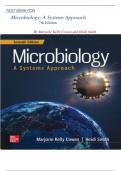
TEST BANK FOR
Microbiology: A Systems Approach
7th Edition
By Marjorie Kelly Cowan and Heidi Smith
,Chapter 1 The Main Themes of Microbiology
1) Microorganisms are best defined as organisms that .
A) cause Human disease
B) lack a CELL nucleus
C) are infectious particles
D) are too small to be seen with the unaided eye
E) can only be found growing in laboratories
Question Details
LEARNING OUTCOME: 01.01 List the six types of microorganisms we will be studying in this
book. ASM Topic : Module 02 Structure and Function
Bloom's : 1. Remember
Section : 01.01
Topic : CELLular Organization
ASM OBJ:02.01 The structure and function of microorganisms have been revealed by the use of m
Accessibility : Keyboard Navigation
2) Which of the following are not considered microorganisms?
A) Mosquitoes
B) Protozoa
C) Bacteria
D) Viruses
E) Fungi
Question Details
LEARNING OUTCOME: 01.01 List the six types of microorganisms we will be studying in this
book. ASM Topic : Module 05 Systems
ASM OBJ:05.01 Microorganisms are ubiquitous and live in diverse and dynamic ecosystems.
Bloom's : 2. Understand
Section : 01.01
Topic : Taxonomy of Microorganisms
Accessibility : Keyboard Navigation
Version 1 1
,3) Helminths are .
A) bacteria
B) protozoa
C) molds
D) parasitic worms
E) infectious particles
Question Details
LEARNING OUTCOME: 01.01 List the six types of microorganisms we will be studying in this
book. ASM Topic : Module 02 Structure and Function
ASM OBJ:02.04 While microscopic eukaryotes (for example, fungi, protozoa, and algae) carry ou
Bloom's : 1. Remember
Section : 01.01
Topic : Taxonomy of Microorganisms
Accessibility : Keyboard Navigation
4) Among these types of microorganisms, the arenonCELLular.
A) viruses
B) helminths
C) protozoans
D) bacteria
Question Details
LEARNING OUTCOME: 01.01 List the six types of microorganisms we will be studying in this
book. LEARNING OUTCOME: 01.08 Identify two types of aCELLular microorganisms.
ASM Topic : Module 02 Structure and Function
Bloom's : 1. Remember
Section : 01.01
Section : 01.05
Topic : CELLular Organization
ASM OBJ:02.05 The replication cycles of viruses (lytic and lysogenic) differ among viruses a
Accessibility : Keyboard Navigation
Version 1 2
, 5) Studies of the immune response to an infection caused by microorganisms would be
performed by a/an .
A) hypersensitivity specialist
B) epidemiologist
C) immunologist
D) geomicrobiologist
Question Details
LEARNING OUTCOME: 01.02 Identify multiple professions using
microbiology. ASM Topic : Module 05 Systems
ASM OBJ:05.04 Microorganisms, CELLular and viral, can interact with both Human and nonHuman h
Bloom's : 1. Remember
Section : 01.01
Topic : Microbial Roles
Accessibility : Keyboard Navigation
6) Which of the following pairs of career descriptions and work tasks is not correctly
matched?
A) Industrial microbiologist -- manipulate bacterial strains to be less pathogenic
B) Agricultural microbiologist -- identify bacterial causes of crop disease
C) Public health microbiologist -- track the incidence of AIDS in a population
D) Medical microbiologist -- identify the cause of a bladder infection at a hospital lab
Question Details
LEARNING OUTCOME: 01.02 Identify multiple professions using
microbiology. ASM Topic : Module 06 Impact of Microorganisms
ASM OBJ:06.03 Humans utilize and harness microorganisms and their products. Bloom's :
1. Remember
Section : 01.01
Topic : Microbial Roles
Accessibility : Keyboard Navigation
Version 1 3
Microbiology: A Systems Approach
7th Edition
By Marjorie Kelly Cowan and Heidi Smith
,Chapter 1 The Main Themes of Microbiology
1) Microorganisms are best defined as organisms that .
A) cause Human disease
B) lack a CELL nucleus
C) are infectious particles
D) are too small to be seen with the unaided eye
E) can only be found growing in laboratories
Question Details
LEARNING OUTCOME: 01.01 List the six types of microorganisms we will be studying in this
book. ASM Topic : Module 02 Structure and Function
Bloom's : 1. Remember
Section : 01.01
Topic : CELLular Organization
ASM OBJ:02.01 The structure and function of microorganisms have been revealed by the use of m
Accessibility : Keyboard Navigation
2) Which of the following are not considered microorganisms?
A) Mosquitoes
B) Protozoa
C) Bacteria
D) Viruses
E) Fungi
Question Details
LEARNING OUTCOME: 01.01 List the six types of microorganisms we will be studying in this
book. ASM Topic : Module 05 Systems
ASM OBJ:05.01 Microorganisms are ubiquitous and live in diverse and dynamic ecosystems.
Bloom's : 2. Understand
Section : 01.01
Topic : Taxonomy of Microorganisms
Accessibility : Keyboard Navigation
Version 1 1
,3) Helminths are .
A) bacteria
B) protozoa
C) molds
D) parasitic worms
E) infectious particles
Question Details
LEARNING OUTCOME: 01.01 List the six types of microorganisms we will be studying in this
book. ASM Topic : Module 02 Structure and Function
ASM OBJ:02.04 While microscopic eukaryotes (for example, fungi, protozoa, and algae) carry ou
Bloom's : 1. Remember
Section : 01.01
Topic : Taxonomy of Microorganisms
Accessibility : Keyboard Navigation
4) Among these types of microorganisms, the arenonCELLular.
A) viruses
B) helminths
C) protozoans
D) bacteria
Question Details
LEARNING OUTCOME: 01.01 List the six types of microorganisms we will be studying in this
book. LEARNING OUTCOME: 01.08 Identify two types of aCELLular microorganisms.
ASM Topic : Module 02 Structure and Function
Bloom's : 1. Remember
Section : 01.01
Section : 01.05
Topic : CELLular Organization
ASM OBJ:02.05 The replication cycles of viruses (lytic and lysogenic) differ among viruses a
Accessibility : Keyboard Navigation
Version 1 2
, 5) Studies of the immune response to an infection caused by microorganisms would be
performed by a/an .
A) hypersensitivity specialist
B) epidemiologist
C) immunologist
D) geomicrobiologist
Question Details
LEARNING OUTCOME: 01.02 Identify multiple professions using
microbiology. ASM Topic : Module 05 Systems
ASM OBJ:05.04 Microorganisms, CELLular and viral, can interact with both Human and nonHuman h
Bloom's : 1. Remember
Section : 01.01
Topic : Microbial Roles
Accessibility : Keyboard Navigation
6) Which of the following pairs of career descriptions and work tasks is not correctly
matched?
A) Industrial microbiologist -- manipulate bacterial strains to be less pathogenic
B) Agricultural microbiologist -- identify bacterial causes of crop disease
C) Public health microbiologist -- track the incidence of AIDS in a population
D) Medical microbiologist -- identify the cause of a bladder infection at a hospital lab
Question Details
LEARNING OUTCOME: 01.02 Identify multiple professions using
microbiology. ASM Topic : Module 06 Impact of Microorganisms
ASM OBJ:06.03 Humans utilize and harness microorganisms and their products. Bloom's :
1. Remember
Section : 01.01
Topic : Microbial Roles
Accessibility : Keyboard Navigation
Version 1 3




