Beef Cattle Production Test 1 exam fully solved & updated
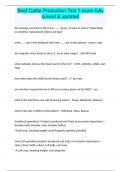
the average cow herd in the U.S is..........head - 41 plus or minus 7 depending on whether replacement heifers are kept most .......are in the feedyard and most.........are in the pasture - steers, cows the majority of the herds in the U.S. are in what range? - 100-499 head what websites tell you the head count in the U.S.? - LMIC, cattlefax, USDA, and Nass how often does the USDA do the head count? - 2* per year are ranchers required by law to fill out a census given out by NASS? - yes what is the top three cow-calf producing states? - Texas, Oklahoma, Missouri what is the top 3 cattle on feed states? - Nebraska, Texas, Kansas Seedstock operations' Products produced and Traits of economic importance - -breeder bulls, breeder cows, breeder heifers -%calf crop, weaning weight, stock longevity, genetic potential Cow Calf operation products produced and traits of economic importance - -steer calves, heifer calves, cull bulls, cull cows -% calf crop, weaning weight, cow longevity, Stocker products produced and traits of economic importance - -feeder steers , feeder heifers - survivability, adaptability, performance potential Feeder products produced and traits of economic importance - -slaughter steers, slaughter heifers, slaughter bulls, slaughter cows -ADG, Feed efficiency packer products produced and traits of economic importance - -box beef, Carcasses -quality grade,yeild grade, shelf life purveyor products produced and traits of economic importance - -carcass, retail cuts -yeild grade, quality grade, shelf life Retailer products produced and traits of economic importance - -retail cuts -yeild grade, quality grade, shelf life Consumer products produced and traits of economic importance - -NONE -tenderness, juiciness, lean to fat ratio, lean to bone ratio, consistency how long will it typically take for a beef animal to get all the way through the cycle, from seedstock to the consumer? - typically 5-12 years with a typical market weight of a steer at ......... what will the yield % be? - 1280 lbs 62.5% yeild=800 lbs at the packer, what will the average % of red meat, loss, and auffal be? - 80% red meat and trim, 20% bone and loss, and 32lbs of auffal what % is round of the carcass? - 21.8% what % is loin of the carcass? - 16.2% what % is rib of the carcass? - 9.3% What % is chuck of the carcass? - 29.3 % What % is thin cuts of the carcass? - 18.8% What % is the miscellaneous auffal of the carcass? - 4.6% what two sections of the animal make up 45% of the value of the animal? - rib and loin end meats - end meats are the meats on the end of the animal like the chuck and rump. They are worked more and dont have as much fat. This meat is more tough middle meats - meats such as the rib and loin that are in the middle of the animal that are not used as heavily. They have more fat and are much more tender 50 % of the beef that consumers buy is........ - ground beef the beef cycle is a .........year cycle of peaks and cycles - 10 year what is the profit or loss equasion - animals(lbs per cow)* price-total expenses what are the four main factors that effect the profitability of a cow/calf enterprise? - annual cost of production, average weaning weight, % calf crop, marketability of calves what is the primary purpose of a cow/calf budget? - to estimate the costs, returns, and profit on a per acre or per head basis. Expenses are compiled on a per cow basis a complete and accurate budget allows for..... - enterprise analysis the enterprise budget is a ..............budget - pro forma what is enterprise analysis - understanding of costs and profitability and where emphasis should be placed in order to lower costs and maximize profit/production depreciation formula - (cost-SV)/useful life you are not ranching unless you have these? - fixed costs how long is the useful life for livestock? - 5 years what are the 4 ways to increase net profit on cow calf operations? - increase weaning weight, increase % calf crop, cut costs to improve efficiency, increase value per pound produced what is mark to market? - seeing what something is worth, and marking your product to that value what is condition? - it is looking at the animal as a whole. It consists off all the traits that contribute to its potential to grow. It is defined as the animals potential to undergo significant compensatory gain. what are some terms that contribute to overall condition? - fleshiness, thriftiness, frame, muscling what is the term compensatory gain, in terms of stocker cattle? - the potential that the cattle have for gains. How malnourished they appear. Is there room for gain what is the term compensatory gain, in terms of beef cows and fat cattle? - a measure of nutritional status and body reserves what is the breakeven? - it is an evaluation of all the costs involved, in order to produce one unit of product, in our case is 1 lb of calf. Then this is divided by the average weight of the calves at sale. This will give the rancher the cost needed for the calves in order for him to cover all the costs incurred on the ranch what is the formula for adjusted cow cost - total cost per cow/ %calf crop what is the overriding principle of breeding cattle selection and evaluation? - match the cow to her environment when defining breeding goals, what might you think of - finding the cows that will produce a calf that will succeed in the current market and your marketing strategy what are some environmental conditions you might consider for selecting breeding cattle? - weather and climate, labor for the area, forage, topography what is some basis selection criteria for breeding cattle? - define the breed that will fit the climate and market, define the functional traits you need to meet production goals, define the weights that you wish to achieve with that breed, define the growth rate you need for those cattle what are composite cattle? - cattle that are crossbred, but we consider them purebred over time. Examples are santa gertrudis, brangus what is the most profitable calf on the market? - plain black baldy @ first breedup, the heifer should be what % of her mature body weight? - 65% a cow should give a calf at weaning which is ..........% of her body weight? - 50% what are some traits to select for for Females? - FERTILITY, femininity, udder development, height of teets off =of the ground, structural correctness, muscle, straight back, deep chest floor what are some traits to select for for Bulls? - testicle circumfrence, masculinity, travel, balance, muscle, temperament, fertility what is the zone of thermoneutrality - range of the temperature where the cattle will perform best with ease ambient temperature is related to... - temperature, humidity, air movement what is the cheapest food by which beef cattle production systems are driven by? - forage it is important for producers to study the dynamics of.................and animal..........requirements - forage growth, animal nutrition a cows nutrient requirements are lowest in her........stage - maintenance a cows nutrition requirements are higher in the ...........of gestation. Why? - third trimester. Because 70-75 % of the fetus growth occurs here a cows nutrition requirements are highest in what stage of development? - lactation what is a physiological state? - how the body is functioning at a given time/stage what are the physiological states? - lactation, gestation, work, growth, maintenance forage growth depends on what factors? - environmental factors, plant species, plant variety one of the most significant challenges in beef production systems is to match the correct biological animal to the proper........ - economical feed source rough, brushy country requires more bulls per cow. T or F? - True what is a breed - a group of animals with similar ancestry and visibly similar traits and charachteristics. there is as much difference within a breed as with 2 different breeds. True or False? - True british beef cattle are the only type of cattle developed for consumption/beef production. True or False? - true what are some types of british breeds ? - Angus, shorthorn, hereford, red angus continental breeds are usually used as terminal sires in commercial crossbred operations. True or False? - true continental breeds are known for producing a lot of - red meat what are the two types of continental cattle? - beef and milk (gelvie, simmetal, charlois), beef and draft( charolais, Limousin) what are some bos indicus breeds - gir, nalore, krishna valley american beef cattle - cattle originally bred in the U.S. Usually have some bos indicus influence What are some examples of american beef cattle? - simbrah, brangus, santa gertrudis, beefmaster, santa cruz what are specialty cattle - cattle selected for specific purposes and traits. Usually unusual traits what are some examples of specialty catlle? - longhorn, wagyu, watusi maximum pregnancy rates are reached at what years? - 5 to 7 do calving problems incerase with age? - no do fertilization rates decrease with age? - yes genetically larger framed cattle tend to mature slower. True or False? - False, they mature faster genetically larger framed cattle tend to reach puberty.... - later calves from bos indicus dams are relatively.........at birth - small calves from bos indicus sires are relatively.........at birth - large age at puberty is highly related to.... - body size, milking potential, and growth potential smaller cattle mature......... - earlier larger framed cattle and larger framed cattle tend to mature........... - later bos indicus cattle tend to have a longer productive life. T or F? - True what is the higher milking problem - milking animals mature sooner and calve sooner, but put much of the nutrients into milk, so it decreases fertility What is the larger framed problem? - you can give these heifers more feed if not at 65% of mature weight, but likely will induce fertility problems what type of cattle do best in hot regions? - thin skinned, dark skin colored, short hair coats what is the key factor in adaptability - effective ambient temperature what is fleshing ability - a measure of the body's ability to gain and retain condition fleshing ability is .......correlated with body size - negatively what are the most important factors of cutability in order - fat, muscle, bone Bos indicus cattle keep their teeth for a shorter amount of time. True or false? - false. they keep them longer marbling is generally higher in smaller framed and milking cattle. True or False? - True bos indicus have higher marbling. T or F? - false, they have less baby mouth - a term used to describe a 4 year old cow what are the types of mounths on cattle? - 5-7 years old= solid mouth 7-10 years old- short solid mouth bad/cull=broke mouth no teeth=gummer a calf at birth may only weigh ........of its mature body weight - 5-7% heifers need to be in good condition enough to maintain adequate growth, condition, fetal development, and lactation up to the .......year of age - 5th year body condition scoring is useful in determining the changes in ...............over time - nutritional requirements body condition scoring affects what areas of production? - percentage of open cows, calving period and period of involution, calf vigor at birth, number of services per conception what is involution? - preparing the uterous to get back to the normal size cow hocked cattle - lack sufficient muscleling to keep the hocks apart what are the six classes of animal carcass - steer, heifer, cow, bulluck, bull all packing plants involved in interstate commerce must be........... - federally inspected beef carcasses are inspected for - wholesomeness USDA quality grading is a .............system - voluntary what are the levels of quality grade under the age of 4? Over the age of 4? - prime, choice, select, standard commercial, utility, cutter, canner quality grade relates to.... - consumer taste, juiciness, tenderness USDA quality grades are determined by... - bone maturity, Marbling, Lean color, texture cattle get more tender as they get older. T or F? - false, they get less tender most cattle are slaughtered withinn........months of age - 30 lean color becomes darker with age. T or F? - True Dark Cutter - animal with excessively dark meat. Usually induced by stress prior to slaughter texture becomes more coarse as the animal ages. T or F? - True yield grade is a prediction of - cutability yeild grade refers to the ..........of the four major cuts - (BCTRC) boneless closely trimmed retail cuts USDA yield grades are determined by - fat thickness, KPH Fat, Ribeye area fat, hot carcass weight the size of the fetus changes and grows to 70% of the mature fetus when? - in the last 3 months of gestation beef cattle growth is measured by what two formulas typically? - ADG and weight per day of age what are some things that effect marbling? - stress, nutrition, sickness, health, breed, genetics, creep feeding, ionophores, age, implants selection for pelvic size is very unheritable. T or F? - False, it is very heritable. 61% to be exact what are the two devices you can measure the pelvis with? - rice pelvimeter or the krautman pelvic meter functional efficiency is correlated to hormone balance through - growth, body condition, secondary charachteristics, behavior
Geschreven voor
- Instelling
- Beef Production
- Vak
- Beef Production
Documentinformatie
- Geüpload op
- 24 mei 2024
- Aantal pagina's
- 15
- Geschreven in
- 2023/2024
- Type
- Tentamen (uitwerkingen)
- Bevat
- Vragen en antwoorden
Onderwerpen
-
beef cattle production test 1 exam fully solved

Ook beschikbaar in voordeelbundel