

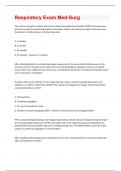
Respiratory Exam Med-Surg Questions and Answers 2024;full solution pack
The nurse is caring for a patient with chronic obstructive pulmonary disorder (COPD) and pneumonia who has an order for arterial blood gases to be drawn. What is the minimum length of time the nurse should plan to hold pressure on the puncture site? A. 2 minutes B. 5 minutes C. 10 minutes D. 15 minutes - Answer-B. 5 minutes After obtaining blood for an arterial blood gas measurement, the nurse should hold pressure on the puncture site for 5 minutes by the clock to be sure that bleeding has stopped. An artery is an elastic vessel under much higher pressure than veins, and significant blood loss or hematoma formation could occur if the time is insufficient. A patient with a recent history of a dry cough has had a chest x-ray that revealed the presence of nodules. In an effort to determine whether the nodules are malignant or benign, what is the primary care provider likely to order? A. Thoracentesis B. Pulmonary angiogram C. CT scan of the patient's chest D. Positron emission tomography (PET) - Answer-D. Positron emission tomography (PET) PET is used to distinguish benign and malignant pulmonary nodules. Because malignant lung cells have an increased uptake of glucose, the PET scan (which uses an IV radioactive glucose preparation) can demonstrate increased uptake of glucose in malignant lung cells. This differentiation cannot be made using CT, a pulmonary angiogram, or thoracentesis. After assisting at the bedside with a thoracentesis, the nurse should continue to assess the patient for signs and symptoms of what?A. Bronchospasm B. Pneumothorax C. Pulmonary edema D. Respiratory acidosis - Answer-B. Pneumothorax Because thoracentesis involves the introduction of a catheter into the pleural space, there is a risk of pneumothorax. Thoracentesis does not carry a significant potential for causing bronchospasm, pulmonary edema, or respiratory acidosis. The patient had abdominal surgery yesterday. Today the lung sounds in the lower lobes have decreased. The nurse knows this could be due to what occurring? A. Pain B. Atelectasis C. Pneumonia D. Pleural effusion - Answer-B. Atelectasis
Document information
- Uploaded on
- May 22, 2024
- Number of pages
- 10
- Written in
- 2023/2024
- Type
- Exam (elaborations)
- Contains
- Questions & answers


