

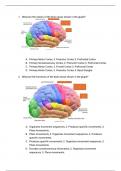
1. What are the names of the brain areas shown in the graph?
zoom_in
A. Primary Motor Cortex, 2. Premotor Cortex 3. Prefrontal Cortex
B. Primary Somatosensory Cortex, 2. Premotor Cortex 3. Prefrontal Cortex
C. Primary Motor Cortex, 2. Frontal Cortex 3. Prefrontal Cortex
D. Primary Motor Cortex, 2. Premotor Cortex 3. Basal Ganglia
2. What are the functions of the brain areas shown in the graph?
A. Organizes movement sequences, 2. Produces specific movements, 3.
Plans movements.
B. Plans movements, 2. Organizes movement sequences, 3. Produces
specific movements.
C. Produces specific movements, 2. Organizes movement sequences, 3.
Plans movements.
D. Encodes somatosensory information, 2. Organizes movement
sequences, 3. Plans movements.
, 3. How can we characterize prosopagnosia, and which brain area is damaged
when people are affected by this disease?
A. Prosopagnosia, often referred to as "face blindness," is a neurological
condition characterized by difficulty in recognizing faces.
Prosopagnosia can be caused by damage to the fusiform face area.
B. Prosopagnosia involves difficulty in recognizing and identifying objects
or visual stimuli despite intact perception of the stimuli themselves.
Prosopagnosia can be caused by damage to the fusiform face area.
C. Prosopagnosia involves difficulty in recognizing and identifying objects
or visual stimuli despite intact perception of the stimuli themselves.
Prosopagnosia can be caused by damage to the posterior parietal lobe.
D. Prosopagnosia, often referred to as "face blindness," is a neurological
condition characterized by difficulty in recognizing faces.
Prosopagnosia can be caused by damage to the posterior parietal lobe.
4. How can we characterize ideational apraxia and which area of the brain is
damaged when people are affected by this disease?
A. Ideational apraxia involves difficulty in conceptualizing and sequencing the
steps needed to complete a task. It can be caused by damage to the parietal
lobe.
B. Ideational apraxia involves difficulty in conceptualizing and sequencing the
steps needed to complete a task. It can be caused by damage to the occipital
lobe.
C. Ideational apraxia involves difficulty in executing purposeful motor
movements, despite having the conceptual understanding of the task. It can
be caused by damage to the occipital lobe.
D. Ideational apraxia involves difficulty in executing purposeful motor
movements, despite having the conceptual understanding of the task. It can
be caused by damage to the parietal lobe.
5. According to the paper of Heutik et al., visual agnosia can be treated with
restorative and compensatory methods. What is the goal of these treatments?
A. Both restorative and compensatory treatments aim at improving function of
the lesioned brain regions.
zoom_in
A. Primary Motor Cortex, 2. Premotor Cortex 3. Prefrontal Cortex
B. Primary Somatosensory Cortex, 2. Premotor Cortex 3. Prefrontal Cortex
C. Primary Motor Cortex, 2. Frontal Cortex 3. Prefrontal Cortex
D. Primary Motor Cortex, 2. Premotor Cortex 3. Basal Ganglia
2. What are the functions of the brain areas shown in the graph?
A. Organizes movement sequences, 2. Produces specific movements, 3.
Plans movements.
B. Plans movements, 2. Organizes movement sequences, 3. Produces
specific movements.
C. Produces specific movements, 2. Organizes movement sequences, 3.
Plans movements.
D. Encodes somatosensory information, 2. Organizes movement
sequences, 3. Plans movements.
, 3. How can we characterize prosopagnosia, and which brain area is damaged
when people are affected by this disease?
A. Prosopagnosia, often referred to as "face blindness," is a neurological
condition characterized by difficulty in recognizing faces.
Prosopagnosia can be caused by damage to the fusiform face area.
B. Prosopagnosia involves difficulty in recognizing and identifying objects
or visual stimuli despite intact perception of the stimuli themselves.
Prosopagnosia can be caused by damage to the fusiform face area.
C. Prosopagnosia involves difficulty in recognizing and identifying objects
or visual stimuli despite intact perception of the stimuli themselves.
Prosopagnosia can be caused by damage to the posterior parietal lobe.
D. Prosopagnosia, often referred to as "face blindness," is a neurological
condition characterized by difficulty in recognizing faces.
Prosopagnosia can be caused by damage to the posterior parietal lobe.
4. How can we characterize ideational apraxia and which area of the brain is
damaged when people are affected by this disease?
A. Ideational apraxia involves difficulty in conceptualizing and sequencing the
steps needed to complete a task. It can be caused by damage to the parietal
lobe.
B. Ideational apraxia involves difficulty in conceptualizing and sequencing the
steps needed to complete a task. It can be caused by damage to the occipital
lobe.
C. Ideational apraxia involves difficulty in executing purposeful motor
movements, despite having the conceptual understanding of the task. It can
be caused by damage to the occipital lobe.
D. Ideational apraxia involves difficulty in executing purposeful motor
movements, despite having the conceptual understanding of the task. It can
be caused by damage to the parietal lobe.
5. According to the paper of Heutik et al., visual agnosia can be treated with
restorative and compensatory methods. What is the goal of these treatments?
A. Both restorative and compensatory treatments aim at improving function of
the lesioned brain regions.


